
Why Is Bluetooth Called Bluetooth? The Surprising Story of a 10th-Century Viking King
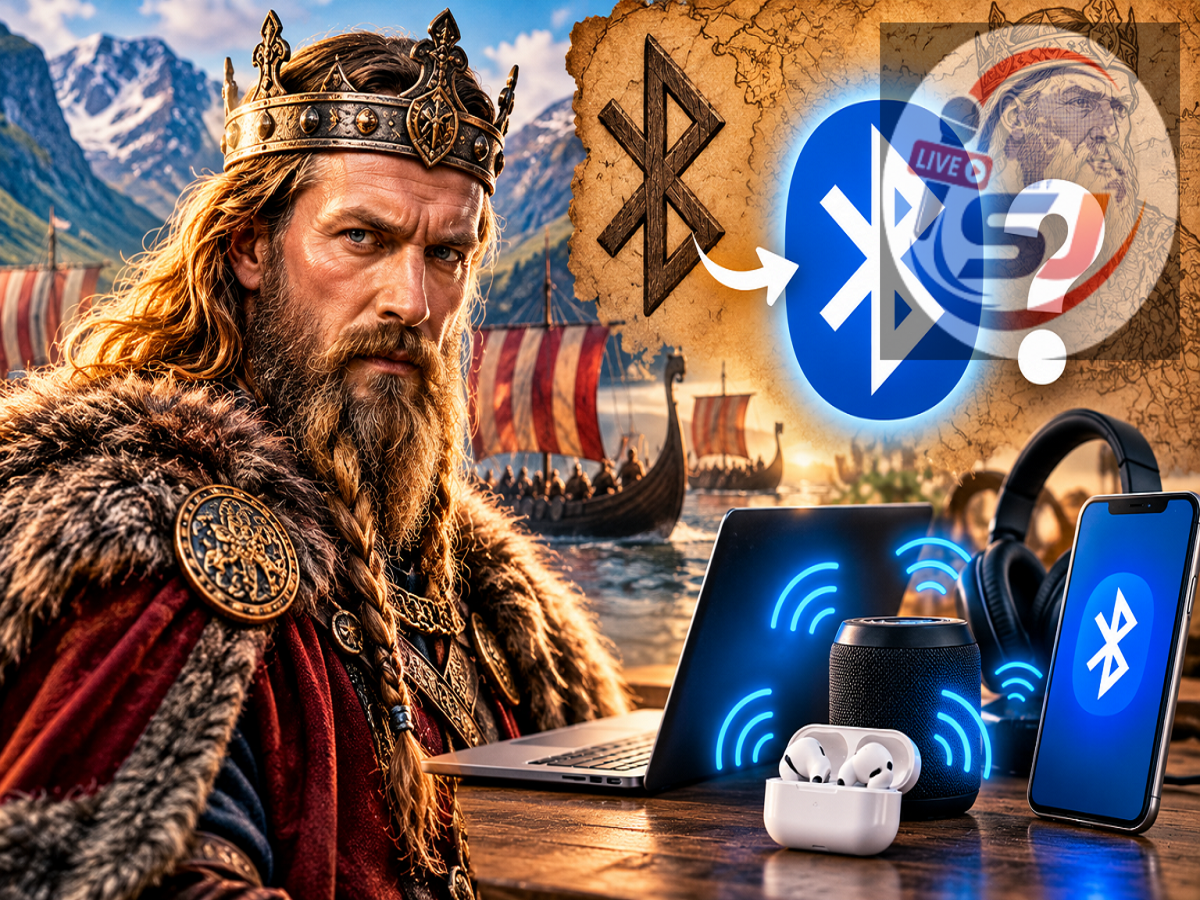
Bluetooth Technology History: Bluetooth has become an essential part of everyday technology. From wireless earphones and smartwatches to laptops, speakers, and car entertainment systems, millions of people use Bluetooth-enabled devices without thinking about the unusual name behind the technology.
But have you ever wondered why this wireless communication system is called Bluetooth?
Surprisingly, the name has nothing to do with blue-coloured teeth, modern electronics, or radio signals. Instead, it comes from a powerful Scandinavian ruler who lived more than 1,000 years ago.
The technology was named after King Harald “Bluetooth” Gormsson, a 10th-century Viking ruler remembered for bringing different parts of Denmark together and extending his influence into Norway.
His ability to unite people and territories became an inspiration for engineers developing a wireless standard that could connect different electronic devices.
Even the familiar Bluetooth logo has a fascinating connection to the Viking king.
Who Was Harald Bluetooth, the King Behind the Technology?
Harald Gormsson, popularly known as Harald Bluetooth, was a Scandinavian king who ruled Denmark during the 10th century.
He is generally believed to have become king around 958 AD, succeeding his father, Gorm the Old.
His reign is commonly dated to approximately 958–986 AD, although historical accounts differ on some details.
Harald is remembered for consolidating royal power in Denmark and extending his influence into parts of Norway.
At a time when Scandinavian territories were divided among different rulers and groups, Harald played an important role in strengthening the Danish kingdom.
He is also associated with the spread of Christianity in Denmark.
These achievements made him a significant figure in Scandinavian history, long before his nickname became internationally recognised through wireless technology.
Why Was King Harald Called Bluetooth?
The origin of Harald's unusual nickname remains a subject of historical discussion.
One popular explanation suggests that the king had a discoloured tooth that appeared dark blue or black.
According to this theory, the distinctive tooth may have earned him the nickname Bluetooth.
Another interpretation connects the nickname to older Scandinavian language traditions and descriptions of physical appearance.
However, historians do not have definitive evidence proving exactly why Harald received this name.
The nickname is commonly associated with the Old Norse form Blátǫnn, which is generally translated as Bluetooth.
Whatever its original meaning, the name eventually became one of the most recognisable terms in modern technology.
How Did a Viking King's Name Become a Wireless Technology Brand?
The story moves from medieval Scandinavia to the technology industry of the 1990s.
During this period, major electronics and telecommunications companies were working on ways to connect devices without cables.
Manufacturers needed a common short-range wireless communication standard that could work across different products.
Companies including Ericsson, Intel, and Nokia were involved in discussions about developing such a technology.
The goal was to enable devices such as mobile phones, computers, and accessories to communicate more easily.
However, different companies were pursuing different technical approaches, creating a need for cooperation and standardisation.
This challenge eventually inspired the name Bluetooth.
Intel Engineer Jim Kardach Suggested the Name
Jim Kardach, an engineer at Intel, is widely credited with proposing Bluetooth as the project's temporary codename.
During the development period, Kardach had been reading about Viking history.
He became interested in Harald Bluetooth and the king's reputation for uniting Scandinavian territories.
Kardach noticed a similarity between Harald's historical role and the objective of the wireless technology project.
Just as Harald had helped unite different groups under a common kingdom, the new technology was intended to bring separate electronic industries together through a shared communication standard.
The name Bluetooth therefore became a symbolic reference to technological cooperation.
The comparison was particularly appropriate because the project aimed to connect computers, mobile phones, and other electronic products regardless of their manufacturers.
Bluetooth Was Originally Only a Temporary Codename
Interestingly, Bluetooth was not initially intended to become the permanent commercial name.
During the technology's early development, the participating companies considered several possible names.
Among the alternatives were RadioWire and PAN, short for Personal Area Networking.
These names described the technical purpose of the project more directly.
However, the alternatives presented branding and trademark-related difficulties.
As development progressed, Bluetooth had already become familiar among the engineers and organisations working on the standard.
The temporary name was memorable, distinctive, and connected to the project's broader mission.
Consequently, Bluetooth remained in use and eventually became the permanent identity of the technology.
The Bluetooth Special Interest Group, or Bluetooth SIG, was established in 1998 to support the development and promotion of the wireless standard.
The first Bluetooth specification followed in 1999, helping establish the foundation for commercial adoption.
Why Does the Bluetooth Logo Look So Unusual?
The Bluetooth symbol is another fascinating part of the technology's history.
Unlike many modern technology logos, it was inspired by ancient Scandinavian writing.
The familiar angular design combines two runic characters associated with the initials of Harald Bluetooth's name.
These characters come from the Younger Futhark runic alphabet.
The two symbols are:
-
ᚼ (Hagall): Represents the letter H.
-
ᛒ (Bjarkan): Represents the letter B.
When combined, the characters form a single symbol known as a bind rune.
The resulting design became the internationally recognised Bluetooth logo.
Therefore, every time you see the Bluetooth symbol on your smartphone or wireless headphones, you are looking at a design inspired by the initials of a Viking king.
What Is a Bind Rune?
A bind rune is a symbol created by combining two or more runic characters into a single design.
Runic alphabets were used in parts of northern Europe before and during the Viking Age.
Different versions of these alphabets existed across historical periods and regions.
The Bluetooth logo uses the concept of combining runes to represent Harald Bluetooth's initials.
Its simple design makes it easy to recognise on smartphones, computers, speakers, and other electronic devices.
Although most people associate the symbol with wireless connectivity, its visual roots are much older than modern electronics.
The Jelling Stones and Harald Bluetooth's Historical Legacy
One of the most important surviving historical references to Harald Bluetooth can be found in Denmark.
The Jelling Stones are famous Viking Age monuments associated with Denmark's early royal history.
The larger Jelling Stone was commissioned by Harald Bluetooth and commemorates his parents, Gorm and Thyra.
Its inscription also refers to Harald's achievements in Denmark and Norway and his association with the Christianisation of the Danes.
The monument is an important source for understanding the political and religious changes taking place in Scandinavia during the 10th century.
The Jelling monuments are recognised for their historical significance and remain closely associated with Denmark's Viking heritage.
Harald's role in bringing territories together helped inspire the technology industry's decision to use his nickname centuries later.
How Does Bluetooth Technology Actually Work?
Bluetooth is a short-range wireless communication technology designed to exchange information between compatible electronic devices.
It operates using radio waves in the 2.4 GHz frequency band.
This allows devices to communicate without requiring a physical cable.
For example, when you connect wireless earbuds to a smartphone, Bluetooth enables audio-related communication between the devices.
Similarly, Bluetooth can connect keyboards, computer mice, fitness trackers, smartwatches, speakers, and other accessories.
Different Bluetooth versions and device classes support different capabilities, speeds, power requirements, and operating ranges.
Modern Bluetooth technology includes features designed for applications ranging from wireless audio to low-power sensors.
Its main advantage is the ability to establish convenient connections between compatible devices.
Bluetooth's Journey From the 1990s to Modern Smartphones
Bluetooth began as an industry effort to simplify communication between electronic products.
Over time, it became a widely adopted wireless standard.
Early Bluetooth-enabled devices helped users connect mobile phones, headsets, and computers.
As smartphones became more advanced, Bluetooth gained additional importance.
Wireless earphones, smartwatches, fitness bands, and portable speakers increasingly relied on the technology.
Bluetooth Low Energy also made it possible to support many devices that need to operate for extended periods while consuming relatively little power.
Today, Bluetooth is used in consumer electronics, healthcare equipment, industrial systems, and connected-home products.
Although the technology has evolved significantly since its introduction, its historical name and distinctive logo have remained recognisable.
Five Interesting Facts About Bluetooth
| Interesting Fact | Explanation |
|---|---|
| Origin of the name | Named after Harald “Bluetooth” Gormsson, a 10th-century Scandinavian king |
| Person credited with suggesting it | Intel engineer Jim Kardach |
| Original purpose | A temporary codename for a short-range wireless technology project |
| Logo design | Combines runic symbols representing the initials H and B |
| Technology's main function | Allows compatible electronic devices to communicate wirelessly over short distances |
These details reveal how a medieval historical figure became connected to one of the most commonly used technologies in the digital world.
Why the Name Bluetooth Still Makes Sense Today
The connection between Harald Bluetooth and wireless communication is more meaningful than it first appears.
Harald's historical reputation was built partly around bringing separate territories under a common political authority.
Bluetooth technology was created to help different devices and manufacturers communicate through a shared wireless standard.
The underlying idea in both cases is connection.
That symbolism helped turn an unusual temporary codename into a memorable global technology name.
Even though modern Bluetooth systems are far more sophisticated than the early versions, their purpose remains closely connected to the original vision of enabling communication between different devices.
Final Takeaway
The next time you connect wireless headphones, pair a smartwatch, or switch on a Bluetooth speaker, remember that the technology's name has a history stretching back more than a thousand years.
Bluetooth was named after Harald “Bluetooth” Gormsson, a Viking Age king associated with the unification of Denmark and influence over parts of Norway.
Intel engineer Jim Kardach proposed the name because the wireless technology project aimed to unite different electronic devices through a common communication standard.
The Bluetooth logo also honours the king by combining two ancient runic characters representing his initials.
What began as a temporary project name eventually became a globally recognised technology brand, connecting the history of Viking Scandinavia with the wireless devices used every day.
Historical note: The exact origin of Harald Bluetooth's nickname and some details of his reign remain debated. The connection between his name and the modern wireless standard, however, is well established.