
Why Do Old Solar Panels Produce Less Electricity? Know the Reasons and How Long They Can Last
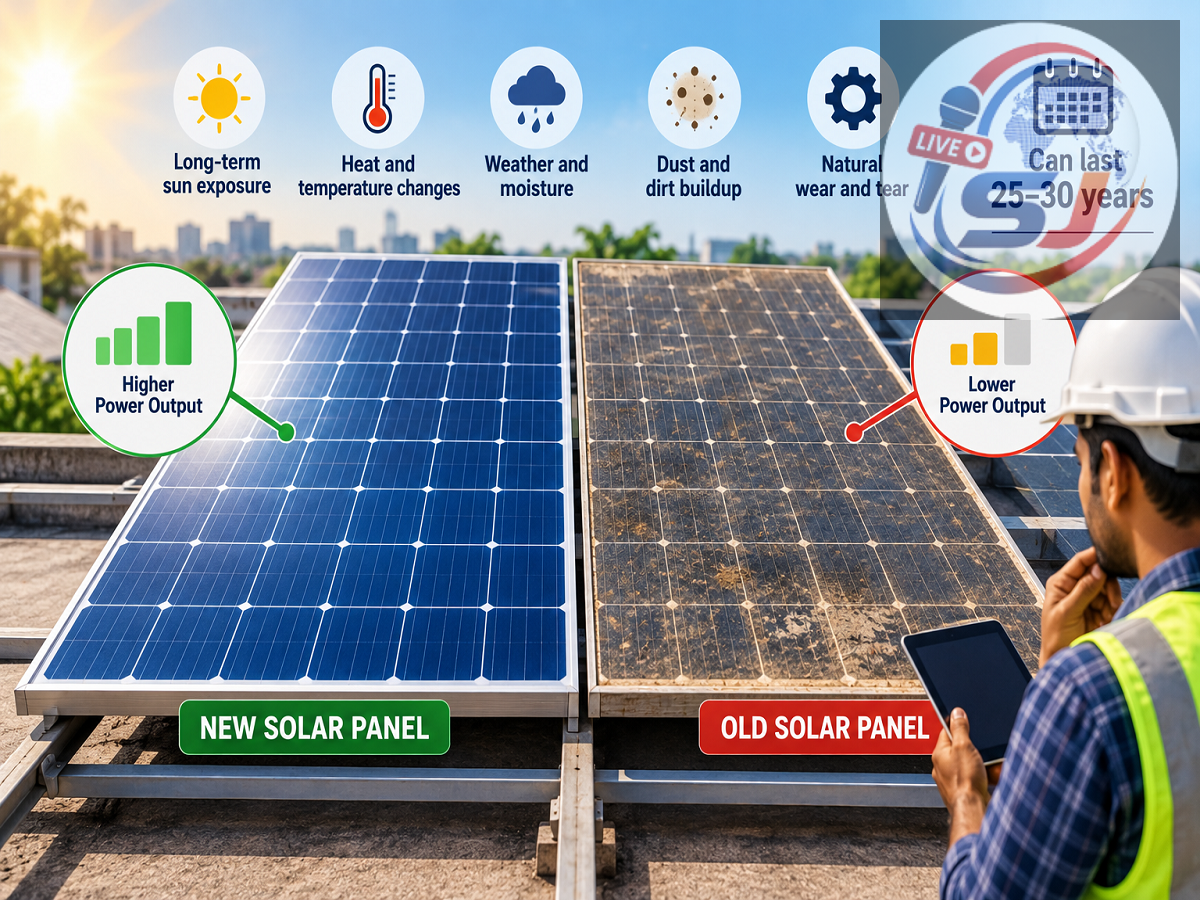
Solar panels can continue producing electricity for decades, but homeowners may notice that their system does not generate exactly the same amount of power after several years of use. A decline in output does not necessarily mean that the solar panel has become defective or needs immediate replacement.
Like most equipment exposed to outdoor conditions, solar panels experience gradual changes as they age. Years of sunlight, ultraviolet (UV) radiation, heat, moisture, rain and temperature fluctuations can slowly affect their ability to convert sunlight into electricity.
This gradual reduction in performance is commonly known as solar panel degradation.
Depending on the panel technology, manufacturing quality, climate and operating conditions, annual degradation can vary. A commonly cited range is around 0.3% to 1% per year, while roughly 0.5% annually is often used as a general industry reference.
Several other factors, including dirt, micro-cracks and electrical degradation, can also reduce the amount of electricity generated by an older solar system.
Why Does Solar Panel Output Decline With Age?
Solar panels installed on rooftops remain outdoors throughout their working life.
During the day, panels can become extremely hot under direct sunlight. At night, their temperature falls. This continuous heating and cooling causes the materials inside the panel to repeatedly expand and contract.
Over many years, this thermal cycling can contribute to tiny structural changes, including micro-cracks in solar cells and stress on electrical connections.
These cracks may be too small to see with the naked eye, but they can affect the pathways through which electricity flows.
As the internal electrical connections become less efficient, the panel's overall power output can gradually decline.
UV Radiation and Weather Also Affect Panels
Sunlight is essential for generating solar power, but long-term exposure to ultraviolet radiation can also contribute to the ageing of some panel materials.
Solar modules must simultaneously withstand rain, humidity, high temperatures, dust and changing weather conditions.
Modern solar panels are designed to tolerate these conditions for many years, but prolonged environmental exposure can gradually affect components such as encapsulation materials, seals and electrical connections.
The rate of deterioration can depend heavily on panel quality and the environment in which the system is installed.
What Is Light-Induced Degradation?
Another phenomenon associated particularly with some older P-Type solar panels is Light-Induced Degradation, commonly called LID.
This can occur after a new solar panel is first exposed to strong sunlight. Changes inside the silicon cells can cause an initial decline in efficiency.
The reduction associated with this early-stage phenomenon may be roughly 1% to 3% in some cases.
Unlike gradual ageing over decades, LID is mainly an initial performance reduction. Once this early degradation has occurred, the panel's performance can become more stable.
Modern N-Type solar panels are generally much less susceptible to certain forms of LID, depending on the specific cell technology and manufacturing process.
What Is PID in Solar Panels?
Potential-Induced Degradation, or PID, is another issue that can reduce solar panel performance.
PID can occur because of electrical potential differences within a photovoltaic system. Conditions such as high voltage, heat and humidity can contribute to the problem.
When PID develops, it can negatively affect the ability of solar cells to generate usable electricity.
Good panel design, appropriate system installation and suitable components can help reduce the risk, while modern modules may include features designed to improve resistance to PID.
Dirt Can Cause a Much Faster Drop in Output
Not every reduction in solar generation is caused by permanent panel degradation.
Sometimes the explanation is much simpler: the panels are dirty.
Dust, pollution, leaves, bird droppings and other material can accumulate on the glass surface. This blocks part of the sunlight that would otherwise reach the photovoltaic cells.
The effect can be particularly noticeable in dusty regions or locations where panels receive little natural cleaning from rainfall.
Depending on local conditions and the severity of soiling, electricity production may fall considerably. The cited estimate suggests that inadequate cleaning in heavily dusty conditions could contribute to losses of around 10% to 20% in some situations.
Actual losses can vary widely depending on the amount and type of dirt, panel angle, rainfall and location.
Lower Generation Does Not Always Mean a Bad Panel
If a rooftop solar system suddenly starts producing significantly less electricity, natural ageing should not automatically be blamed.
Gradual degradation typically occurs slowly.
A sharp or unexpected reduction in generation could instead be linked to heavy soiling, shading from newly grown trees or nearby structures, wiring problems, inverter issues, damaged panels or another system fault.
Seasonal changes also matter. Solar production naturally varies according to sunlight hours, cloud cover, temperature and weather.
Comparing one day's generation with another can therefore be misleading. Looking at production data over similar periods and seasons provides a more useful picture.
How Long Can Solar Panels Continue Working?
The typical useful life of a solar panel is often considered to be around 25 to 30 years, although this does not mean a panel automatically stops generating electricity once it reaches 25 years.
Instead, its maximum output may simply be lower than when it was new.
For example, if a panel experienced an average degradation of 0.5% every year, its output after decades of operation would be lower than its original rated capacity. The exact result would depend on how degradation occurs over time and the panel's actual operating conditions.
Many good-quality solar panels can continue generating electricity beyond their commonly stated 25-30 year service period.
Maintenance Can Help Preserve Solar Output
Panel ageing cannot be eliminated entirely, but good maintenance can help a solar system perform effectively for longer.
Keeping panels reasonably clean, ensuring that they are not unnecessarily shaded and periodically checking the system for visible damage can help maintain output.
The inverter and electrical connections also deserve attention because the panel itself is only one part of a complete rooftop solar system.
If generation drops unexpectedly, professional inspection can help identify whether the cause is normal degradation, dirt, shading or a technical problem.
Ultimately, older solar panels producing slightly less electricity is generally a normal part of long-term operation. With good-quality equipment, proper installation, appropriate cleaning and periodic inspection, solar panels can continue generating useful electricity for 25 to 30 years—and in many cases even longer.