
WhatsApp SIM Binding Rule 2027: Registered SIM May Be Mandatory From January 1, Check New Rules
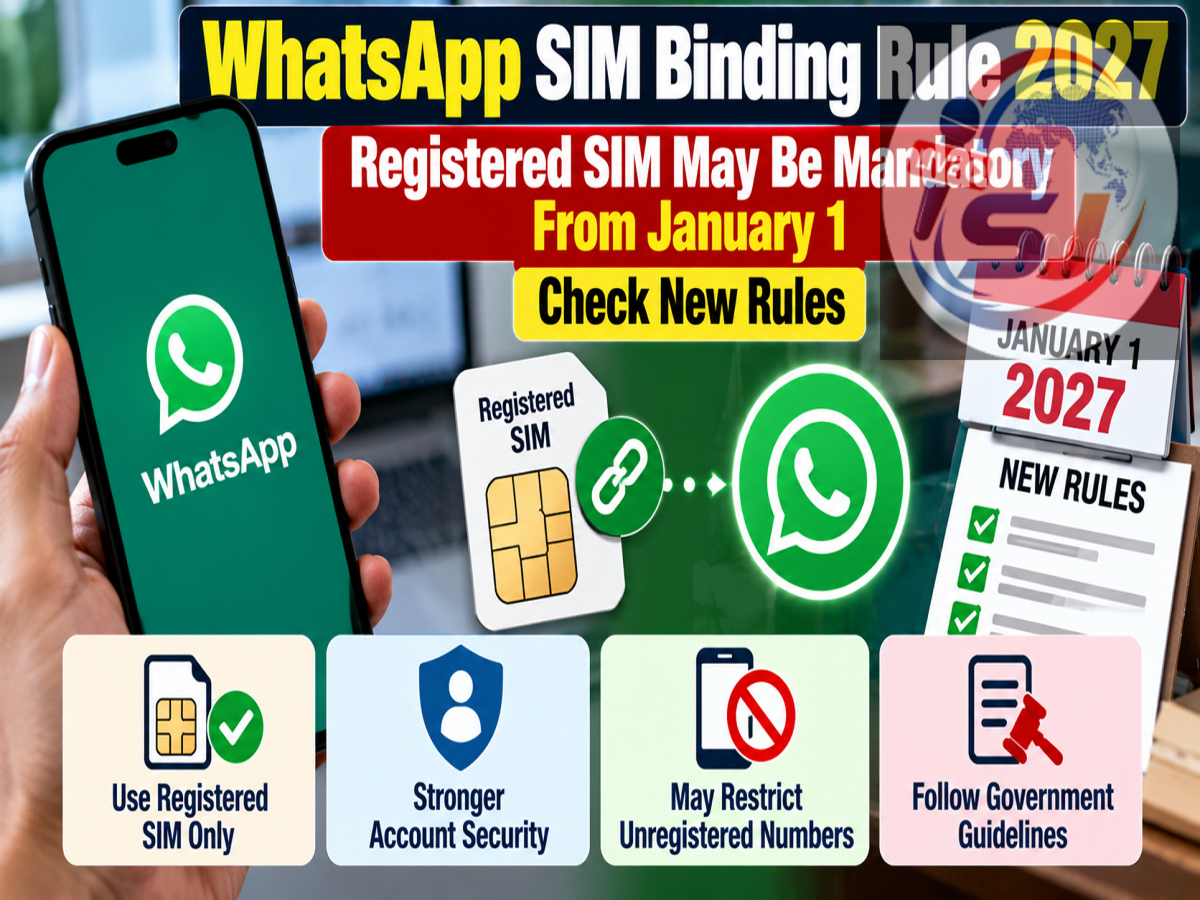
WhatsApp SIM Binding Rule 2027: Millions of WhatsApp and Telegram users in India could face changes in how they access their messaging accounts from January 1, 2027, as the government moves towards enforcing SIM-binding requirements for certain communication applications.
According to reports published on October 22, 2026, the Department of Telecommunications (DoT) has set December 31, 2026, as the compliance deadline for the new requirements.
The reported rules are intended to strengthen the connection between a messaging account and the mobile number used to register it, making it more difficult for fraudsters to operate accounts using SIM cards located in different devices.
For users, the most significant potential change is that the SIM associated with their WhatsApp or Telegram account may need to remain present in the same smartphone on which the application is being used.
However, the government is reportedly no longer pursuing an earlier proposal requiring messaging platforms to automatically log out users from their web sessions every six hours.
Instead, the updated approach is said to focus on suspicious activity and risk-based security measures.
What Is SIM Binding for WhatsApp and Telegram?
SIM binding is a security mechanism designed to associate a messaging application with the SIM corresponding to its registered mobile number.
Currently, users can generally register WhatsApp by verifying a mobile number through an OTP or another supported verification method.
After completing registration, the application may continue functioning even if the SIM is removed or transferred to another device, depending on the platform's security checks.
Under the reported SIM-binding framework, messaging platforms would be required to maintain a stronger connection between the registered mobile number and the device running the application.
This means that users who keep their registered SIM in one phone while accessing the messaging application on another could be affected.
The proposed arrangement is intended to make fraudulent account operations more difficult by strengthening mobile-number verification.
WhatsApp SIM Binding Rules: Important Details
| Particulars | Reported Information |
|---|---|
| New Requirement | SIM binding for specified messaging applications |
| Reported Operational Date | January 1, 2027 |
| Compliance Deadline | December 31, 2026 |
| Government Department | Department of Telecommunications |
| Applications Mentioned | WhatsApp and Telegram |
| Registered SIM | Expected to remain associated with the device |
| Android Users | Potentially affected |
| iPhone Users | Potentially affected |
| Mandatory Six-Hour Web Logout | Reportedly withdrawn |
| Revised Web Security Approach | Risk-based monitoring and intervention |
| Main Objective | Prevent online fraud and misuse of messaging accounts |
The precise technical implementation may vary across platforms and will depend on the final applicable directions.
Why Is the Government Introducing SIM Binding?
The reported decision is aimed at tackling the misuse of messaging platforms for online scams, impersonation and other fraudulent activities.
Cybercriminals sometimes operate messaging accounts using mobile numbers that are not physically associated with the devices on which the accounts remain active.
This can complicate investigations and make it harder to establish a reliable connection between a registered mobile number and the device being used.
SIM binding is intended to introduce an additional verification layer.
By requiring a connection between the registered number and the active device, authorities hope to reduce certain opportunities for misuse.
However, SIM binding alone cannot eliminate online fraud.
Criminals may still use stolen identities, social engineering and other methods to deceive users.
Will WhatsApp Stop Working on January 1, 2027?
The reported rules do not mean that WhatsApp will automatically stop working on every smartphone from January 1.
The date is being described as the beginning of operational enforcement following the compliance deadline for affected platforms.
For most users who already operate WhatsApp on the same phone that contains their registered SIM, the change may not require any immediate action.
The greater impact could be on users whose WhatsApp account is registered with a SIM kept in another phone.
Such arrangements may become incompatible with the new verification requirements once the relevant application implements them.
It is also important to distinguish between a platform's compliance deadline and the exact date on which an individual user's account might be affected.
Specific enforcement procedures and user notifications will depend on the final rules and application updates.
What Happens if Your WhatsApp SIM Is in Another Phone?
Some users maintain separate devices for calling, messaging and other activities.
For example, a person might keep a primary SIM card in a basic phone while using WhatsApp on a separate smartphone connected to Wi-Fi.
Under the reported SIM-binding requirement, this arrangement could become problematic.
The messaging application may need to verify that the registered mobile number is associated with the smartphone on which the account is operating.
If the SIM is not present or cannot be verified, the application may require additional checks or restrict access.
The exact behaviour has not been established in the supplied report.
Users should therefore avoid assuming that all accounts will be immediately suspended or deleted.
Will the Rule Apply to Both Android and iPhone Users?
Yes, the reported SIM-binding framework is intended to cover affected messaging applications regardless of whether they run on Android or iOS.
The requirement concerns the relationship between the registered mobile number, the SIM and the device.
It is not described as a restriction targeting a particular smartphone brand or operating system.
The report also refers to an iOS software update that could support checking whether a SIM is present in an iPhone.
However, the availability of SIM-detection capabilities does not independently confirm the exact technical method that WhatsApp or Telegram will use.
Implementation details will need to be confirmed by the respective platforms.
Will WhatsApp Web Log Out Every Six Hours?
One of the most important changes concerns WhatsApp Web and other browser-based messaging sessions.
When the Department of Telecommunications issued its original SIM-binding directions on November 28, 2025, it included a requirement for web sessions to be logged out periodically, at intervals not exceeding six hours.
This would have required users to reconnect their accounts frequently, potentially creating inconvenience for businesses and professionals using WhatsApp Web throughout the day.
However, the government subsequently relaxed this requirement.
Under the revised approach, web sessions are to be managed through risk-based analysis rather than a mandatory six-hour logout cycle.
This means that ordinary users should not be automatically logged out every six hours solely because of the original proposal.
The revised position was reported following the government's clarification in Parliament in April 2026.
Which Messaging Applications Are Covered?
The original DoT directions identified several applications that use Indian mobile numbers to register or identify users.
These included WhatsApp, Telegram, Signal, Snapchat, Arattai, ShareChat, Josh and JioChat.
Recent reports indicate that WhatsApp and Telegram are among the principal platforms expected to implement SIM binding by the end of 2026.
Some reports suggest that Snapchat may receive an exemption. However, this exemption has not been independently confirmed through a revised official notification.
Similarly, the precise compliance status of Signal and other platforms remains subject to official clarification.
What About Dual-SIM Smartphones?
People using dual-SIM phones may have questions about whether the rule requires their WhatsApp number to be the primary SIM.
The central issue is whether the SIM associated with the registered account remains active and available for verification in the device.
The reported rules do not establish that users must select that number as their primary mobile data connection.
However, platform-specific verification requirements could affect how the system works in practice.
Users should wait for official application instructions rather than changing their SIM settings unnecessarily.
Will eSIM Users Be Affected?
Modern smartphones increasingly support eSIM technology, which allows a mobile connection to operate without a removable physical SIM card.
The underlying objective of SIM binding is to verify the registered mobile connection, not simply the presence of a removable plastic card.
However, the supplied report does not establish the exact eSIM verification process that each messaging platform will adopt.
Users with an active eSIM should follow their service provider's and messaging application's official instructions when the requirements are implemented.
What About WhatsApp Users Travelling Abroad?
International travellers may also be affected by the SIM-binding framework.
Some travellers temporarily remove their Indian SIM and use a local SIM while continuing to access WhatsApp through their original Indian number.
Such arrangements could face additional verification requirements.
However, the DoT has previously clarified that users keeping their registered SIM in the handset while using international roaming should not be affected merely because they are outside India.
Travellers should verify the final rules before departure and avoid assuming that every overseas WhatsApp session will be blocked.
What Should WhatsApp and Telegram Users Do Before January 1?
Users can take a few precautionary steps before the reported implementation date:
-
Check the registered mobile number: Open the messaging application's account settings and verify which number is associated with the account.
-
Keep the registered SIM active: Ensure that the mobile connection remains valid and is not permanently deactivated.
-
Review your device arrangement: If the registered SIM is kept in another phone, consider how the new requirement could affect access.
-
Update the application: Install official WhatsApp or Telegram updates through trusted app stores.
-
Avoid suspicious verification links: Do not enter OTPs or account details on websites claiming to offer SIM-binding registration.
-
Follow official announcements: Check communications from the DoT and the relevant messaging platform for implementation details.
There is currently no reason to pay an agent or third-party service to activate SIM binding.
Will SIM Binding Completely Stop Online Scams?
SIM binding may make certain forms of account misuse more difficult, particularly when messaging accounts are operated without access to the registered mobile connection.
However, it is not a complete solution to cybercrime.
Fraudsters may still exploit stolen identities, compromised accounts, fraudulent SIM registrations and social engineering techniques.
Technology and digital rights experts have also raised concerns about implementation difficulties, privacy and the potential inconvenience caused to legitimate users.
Users should continue following basic cybersecurity practices, including enabling two-step verification and avoiding suspicious links.
Final Word
India's SIM-binding requirements could introduce a significant change for WhatsApp, Telegram and other affected messaging applications from January 2027.
The government's confirmed compliance deadline is December 31, 2026, while January 1, 2027, is being reported as the expected operational starting date.
For users who keep their registered SIM active in the same smartphone, the transition may be relatively straightforward.
Those using messaging accounts on phones without the corresponding SIM could face additional restrictions.
The important clarification is that the government has moved away from mandatory six-hour WhatsApp Web logouts, replacing them with risk-based checks.
Users should follow official announcements and application updates for the final implementation details.
Disclaimer: This article reflects government directions and reporting available as of October 22, 2026. Platform-specific verification methods, exemptions and enforcement procedures may change before implementation.