
WhatsApp New Rules 2027: No Active SIM, No WhatsApp? Check SIM Binding Rules, Deadline and Affected Users
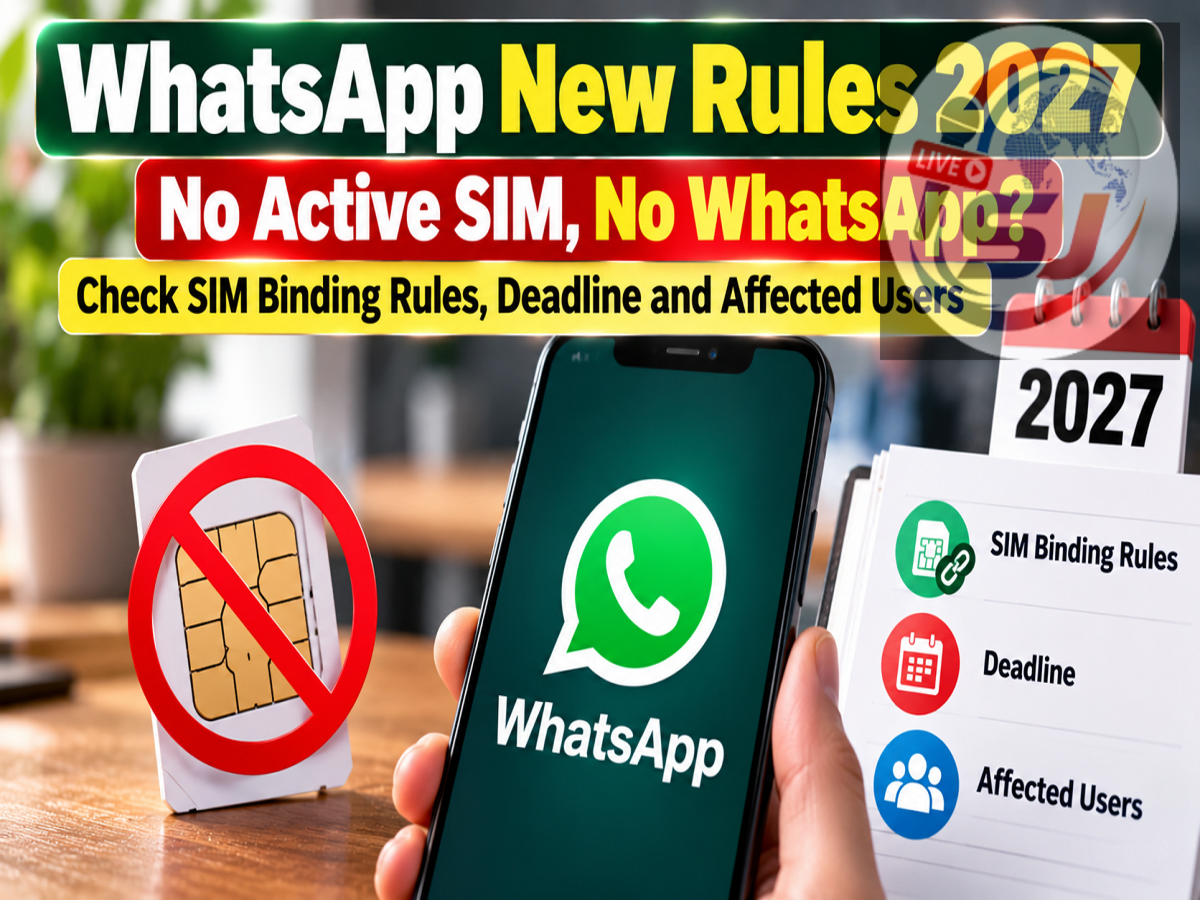
WhatsApp SIM Binding Rules 2027: Millions of WhatsApp and Telegram users in India may experience changes in how their messaging accounts are verified from January 1, 2027. Under new SIM-binding requirements introduced by the Department of Telecommunications (DoT), messaging platforms will need to maintain a connection between user accounts and the active mobile numbers used for registration.
The government has reportedly set December 31, 2026, as the deadline for covered messaging platforms to implement the required verification mechanisms.
The development has raised an important question: Will WhatsApp stop working if the SIM card linked to an account is removed from the smartphone?
Under the reported framework, users who operate WhatsApp or Telegram without keeping their registered SIM or eSIM active on the primary device could face access restrictions.
However, the new requirements do not mean that every WhatsApp account will automatically stop functioning on January 1. The impact will depend on how the platforms implement SIM verification.
WhatsApp SIM Binding Rules 2027: Key Details
| Particulars |
Details |
|---|---|
| Government department |
Department of Telecommunications (DoT) |
| Main requirement |
Messaging account linked to an active registered SIM |
| Original directions |
November 28, 2025 |
| Compliance deadline |
December 31, 2026 |
| Expected operational date |
January 1, 2027 |
| Major affected services |
WhatsApp, Telegram and other covered messaging platforms |
| Physical SIM required? |
An active physical SIM or supported eSIM |
| Main objective |
Reduce cyber fraud and misuse of mobile numbers |
| Impact on users |
Possible access restrictions if registered SIM verification fails |
The requirement forms part of the government's efforts to strengthen telecom cybersecurity and prevent the misuse of Indian mobile numbers.
What Is SIM Binding and How Does It Work?
SIM binding is a security mechanism that connects a messaging account to the mobile SIM associated with its registered phone number.
Currently, many messaging applications verify a phone number using a one-time password during registration.
After verification, users may continue accessing their accounts even if they remove the SIM card from the phone.
The new framework is designed to change this arrangement.
Messaging platforms covered by the directions are expected to verify that the registered mobile connection remains active and available on the device.
For example, consider someone who registers WhatsApp using a SIM card in one smartphone but later removes that SIM and continues using WhatsApp through Wi-Fi.
Under the new requirements, that arrangement could trigger a verification failure or access restriction.
The precise verification process will depend on the technical changes introduced by the messaging platforms.
Will WhatsApp Stop Working Without a SIM Card From January 1?
Users who remove, deactivate or replace the SIM associated with their registered WhatsApp number may face restrictions once the requirements become operational.
If the platform cannot verify the registered mobile connection, access may be interrupted until the number is restored through a valid SIM or eSIM.
However, the rules should not be interpreted as a blanket shutdown of WhatsApp on January 1, 2027.
People who already use WhatsApp with an active registered SIM in their primary smartphone may not need to make significant changes.
The government has identified January 1 as the expected operational date, while the actual user experience will depend on platform implementation.
Which WhatsApp and Telegram Users Could Be Affected?
Several categories of users may need to review their current mobile arrangements.
| User Situation |
Possible Impact |
|---|---|
| Registered SIM active in primary smartphone |
Generally expected to remain compliant |
| WhatsApp registered on a SIM kept in another phone |
May face verification problems |
| Registered SIM removed after account activation |
Access could be restricted |
| Mobile number permanently deactivated |
Messaging account may fail verification |
| Active registered eSIM on the same device |
Expected to satisfy SIM-presence requirements |
| Dual-SIM smartphone |
Registered number should remain active |
| Wi-Fi-only smartphone without registered SIM |
May face access restrictions |
| Frequent international travellers |
May need to review SIM and roaming arrangements |
These scenarios are based on the reported framework. Final app-specific procedures may differ.
What About eSIM Users?
The reported SIM-binding framework recognises both physical SIM cards and electronic SIM profiles.
An eSIM is a digital mobile connection activated on a compatible smartphone without inserting a removable plastic SIM card.
Users with an active eSIM associated with their registered WhatsApp number are not expected to lose access merely because their device lacks a physical SIM slot.
The essential requirement is that the registered mobile connection remains active and available for verification.
Therefore, the new rules are not specifically directed at iPhone users, Android users or particular smartphone brands.
They concern the connection between the messaging account and its registered mobile number.
Will WhatsApp Work on Wi-Fi After January 1, 2027?
The new requirements do not prohibit the use of Wi-Fi for messaging.
A smartphone with an active registered SIM or eSIM may still use Wi-Fi to send messages and make internet-based calls.
The potential difficulty arises when the registered mobile connection is absent from the device.
For example, a user who has an active SIM in the smartphone but connects to home Wi-Fi is in a different position from someone who removed the registered SIM and uses the phone exclusively through Wi-Fi.
The first arrangement is generally consistent with the reported SIM-presence requirement.
The second could lead to verification issues.
What Will Happen to WhatsApp Web and Desktop Users?
Earlier SIM-binding directions also included a requirement for web-based messaging sessions to be logged out automatically at intervals of no more than six hours.
However, reports published in October 2026 indicate that the government subsequently withdrew the blanket six-hour logout requirement.
The revised approach reportedly uses risk-based session termination, allowing suspicious or potentially fraudulent activity to trigger additional security action.
Therefore, users should not assume that WhatsApp Web will automatically disconnect every six hours under the updated framework.
The separate SIM-binding requirement for the primary account remains relevant.
Why Is the Government Introducing SIM Binding?
The Department of Telecommunications has linked the initiative to concerns about cybercrime involving Indian mobile numbers.
According to reports, fraudsters have sometimes obtained Indian SIM cards, registered messaging accounts and subsequently operated those accounts without maintaining the original mobile connection in the device.
Such arrangements can make it more difficult to identify and disrupt fraudulent activity.
The government hopes that maintaining a stronger link between messaging accounts and active, verified mobile connections will reduce opportunities for impersonation and misuse.
The initiative is particularly relevant to scams involving fake government officials, phishing messages and fraudulent financial requests.
However, SIM binding is only one cybersecurity measure. It cannot prevent every form of online fraud or account compromise.
Will OTP Verification Be Required Every Time WhatsApp Opens?
The available reports do not establish that every user must enter a new SMS OTP each time WhatsApp is opened.
SIM binding and OTP verification are related but different processes.
An OTP is commonly used to verify ownership of a mobile number during registration or account recovery.
SIM binding is intended to maintain an ongoing association between the account and its registered mobile connection.
Platforms may implement this through technical checks rather than requiring users to manually enter an OTP for every messaging session.
Users should wait for official instructions from WhatsApp, Telegram or the Department of Telecommunications before assuming that a particular authentication process will be mandatory.
What Should WhatsApp Users Do Before December 31, 2026?
Users can take a few practical precautions to reduce the possibility of disruption.
-
Check the registered number: Open WhatsApp settings and confirm which mobile number is linked to the account.
-
Keep the number active: Ensure that the SIM or eSIM associated with the account has not been permanently deactivated.
-
Review multiple-device arrangements: If the registered SIM is kept in a different smartphone, monitor official guidance on the new requirements.
-
Update WhatsApp regularly: Install updates through the official Google Play Store or Apple App Store.
-
Protect account security: Enable two-step verification and avoid sharing registration codes.
-
Watch for official notices: Follow announcements from the messaging platform and government rather than relying on forwarded messages.
Users should not transfer SIM cards, change registered numbers or make unnecessary purchases based solely on unverified social media claims.
Can SIM Binding Prevent WhatsApp Scams?
The proposed verification mechanism may make some forms of mobile-number misuse more difficult.
However, fraudsters can still attempt scams through compromised accounts, malicious links, impersonation and social engineering.
Users should remain cautious about messages requesting money, passwords, banking details or verification codes.
WhatsApp users should also avoid scanning unknown QR codes or installing unofficial versions of the app.
A security rule can strengthen account verification, but individual awareness remains essential.
Final Takeaway
India's SIM-binding requirements could bring an important change to WhatsApp and Telegram account verification from January 1, 2027.
Covered messaging platforms have reportedly been directed to complete the necessary compliance measures by December 31, 2026.
The central requirement is that a messaging account should remain linked to the active SIM or eSIM associated with its registered mobile number.
Users who keep their registered SIM active in their primary smartphone are less likely to experience problems, while those operating accounts without the associated SIM may face restrictions.
The final impact will depend on the implementation procedures adopted by individual messaging services.
Disclaimer: This article reflects reporting available as of October 23, 2026. Technical implementation details may change, and users should consult official government and messaging-platform announcements for the latest instructions.