
Using the Same SIM Card for Years? Here’s When You Should Consider Replacing It
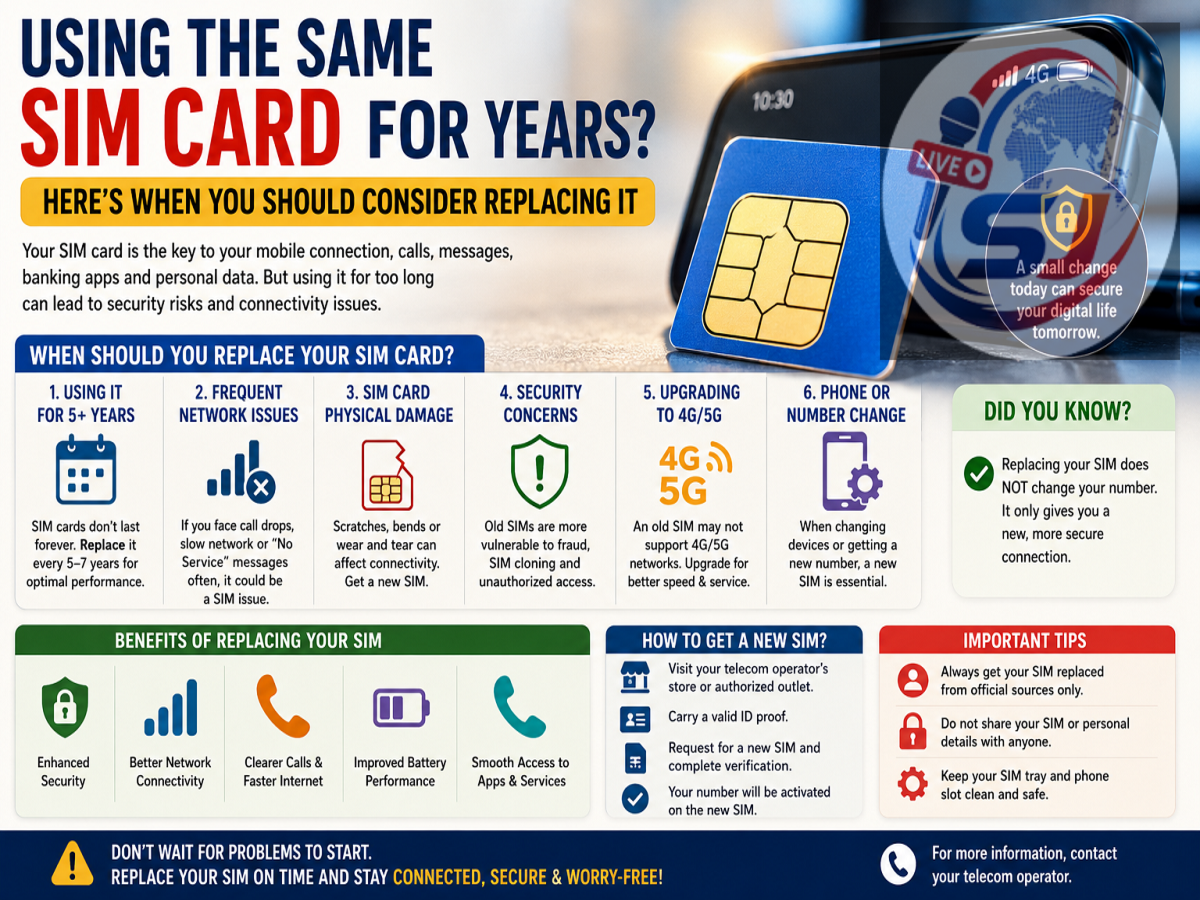
SIM Card Expiry: Unlike many physical products, SIM cards generally do not come with a fixed expiry date. If your SIM continues to work properly and your mobile number remains active, you may be able to use the same card for years. However, certain signs can indicate that it is time for a replacement.
Mobile phones have become essential for communication, banking, digital payments and accessing online services. Behind the cellular connection sits a small but important component—the SIM card.
Many users continue using the same SIM card for several years without experiencing any problems. This often raises a question: Does a SIM card eventually expire, and should an old SIM be replaced after a particular number of years?
There is usually no simple age-based answer.
Does a SIM Card Have an Expiry Date?
A physical SIM card normally does not carry a fixed expiry date similar to food, medicine or other time-sensitive products.
Its usable life is not determined solely by how many years have passed since it was issued. If the SIM is functioning normally, your mobile number remains active with the telecom operator and the card works properly with your device, there is generally no need to replace it merely because it is old.
In other words, a SIM that is several years old can continue working without problems.
When Should You Replace an Old SIM Card?
Although SIM cards can remain functional for a long time, they are physical electronic components and can eventually develop problems.
Consider contacting your telecom operator for a replacement if your phone frequently displays messages such as “No SIM,” “SIM Not Detected” or “Invalid SIM”, especially after you have ruled out a handset-related problem.
Frequent network disconnections can also indicate a possible SIM issue, although poor coverage, device settings or network outages may cause similar symptoms.
Physical Damage Is Another Warning Sign
Repeatedly removing and inserting a SIM can cause wear over time. The metallic contact area may become scratched, dirty or damaged.
A cracked, bent or heavily worn SIM should generally be replaced rather than repeatedly adjusted inside the phone.
Avoid cutting an older, larger SIM manually to fit a nano-SIM slot. Getting an officially issued replacement from your telecom provider is safer and reduces the possibility of damaging the SIM or handset.
An Old SIM May Not Support Newer Network Features Properly
A SIM issued many years ago may sometimes need upgrading to support newer network services or operator-specific features.
For example, users moving from older network generations to newer services may be advised by their telecom operator to obtain an updated SIM.
However, 5G does not automatically mean every user needs a new SIM. Whether replacement is necessary depends on the existing SIM, handset and telecom operator.
Therefore, users should check with their operator before replacing a functioning SIM simply to access a newer network.
SIM Age and Mobile Number Validity Are Different Things
An important distinction is that SIM-card lifespan and mobile-number validity are not the same.
A perfectly functional SIM can lose service if the associated mobile connection becomes inactive under the telecom operator's applicable rules.
Similarly, replacing a damaged SIM does not necessarily mean changing your mobile number. Telecom operators can generally issue a replacement SIM linked to the existing number after completing the required identity and security verification.
Signs Your SIM May Need Replacement
You may want to have the SIM checked or replaced if you repeatedly experience:
-
SIM not detected or invalid-SIM errors
-
Visible cracks, bending or damaged contact points
-
Persistent connectivity problems specifically linked to the SIM
-
Failure of the SIM across multiple compatible phones
-
Operator advice that an upgraded SIM is required for a particular service
-
A change to a device requiring a different SIM format or eSIM
Before requesting a replacement, restart the phone, check network settings and—where practical—test the SIM in another compatible device. This can help determine whether the problem lies with the SIM or the handset.
What About eSIM?
Modern smartphones increasingly support eSIM, which eliminates the need to insert a traditional plastic SIM card.
Instead, the subscriber profile is provisioned digitally on a supported device. This removes problems associated with physical wear, scratches or damaged SIM trays, although switching devices may require following the telecom operator's eSIM transfer or activation process.
Should You Replace a SIM Just Because It Is 5 or 10 Years Old?
Not necessarily.
If a 5-, 7- or even 10-year-old SIM continues to work reliably and supports the services you need, its age alone is generally not a reason to replace it.
The more important factors are its physical condition, network compatibility and reliability.
Bottom Line
SIM cards generally do not have a universal fixed expiry date. A card can potentially remain usable for many years as long as it stays functional and the associated mobile connection remains active.
Instead of replacing a SIM according to its age, watch for physical damage, repeated detection errors, persistent SIM-related connectivity problems or an operator requirement to upgrade. If any of these issues appear, obtaining an official replacement SIM while retaining your existing number may be the better option.