
UPI MDR Rules 2026: Will Electricity Bills, Mobile Recharges and OTT Payments Cost More?
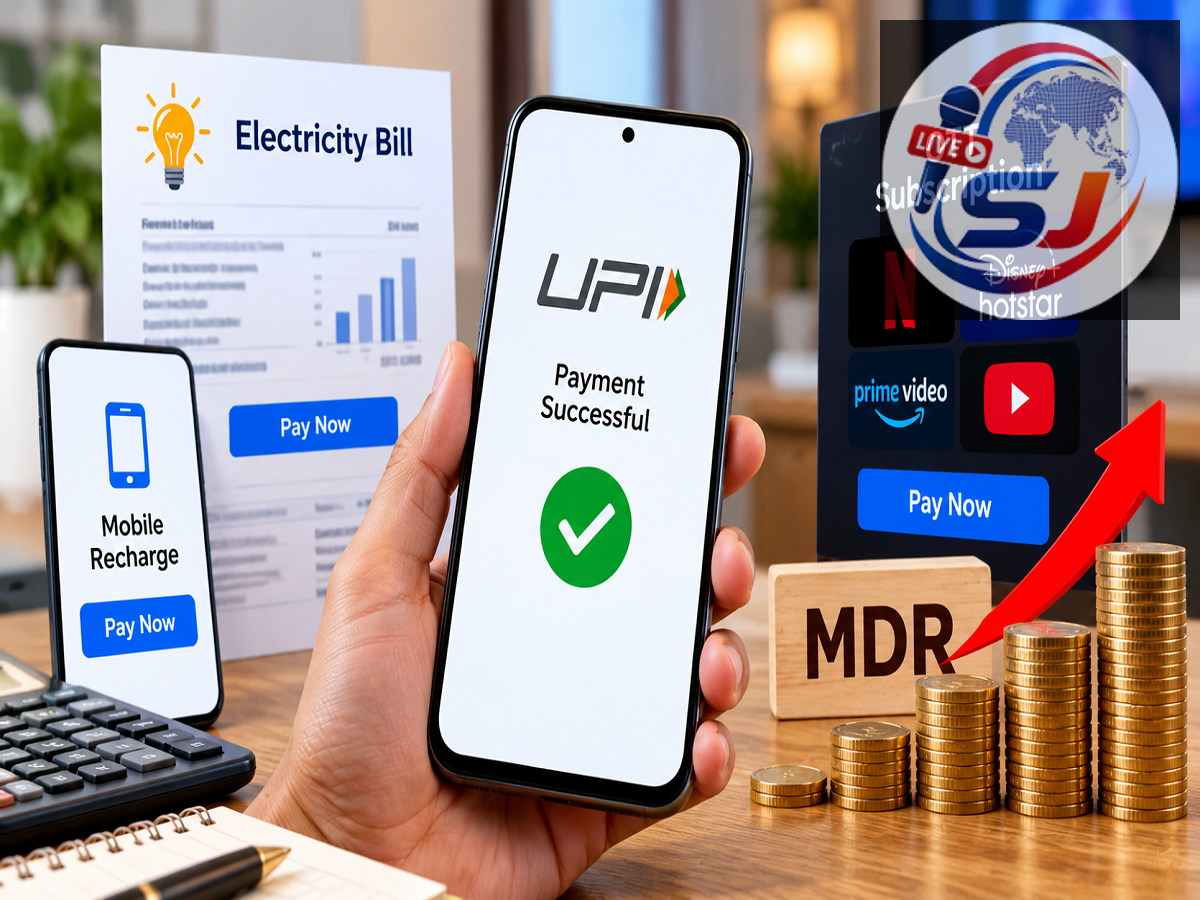
India’s new Merchant Discount Rate (MDR) framework for select UPI payments has raised an important question for millions of digital-payment users: will everyday transactions such as electricity bills, mobile recharges and OTT subscriptions now become more expensive?
The short answer for consumers is no. The new MDR framework is designed as a merchant-side payment charge, not a fee that ordinary customers are supposed to pay for using UPI. The government has clarified that person-to-person transfers will remain free, while most merchant transactions will also stay outside the MDR framework.
The revised rules are scheduled to take effect from October 15, 2026. However, the treatment of a transaction can vary depending on whether it is a normal merchant payment, an essential-service payment or a recurring UPI AutoPay mandate.
What Is Changing for UPI Payments?
Under the new framework, all person-to-person (P2P) UPI transfers will continue to be free regardless of the amount. Therefore, sending ₹5,000, ₹20,000 or another eligible amount to a friend or family member does not attract MDR merely because the transaction exceeds ₹2,000.
For standard person-to-merchant (P2M) payments, transactions of up to ₹2,000 will remain free from MDR. On applicable merchant payments exceeding ₹2,000, the standard MDR has been fixed at 0.4% of the transaction value. For transactions of ₹75,000 or more, the MDR is capped at ₹300 per transaction.
Importantly, MDR is not a government tax or a direct UPI usage charge on consumers. According to the Finance Ministry, it is distributed among participants in the payment ecosystem, including banks and payment service providers. Banks have also been advised to ensure that merchants do not pass the MDR burden on to customers.
What Happens When You Pay an Electricity Bill?
Electricity payments receive special treatment under the framework.
Public utility payments such as electricity and water bills fall under designated categories for which a concessional structure applies. For an eligible utility payment exceeding ₹2,000, the MDR is a flat ₹5 per transaction instead of the standard 0.4% rate. Payments up to ₹2,000 remain free from MDR.
For example, if an electricity bill is ₹5,000 and it is paid through an eligible UPI merchant transaction, the applicable MDR would be ₹5 rather than ₹20 under the standard 0.4% calculation.
That ₹5, however, is not supposed to be collected from the consumer as a UPI transaction fee. It applies within the merchant/payment ecosystem.
What About Mobile Recharge and Telecom Bills?
Telecommunications is also among the essential or thin-margin sectors receiving concessional treatment.
For qualifying telecom transactions exceeding ₹2,000, the government’s framework provides a flat ₹5 MDR instead of the usual percentage-based charge.
This distinction matters because most routine prepaid mobile recharges are well below ₹2,000 anyway. In such cases, MDR would not apply under the ₹2,000 threshold rule.
Even when a qualifying telecom payment exceeds that level, the MDR remains a merchant-side charge rather than an additional UPI fee payable by the customer.
Will OTT AutoPay Subscriptions Attract MDR?
There is further relief for people who use UPI AutoPay for recurring subscriptions.
According to reporting based on NPCI’s FAQ, UPI AutoPay and recurring mandates are exempt from the prescribed MDR transaction charge. This covers recurring payments such as eligible OTT subscriptions and other payments processed through UPI mandates.
So, if an OTT subscription is automatically renewed through an existing UPI AutoPay mandate, the new standard MDR should not suddenly create a separate UPI transaction charge for the subscriber.
The same distinction is relevant for other recurring payments made through UPI mandates. Users should therefore differentiate between a one-time merchant payment and an automated recurring mandate.
Who Actually Pays the MDR?
This is perhaps the most important part of the new rules.
Consumers are not required to pay MDR. The charge applies on the merchant side of eligible transactions. The government has specifically said that UPI application providers cannot impose platform fees or hidden charges on users under this framework.
Small merchants also receive significant protection. Street vendors and other small merchants receiving up to ₹1 lakh per month through UPI QR codes under the P2PM category will continue to get zero-MDR treatment.
According to the government, only around 4% of merchant transactions are expected to come under MDR, meaning approximately 96% of P2M transactions should remain unaffected.
What UPI Users Should Remember
The introduction of MDR does not mean that every UPI payment above ₹2,000 will suddenly cost the customer extra money. Person-to-person transfers remain free regardless of value, merchant payments up to ₹2,000 remain free from MDR, and small merchants covered by the zero-MDR framework retain their exemption.
For eligible electricity, telecom and certain other essential-service payments above ₹2,000, a concessional flat MDR can apply instead of the standard 0.4% rate. Recurring transactions processed through UPI AutoPay mandates are also treated separately under the framework.
For ordinary users, the key takeaway is straightforward: UPI itself remains free for consumers under the new framework. The MDR changes primarily alter how certain merchant-side payment-processing costs are handled after the new rules take effect on October 15, 2026.