
UPI MDR Charges Explained: Why Merchant Fees May Return and Who Could Receive the Money
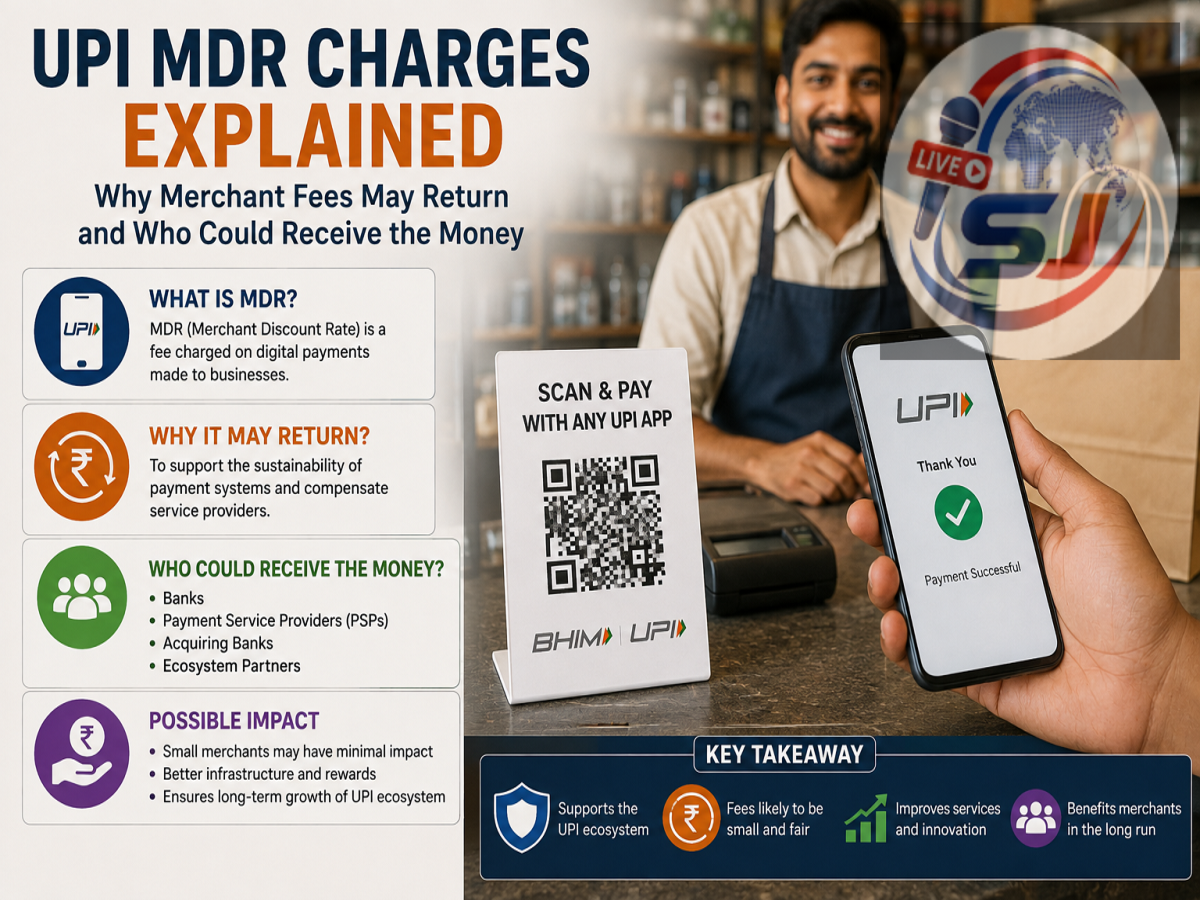
UPI has transformed digital payments in India by making instant bank-to-bank transfers simple, fast and widely accessible. For several years, ordinary UPI transactions have operated under a zero-MDR framework, helping merchants and consumers adopt QR-based payments at a massive scale.
Now, discussion around bringing back Merchant Discount Rate, or MDR, for selected UPI merchant transactions has gained attention again. Reports suggest that policymakers are examining whether a small fee could be introduced for higher-value merchant payments, potentially beginning with transactions of ₹2,000 or more.
However, one important point needs to be kept clear: as of now, a new 0.3% MDR on such UPI payments should not be treated as a universally implemented charge unless formally notified by the government or the relevant authorities. The existing zero-MDR framework for prescribed UPI transactions dates back to January 1, 2020. RBI records confirm that the government had directed that MDR should not be collected on UPI and RuPay debit-card transactions from that date. (Reserve Bank of India)
What Exactly Is MDR?
Merchant Discount Rate is a fee associated with processing a digital payment made to a merchant.
Despite its name, MDR is not normally a charge that should automatically be added to a customer's bill. It is essentially part of the cost borne within the payment ecosystem for processing and settling a transaction.
Different entities participate when a digital payment takes place. These may include the customer's bank, the merchant's bank, payment service providers and the network that routes and settles transactions.
The payment-processing fee helps compensate these players for maintaining infrastructure, handling transactions, managing fraud risks, providing customer support and keeping the payment network operational.
Why Was MDR Removed From UPI?
The government adopted the zero-MDR model to accelerate digital payment adoption.
From January 1, 2020, MDR was not to be collected on transactions made through prescribed modes including UPI and RuPay debit cards. The objective was to lower the cost of accepting digital payments and encourage more businesses, including smaller merchants, to shift away from cash. (Reserve Bank of India)
The strategy played an important role in making QR-code payments common even among small shops, street vendors and service providers.
But running such a large payment system is not free. Banks, payment companies and other participants must spend on servers, cybersecurity, fraud prevention, compliance, dispute handling and technology upgrades.
That has created a continuing debate over who should ultimately bear those costs.
Why Is the Return of UPI MDR Being Discussed?
The central issue is the long-term financial sustainability of India's rapidly expanding digital-payment infrastructure.
As transaction volumes increase, banks and fintech companies are required to invest more in cybersecurity, fraud monitoring, transaction processing and system reliability.
There is also a policy trade-off. Keeping UPI completely free helps merchants adopt digital payments, but it may leave banks and payment companies with limited direct revenue from transactions.
RBI has previously highlighted the need to balance low payment costs with the financial viability of the entities running payment systems. The central bank has noted that excessively high charges could discourage digital adoption, while very low charges may reduce incentives for continued investment in payment infrastructure. (Reserve Bank of India)
This is one reason discussions around a more sustainable pricing framework periodically return.
Could a 0.3% MDR Apply to Payments Above ₹2,000?
One proposal being discussed involves charging MDR on higher-value person-to-merchant, or P2M, transactions while leaving most smaller payments untouched.
A rate of around 0.3% for merchant payments of ₹2,000 or more has been cited in reports.
If such a structure were introduced, a ₹5,000 merchant payment at 0.3% would generate an MDR of ₹15, while a ₹10,000 payment would result in ₹30.
However, these examples should be viewed only as illustrations unless and until the final framework is formally announced.
The exact threshold, rate, exemptions and effective date could differ from the proposals being discussed.
Will Customers Have to Pay the MDR?
This is probably the most important question for UPI users.
MDR is primarily a merchant-side payment-processing charge, not automatically a customer fee.
Even under older payment frameworks, RBI's policy position has generally distinguished MDR from convenience charges passed directly to customers. RBI has previously stated in the debit-card context that merchants should display that customers do not have to pay an additional convenience or service charge. (Reserve Bank of India)
Therefore, even if MDR returns for selected UPI transactions, that would not necessarily mean consumers will be charged extra each time they scan a QR code.
The final rules would determine who bears the cost and which merchants or transactions are covered.
Smaller Merchants Could Remain Protected
One of the policy concerns is ensuring that charges do not discourage small businesses from accepting UPI.
Small-value transactions form a major part of everyday UPI use. Tea stalls, grocery stores, vegetable vendors, local transport providers and neighbourhood shops often depend heavily on QR payments.
A fee that applies uniformly to every transaction could reduce the attractiveness of digital payments for such merchants.
This is why proposals have focused more on higher-value merchant transactions while protecting smaller businesses and ordinary customers.
If a threshold-based MDR model is eventually introduced, sectors involving higher-ticket purchases—such as electronics, fashion, investments or other expensive goods and services—could be affected more than routine small-value payments.
Who Gets the Money Collected Through MDR?
MDR does not usually go to one company.
A typical digital transaction involves several participants, and the fee can be divided across the payment chain.
The customer's bank, often referred to as the issuing bank, may receive a share because it maintains the payer's account and authorises the transaction.
The merchant's acquiring bank or payment service provider can receive another portion for onboarding the merchant and handling acceptance infrastructure.
Payment apps and service providers involved in processing may receive part of the economics depending on the final commercial framework.
NPCI, which operates the UPI network, may also receive a relatively small network-processing component.
The precise distribution would depend on the structure ultimately notified for UPI MDR.
What Are Issuing and Acquiring Banks?
Understanding these two terms makes MDR easier to follow.
The issuing bank is generally the bank where the customer holds the account from which the money is paid.
The acquiring bank is the institution associated with the merchant that receives or facilitates acceptance of the payment.
Payment service providers and UPI apps may sit between these participants, while NPCI provides the network layer that allows different banks and apps to communicate and settle UPI transactions.
Therefore, the cost of operating UPI is spread across multiple institutions rather than one organisation.
Why Payment Companies Want a Sustainable Revenue Model
Processing one UPI transaction may appear almost effortless to the user, but several systems work in the background.
Banks and fintech companies need infrastructure capable of handling huge volumes of real-time payments. They must also invest continuously in fraud detection, data protection, customer grievance systems, server capacity and compliance.
The growing sophistication of cybercrime adds another layer of expense.
A sustainable revenue mechanism could potentially help payment participants continue investing in these systems without relying entirely on government incentives or cross-subsidies from other financial services.
Could Government Support Continue Instead?
MDR is not the only way to fund the UPI ecosystem.
Another approach is continued government support to compensate banks and payment companies for processing zero-MDR transactions.
Policymakers therefore face a choice between maintaining incentives, gradually reducing subsidy support, or allowing selected transactions to generate merchant fees.
A hybrid structure is also possible, where smaller transactions remain free while larger commercial payments contribute toward network costs.
The final policy will depend on how the government balances digital-payment adoption with the financial sustainability of the ecosystem.
UPI Users Should Avoid Assuming That All Payments Will Become Chargeable
Headlines claiming that UPI is about to become “paid” can be misleading.
Even if MDR is reintroduced for selected merchant transactions, it does not mean person-to-person transfers between individuals will necessarily become chargeable.
Similarly, a merchant-side MDR does not automatically translate into a fee paid by customers.
The most likely policy discussion centres on selected P2M transactions rather than every UPI transfer.
Consumers should therefore wait for an official notification before assuming that sending money to friends, paying utility bills or making routine QR payments will attract new charges.
Zero-MDR Has Been in Place Since 2020
The current zero-MDR framework has been in place for more than six years.
RBI documentation confirms that the government directed that MDR should not be collected for UPI and RuPay debit-card transactions from January 1, 2020. (Reserve Bank of India)
The move was part of a broader push to make digital payments affordable and accessible.
UPI's extraordinary growth since then has changed the scale of the question. Policymakers are no longer focused only on adoption; they are also examining whether the underlying payment infrastructure can remain financially sustainable over the long term.
What Should Merchants and Customers Do Now?
For now, merchants and consumers should continue following the applicable UPI rules and avoid reacting to unconfirmed messages circulating on social media.
If a new MDR framework is introduced, the government, RBI, NPCI or other relevant authorities are expected to clarify the rate, transaction threshold, merchant categories, exemptions and effective date.
Until those details are formally announced, claims that every UPI payment above ₹2,000 will automatically attract an additional customer charge should be treated cautiously.
The Bottom Line
The debate over UPI MDR is ultimately about how India should pay for the infrastructure behind one of the world's largest real-time digital payment systems.
Zero-MDR helped UPI spread rapidly, but banks, payment companies and network operators still incur substantial costs for processing transactions, preventing fraud and maintaining secure infrastructure.
A possible solution is to charge selected higher-value merchant payments while keeping everyday consumer and small-merchant transactions protected. If MDR does return, the revenue would likely be shared among different participants in the payment chain rather than going to a single entity.
For UPI users, however, the key message is simple: discussion of MDR does not automatically mean that every UPI transaction will become chargeable. The actual impact will depend on the final rules officially notified by the government and payment authorities.
Disclaimer: This article is for informational purposes. Proposed UPI MDR rates, thresholds and exemptions may change before implementation. Consumers and merchants should rely on official government, RBI and NPCI notifications for the final applicable rules.