
UPI MDR Charges: Could Cash and ATMs Gain Ground Again? How India's Payment Habits Are Changing
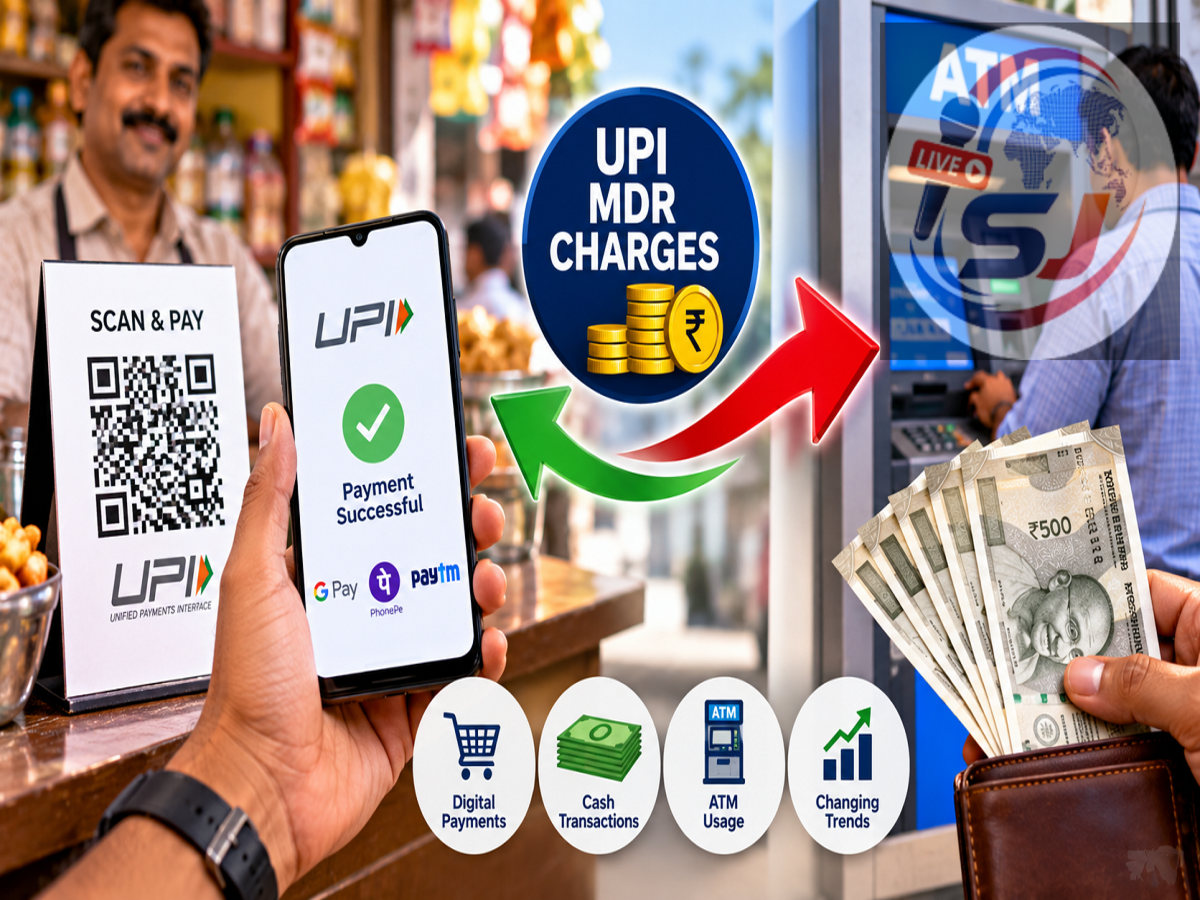
India's payment landscape has transformed dramatically over the past four decades. From standing in long bank queues to withdrawing cash from ATMs and eventually scanning QR codes for instant payments, consumers have repeatedly changed the way they access and spend money.
Now, another development has raised an interesting question: could costs associated with some merchant UPI transactions make cash slightly more relevant again and, in turn, increase the importance of ATMs?
According to the information provided in the report, an MDR-related change for certain merchant UPI transactions is set to take effect from October 15, 2026. Importantly, the report states that the charge would apply to merchants in the specified cases rather than being directly imposed on customers.
That distinction matters because the introduction of a merchant-side cost does not automatically mean consumers will abandon UPI or start paying a fee every time they scan a QR code.
To understand what could happen next, it helps to look at how India's journey from cash to ATMs and then to UPI unfolded.
Before ATMs, Withdrawing Cash Meant Visiting a Bank
There was a time when withdrawing money required a trip to a bank branch.
Customers had to visit during banking hours, wait at the counter and complete the required process before receiving cash. The inconvenience was even more noticeable during periods when large numbers of customers needed to withdraw money.
ATMs fundamentally changed that experience.
India's first ATM was installed by HSBC in Mumbai in 1987, according to the report. It gave customers a new way to access their bank accounts without depending entirely on branch timings.
Insert a card, enter a PIN and withdraw cash — the process that now feels ordinary was a major shift in banking convenience at the time.
ATMs Gradually Became Mini Banking Points
As ATM networks expanded, the machines became capable of doing more than dispensing currency.
Customers could check balances, generate mini statements, change their PINs and, at certain machines, deposit cash.
The development effectively moved some basic banking services away from the branch and made them available through self-service machines.
For years, carrying an ATM or debit card became almost essential for consumers who wanted convenient access to cash.
Then smartphones and digital payments changed the equation again.
UPI Reduced the Need to Withdraw Cash for Everyday Purchases
Mobile and internet banking had already made banking easier, but UPI significantly changed everyday payments.
Instead of withdrawing cash from an ATM before visiting a shop, customers could simply scan a QR code and transfer money directly from their bank account.
For small purchases in particular, the convenience was significant.
A customer no longer necessarily needed cash in their wallet or even a physical debit card. A smartphone connected to a bank account could handle many routine payments within seconds.
This naturally reduced the need to visit an ATM before every purchase.
But the growth of UPI did not make cash or ATMs disappear.
India Still Has a Large ATM Network
According to the figures cited in the report, India had approximately 2.51 lakh ATMs as of March 2025.
Cash continues to be needed for a variety of transactions, particularly in situations where digital payments are unavailable, inconvenient or simply not preferred by either party.
ATMs have also evolved alongside digital payments.
One of the most interesting developments is UPI-enabled cardless cash withdrawal.
At supported ATMs, users may be able to select a UPI cash-withdrawal option, scan the displayed QR code through a compatible UPI application and complete the transaction without inserting a physical debit card.
This creates an unusual relationship between two technologies that are often portrayed as competitors.
UPI may have reduced the need to visit an ATM for routine payments, but UPI technology can also make ATM withdrawals more convenient.
What Does the Report Say About the New UPI MDR?
According to the supplied information, NPCI issued an MDR-related update in September 2026.
The report states that from October 15, 2026, selected merchant UPI transactions above ₹2,000 will attract an MDR of 0.4%.
It further states that for transactions of ₹75,000 or more, the charge would be capped at ₹300.
The report also makes two important distinctions: the specified charge would apply to the merchant rather than the customer, and merchant transactions below ₹2,000 would not attract the stated charge.
Therefore, consumers should not interpret the development as meaning that every UPI payment will suddenly become chargeable.
Could Merchant Costs Push Some Payments Back to Cash?
This is where the debate becomes more interesting.
Suppose a customer wants to make a relatively large payment and a merchant wants to avoid an additional digital-payment cost. In certain situations, the merchant might prefer cash or another available payment method.
If more merchants begin encouraging cash for certain transactions, consumers may occasionally need to withdraw more money.
That could increase ATM usage in specific circumstances.
However, this does not necessarily mean India is heading back to the era when consumers routinely visited an ATM before shopping.
UPI has become deeply integrated into everyday payment habits, and a merchant-side charge on selected transactions alone may not be enough to reverse that transformation.
Could ATMs Make a Comeback?
The more realistic possibility is not a complete ATM comeback but an evolution in how ATMs are used.
Consumers may continue using UPI for routine purchases while relying on ATMs when cash is necessary.
At the same time, UPI-enabled cardless withdrawals could make ATMs part of the broader digital-payment ecosystem instead of leaving them as purely card-based machines.
In other words, the future may not be about choosing between UPI and ATM.
It may increasingly involve using UPI and ATMs together.
Cash, Cards and UPI Have Each Changed the Payment Journey
The evolution of India's payment system can be viewed in stages.
In the early days, consumers depended heavily on bank branches to access cash. ATMs reduced that dependence by making cash available outside branch counters and banking hours.
Cards then became an important payment and cash-access tool.
Mobile banking moved many banking services onto smartphones, while UPI went a step further by making direct bank-to-bank payments extremely convenient for everyday transactions.
Now, QR codes and UPI-enabled cash withdrawals are connecting digital money with physical cash in new ways.
UPI Charges Do Not Necessarily Mean Customers Will Pay More
For consumers, one of the most important points is to distinguish between MDR charged to a merchant and a direct fee charged to a UPI user.
Based on the information provided in the report, the discussed MDR applies to specified merchant transactions and is not described as a direct charge on customers.
How merchants respond to such costs could influence payment preferences in some situations, but it would be premature to conclude that consumers will broadly abandon UPI.
The Future May Be Cash and Digital, Not Cash Versus Digital
ATMs transformed Indian banking by freeing customers from branch queues. UPI later transformed payments by reducing the need to withdraw cash for many everyday purchases.
The next stage may involve these technologies becoming increasingly connected rather than one replacing the other.
Cash continues to serve a purpose, while UPI provides speed and convenience for digital transactions. ATMs, meanwhile, are evolving from card-operated cash machines into access points that can also interact with digital-payment technology.
If merchant payment costs influence behaviour in some categories, cash and ATM withdrawals could gain importance for certain transactions. But describing this as the end of UPI or a full-scale return of the ATM era would be an exaggeration.
India's payment story increasingly appears to be about coexistence: UPI for convenient digital payments, cash where it remains useful, and ATMs acting as a bridge between the two.