
UPI MDR Charges 2026: NPCI Reportedly Delays 0.4% Merchant Fee Until After Diwali, Check New Rules
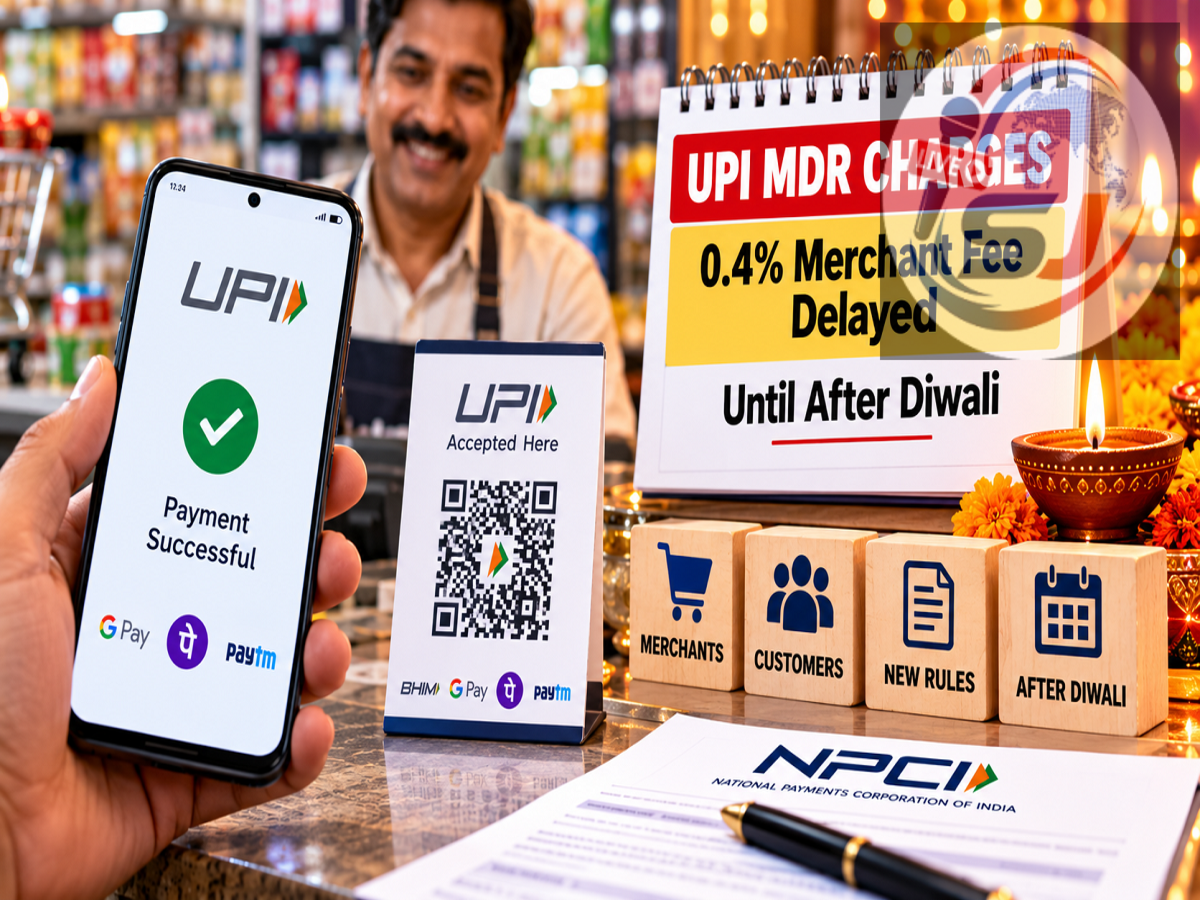
UPI Payment Charges Latest Update: Millions of people using Google Pay, PhonePe, Paytm, and other UPI applications may get temporary relief during the festive shopping season. According to a report published on October 13, 2026, the National Payments Corporation of India (NPCI) has postponed the proposed Merchant Discount Rate (MDR) charges on selected UPI merchant transactions until after Diwali.
The proposed charges were earlier expected to take effect on October 15, 2026. However, concerns raised by merchant associations, fintech companies, and payment service providers reportedly led to a postponement.
Under the reported proposal, certain merchant payments exceeding ₹2,000 could attract an MDR of 0.4%. Importantly, this would be a merchant-side charge rather than a universal fee imposed directly on customers.
NPCI has reportedly indicated that a revised implementation date will be announced separately. Therefore, customers and businesses should not treat any suggested November rollout date as officially confirmed.
Why Were the Proposed UPI MDR Charges Postponed?
The reported postponement comes at a time when businesses across India are preparing for increased consumer spending during the Diwali festive season.
Digital payments have become an essential part of retail transactions, with millions of customers using UPI for shopping, groceries, restaurant bills, and other everyday purchases.
Introducing additional payment processing costs during a busy shopping period could affect merchants, particularly businesses operating with relatively small profit margins.
According to the October 13 report, merchant associations and fintech companies requested additional time before the proposed MDR framework was implemented.
Their concerns included the financial impact on businesses, the need for clarity regarding applicable transaction categories, and technical preparations required by payment service providers.
Some businesses were also concerned that higher digital payment acceptance costs could encourage merchants to prefer cash transactions.
The reported decision to postpone the rollout is intended to provide additional time for preparations and clarification.
When Will the New UPI MDR Charge Come Into Effect?
The proposed implementation date was initially October 15, 2026.
Following the reported postponement, the new framework is expected to be introduced after Diwali.
However, an exact implementation date has not been confirmed in the information provided.
Some media reports have suggested that the charges could begin during the second week of November 2026.
This remains an expectation rather than an officially announced deadline.
The difference is important because customers and businesses should rely on formal notifications before changing their payment arrangements.
Until the revised framework becomes effective, the existing applicable UPI payment rules continue to operate.
What Is the Proposed 0.4% UPI MDR Charge?
Merchant Discount Rate is a fee associated with processing certain digital payments received by businesses.
Under the proposal described in the report, an MDR of 0.4% could apply to selected UPI merchant transactions exceeding ₹2,000.
The proposed charge would not apply to every UPI payment.
For example, if a qualifying merchant receives a payment of ₹10,000 and the 0.4% rate applies, the calculated MDR would be ₹40.
Here is how the calculation works.
| UPI payment amount |
MDR at 0.4% |
Reported applicability |
|---|---|---|
| ₹1,000 |
₹4 |
Below the proposed ₹2,000 threshold; expected exemption |
| ₹2,000 |
₹8 |
At the proposed threshold; expected exemption |
| ₹3,000 |
₹12 |
May apply to eligible merchant transactions |
| ₹5,000 |
₹20 |
May apply to eligible merchant transactions |
| ₹10,000 |
₹40 |
May apply to eligible merchant transactions |
| ₹20,000 |
₹80 |
May apply to eligible merchant transactions |
The MDR amounts shown are mathematical illustrations. A transaction is not necessarily chargeable simply because it exceeds ₹2,000.
The final framework must establish which merchants and payment categories are covered.
Will Google Pay, PhonePe and Paytm Users Have to Pay Extra?
For ordinary UPI users, the most important point is that the reported MDR proposal does not introduce a universal fee for using UPI applications.
Customers making payments through Google Pay, PhonePe, Paytm, or other supported UPI platforms would not automatically be charged merely for choosing these applications.
The proposed MDR is intended to be collected from eligible merchants for processing specified payments.
This distinction matters because some misleading messages may suggest that every UPI transaction will attract a 0.4% deduction.
That is not what the reported proposal states.
Customers should therefore avoid believing social media claims that all UPI transfers will become chargeable after Diwali.
Will Personal UPI Transfers Remain Free?
Yes, the reported proposal does not introduce MDR charges on ordinary person-to-person UPI transfers.
For example, sending money to a friend, family member, or relative through an eligible bank-account-based UPI transaction would remain outside the proposed merchant MDR framework.
The same distinction applies when transferring money between individuals for personal purposes.
Merchant payments and personal transfers are treated differently under the proposed arrangement.
Customers should also remember that other payment methods, such as certain wallet-funded transactions, can have separate rules. These should not be confused with the proposed MDR on selected merchant UPI payments.
Who Will Pay the UPI MDR Charge: Customers or Shopkeepers?
MDR is generally a merchant-side payment processing fee.
Under the reported proposal, eligible businesses accepting qualifying UPI payments would bear the charge.
The government has reportedly emphasized that customers should not be separately charged MDR simply because they choose UPI.
However, business associations have expressed concerns that additional payment acceptance costs could affect merchant profitability.
Some merchants may worry about how to manage these costs, particularly when processing a large number of transactions.
This is one reason the proposed framework has attracted attention from retailers and payment service providers.
How Could the Proposed Rules Affect Small Businesses?
Small retailers, local grocery stores, street vendors, and neighborhood shops rely heavily on UPI because of its convenience and widespread customer acceptance.
For businesses receiving mostly small-value transactions, exemptions could help reduce the financial impact of the proposed framework.
However, businesses processing larger payments may need to assess whether their transactions fall within the chargeable categories.
For example, a merchant selling electronic appliances or other high-value products may receive payments considerably above ₹2,000.
If the business qualifies under the final MDR rules, those payments could involve additional processing costs.
The actual effect will depend on transaction volumes, applicable exemptions, and the final rate structure.
Therefore, merchants should wait for the detailed implementation guidelines before estimating their expenses.
Why Is MDR Being Considered for UPI Payments?
UPI has experienced significant growth as consumers increasingly prefer digital payments over cash for many everyday transactions.
Supporting this payment infrastructure involves expenses for banks, payment service providers, and technology networks.
These costs may include transaction processing, cybersecurity systems, infrastructure maintenance, fraud prevention, and customer support.
The proposed MDR arrangement is reportedly intended to address some of these operational expenses while preserving exemptions for smaller transactions.
However, introducing merchant fees also raises questions about the affordability of digital payments for businesses.
Policymakers and payment industry participants must consider both the cost of maintaining payment infrastructure and the need to encourage continued digital payment adoption.
What Should Customers and Merchants Do Now?
For now, customers can continue using their usual UPI applications under the existing applicable rules.
There is no reason to assume that every payment will attract an additional charge after October 15.
Businesses should monitor official communications regarding the revised implementation date and transaction eligibility criteria.
Merchants should also check whether their payment service providers issue updated terms or fee schedules.
Customers should remain cautious about fraudulent messages claiming that a new UPI charge must be paid to activate or continue using their accounts.
No one should share their UPI PIN, OTP, or banking password in response to such messages.
Conclusion
The proposed introduction of a 0.4% MDR charge on selected UPI merchant transactions exceeding ₹2,000 has reportedly been postponed until after Diwali 2026.
The decision follows concerns from merchant organizations, fintech firms, and payment service providers about introducing additional charges during the festive shopping season.
The most important point for customers is that ordinary person-to-person UPI transfers are not covered by the proposed merchant MDR charge.
Google Pay, PhonePe, and Paytm users should not assume that all digital payments will become chargeable.
For merchants, the financial impact will depend on the final transaction categories, thresholds, and applicable conditions.
The revised implementation date has not yet been confirmed, and further official clarification is awaited.
Disclaimer: This article describes the reported October 13, 2026, UPI MDR proposal and postponement. The 0.4% rate, transaction thresholds, exemptions, and implementation schedule should be confirmed through official NPCI and government notifications before being treated as effective rules.