
UPI Charges From October 15: Will ₹10 Tea Cost More? Know the Truth About the New 0.4% MDR Rule
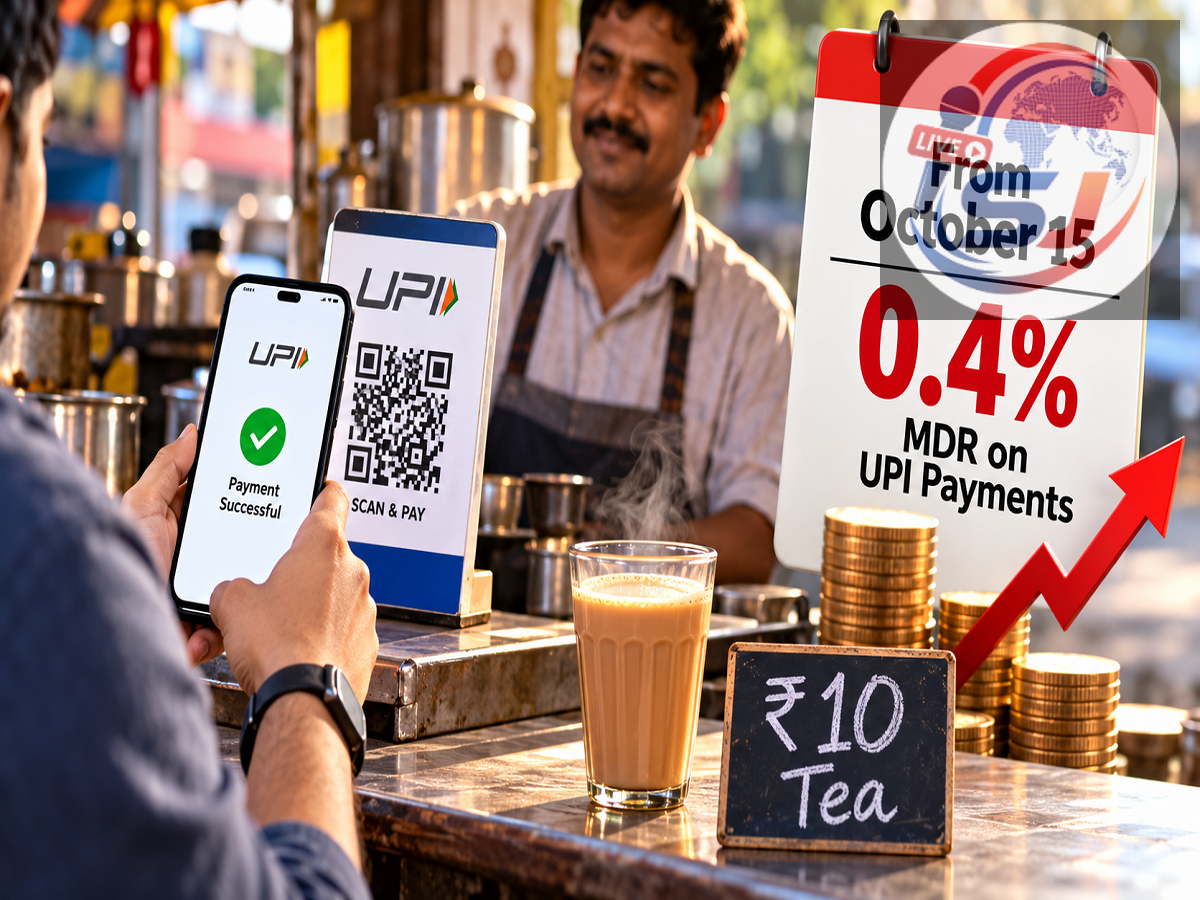
UPI New Charges October 2026: Millions of Indians use Unified Payments Interface (UPI) every day to pay for tea, groceries, vegetables, transport and online purchases. With reports circulating about possible changes to UPI merchant transaction charges from October 15, 2026, many consumers are wondering whether digital payments will become more expensive.
The biggest concern is whether customers will need to pay an additional fee every time they scan a QR code at a shop. According to the reported proposal, the answer is no. The changes being discussed concern Merchant Discount Rate (MDR) charges on certain business transactions rather than a direct tax on every UPI payment.
However, the reported 0.4% MDR on selected merchant payments exceeding ₹2,000 has not been independently confirmed as an officially notified rule. Consumers should distinguish between reported proposals and implemented payment regulations.
Will You Pay Extra for ₹10 Tea Through UPI?
For ordinary customers, the most important question is whether everyday purchases will attract additional charges.
Consider a simple example. You visit a roadside tea stall and order tea costing ₹10. After drinking it, you scan the shopkeeper's QR code and complete the payment using UPI.
Under the arrangement described in the report, you would pay only ₹10.
Similarly, purchasing vegetables worth ₹100 or groceries worth ₹500 would not automatically attract an additional UPI fee.
The report states that eligible merchant payments up to ₹2,000 would remain outside the proposed MDR structure.
This means the reported change is not a blanket charge on small digital transactions.
What Is the Proposed 0.4% MDR on UPI Payments?
Merchant Discount Rate, commonly known as MDR, is a fee associated with processing certain merchant payments.
It is generally a cost borne by the merchant or another party in the payment acceptance arrangement, depending on the applicable rules and commercial structure.
The article claims that a 0.4% MDR could apply to selected eligible merchant UPI transactions exceeding ₹2,000 from October 15.
For example, if a qualifying merchant receives ₹10,000 through UPI, a 0.4% fee would equal ₹40.
Importantly, MDR should not be confused with a government tax imposed directly on the customer.
The existence of a merchant processing fee does not automatically mean that the buyer must pay an additional amount at checkout.
How Much MDR Will Merchants Pay on UPI Transactions?
Under the framework announced on September 15, 2026, qualifying merchant transactions above ₹2,000 will attract an MDR of 0.4%, subject to a maximum charge of ₹300 per transaction.
The following examples show how the fee works.
| UPI Payment Amount |
Merchant MDR |
Customer Pays |
|---|---|---|
| ₹10 |
₹0 |
₹10 |
| ₹100 |
₹0 |
₹100 |
| ₹500 |
₹0 |
₹500 |
| ₹2,000 |
₹0 |
₹2,000 |
| ₹5,000 |
₹20 |
₹5,000 |
| ₹10,000 |
₹40 |
₹10,000 |
| ₹25,000 |
₹100 |
₹25,000 |
| ₹75,000 |
₹300 |
₹75,000 |
| ₹1,00,000 |
₹300 |
₹1,00,000 |
Illustrative MDR calculations for qualifying standard merchant transactions. Exempt merchants and special merchant categories may have different treatment.
Will Small Shopkeepers and Street Vendors Have to Pay MDR?
The government has introduced exemptions intended to protect smaller businesses from additional payment-processing expenses.
Small merchants receiving up to ₹1 lakh per month through qualifying UPI QR payments are covered by the zero-MDR arrangement.
This is particularly relevant for neighbourhood grocery shops, roadside tea sellers, vegetable vendors and other small businesses.
According to the Ministry of Finance, approximately 96% of person-to-merchant UPI transactions will remain unaffected by the new framework.
The government has also confirmed that ordinary person-to-person transfers will continue to remain free, regardless of the amount transferred.
Special UPI Charges for Fuel, Railways and Other Services
Not every qualifying merchant transaction above ₹2,000 will attract the standard 0.4% rate.
The framework provides special treatment for certain essential services and sectors operating with relatively narrow profit margins.
Eligible transactions above ₹2,000 involving fuel, railways, telecommunications, insurance and agricultural inputs will attract a flat MDR of ₹5.
Capital-market transactions, including eligible payments related to mutual funds and securities, have a separate MDR rate of 0.02%, capped at ₹300.
These charges are part of the merchant payment system and are not additional taxes imposed directly on customers.
Can Shopkeepers Ask Customers to Pay Cash Instead?
Although the MDR is intended to be borne within the merchant payment ecosystem, some business owners have expressed concerns about higher operating costs.
A merchant receiving a large number of qualifying UPI payments may need to account for the additional processing expense.
This could encourage some retailers to promote cash payments or reconsider how they accept digital transactions.
However, the government has made clear that merchants should not transfer the MDR directly to customers as an additional UPI charge.
The introduction of MDR therefore does not mean customers are legally required to pay extra simply for choosing UPI.
Why Is the Government Introducing UPI Merchant Charges?
UPI has grown into one of India's most widely used payment systems, allowing individuals and businesses to transfer money almost instantly.
Maintaining this infrastructure requires investment in banking systems, transaction processing, cybersecurity, fraud prevention and customer support.
The new MDR framework is intended to provide revenue to participants responsible for operating and maintaining the payment network.
According to the Ministry of Finance, the charges will be distributed among payment ecosystem participants rather than collected as a government tax.
The policy aims to balance the long-term financial sustainability of UPI with continued access to free digital payments for consumers and small merchants.
Will UPI Payments Become More Expensive From October 15?
For ordinary consumers, the announced framework does not introduce a new payment charge.
Whether someone is purchasing a cup of tea, paying for groceries or transferring money to a family member, the payment amount itself will not automatically increase because of MDR.
The announced October 15 implementation date remains subject to any subsequent official changes. Reports have also discussed a possible postponement, but a proposed delay should not be treated as a confirmed revised date.
Customers can continue using supported UPI applications such as Google Pay, PhonePe, Paytm and BHIM for everyday transactions.
UPI New Rules 2026: What Customers Should Remember
The biggest misunderstanding surrounding the October 15 change is the belief that every UPI transaction will become chargeable.
The official framework distinguishes between ordinary consumers and qualifying merchant transactions.
Customers are not required to pay MDR, eligible small merchants retain exemptions, and personal transfers remain free.
For larger businesses, the 0.4% merchant fee introduces a new payment-processing expense, but this does not automatically change the price displayed to buyers.
The bottom line: Your ₹10 cup of tea should still cost ₹10 when paid through UPI. The new framework concerns specified merchant transactions, not a universal charge on digital payments.
For official updates, consumers and businesses can refer to the NPCI UPI circulars and announcements from the Ministry of Finance.