
UPI Charges 2026: New MDR Fee Postponed Until After Diwali, Check Rules for Customers and Shopkeepers
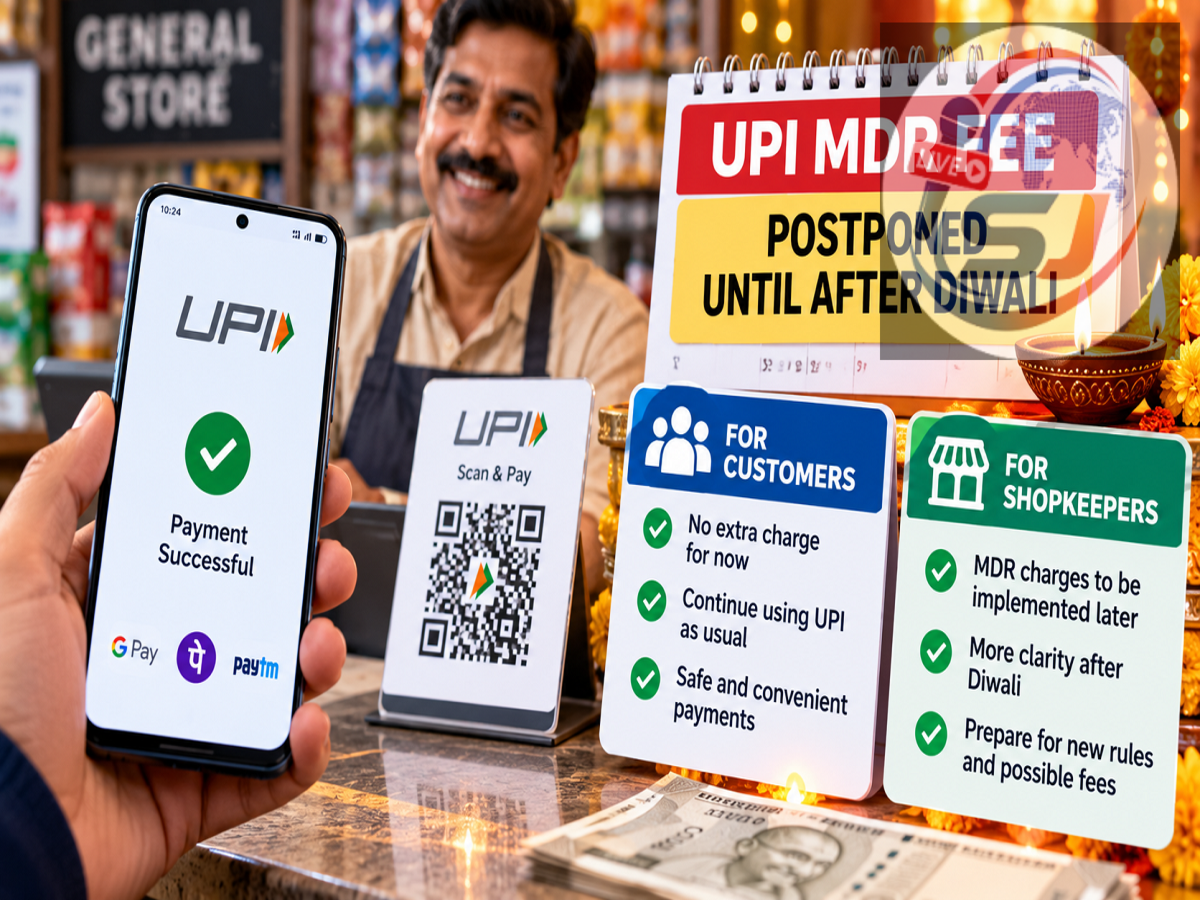
UPI MDR Charges Latest Update: Millions of Indians who use Google Pay, PhonePe, Paytm, and other UPI applications for everyday transactions have received an important update. The proposed introduction of Merchant Discount Rate (MDR) charges on selected UPI merchant payments has reportedly been postponed until after Diwali 2026.
According to a report dated October 13, 2026, the National Payments Corporation of India (NPCI) decided to delay the proposed implementation during a UPI Steering Committee meeting. The revised framework was earlier expected to take effect on October 15, 2026.
However, the new implementation date has not yet been officially confirmed in the information provided.
The proposed changes are primarily related to merchant transactions rather than ordinary person-to-person money transfers. This means customers should not assume that every UPI payment will suddenly attract an additional fee.
Here is what the reported postponement means for UPI users, small businesses, and larger merchants.
UPI MDR Charges: What Is the New Implementation Date?
The proposed MDR framework was initially scheduled to begin on October 15, 2026.
However, the October 13 report states that the implementation has been deferred until after the Diwali festival.
The decision reportedly followed discussions at the UPI Steering Committee meeting.
Some reports suggest that the new framework could be introduced during the second week of November 2026.
Nevertheless, this timeline remains speculative because a confirmed implementation date has not been announced.
The postponement should also not be interpreted as a complete withdrawal of the proposed charges.
A final implementation schedule and detailed operating instructions are still awaited.
Will Google Pay, PhonePe and Paytm Users Have to Pay Extra?
For ordinary customers, the most important question is whether UPI payments will become more expensive.
According to the reported framework, regular person-to-person transfers will continue without a separate MDR charge.
This includes common transactions such as sending money to family members, transferring funds to friends, or making other eligible bank-account-based UPI transfers.
The proposed merchant charges are not intended to create a universal fee for every UPI transaction.
Therefore, customers should not confuse a merchant-side MDR charge with a mandatory payment fee imposed directly on individuals.
The exact treatment of different payment categories will depend on the final official rules.
What Is MDR and How Does It Work?
Merchant Discount Rate, commonly known as MDR, is a transaction-related charge that may be paid by a business accepting digital payments.
It is generally associated with the services and infrastructure used to process payments.
Depending on the applicable payment system, the charge may be shared among participating financial institutions and payment service providers.
For example, if a merchant receives a digital payment of ₹5,000 and an MDR of 0.5% applies, the charge would amount to ₹25.
This is only a mathematical illustration, not a confirmed MDR rate under the proposed UPI framework.
The actual rate, eligible transactions, exemptions, and collection arrangements must be determined by the final applicable rules.
Which UPI Transactions May Remain Exempt?
The October 13 report identifies several categories expected to remain outside the proposed MDR charges.
| Transaction category |
Reported treatment under the proposed framework |
|---|---|
| Person-to-person UPI transfers |
No separate MDR charge |
| Merchant payments up to ₹2,000 |
Expected to remain exempt |
| Eligible small merchants receiving up to ₹1 lakh monthly through QR payments |
Expected exemption, subject to conditions |
| Other qualifying merchant transactions |
May attract MDR under the final rules |
| General UPI customer payments |
No universal customer fee announced |
These are reported features of the proposed framework and should not be treated as a substitute for final NPCI or government instructions.
Government Says Around 96% of Merchant UPI Transactions May Be Unaffected
One of the key claims in the report is that approximately 96% of merchant UPI transactions would remain unaffected by the proposed charges.
This suggests that the framework is intended to preserve the affordability of a large share of everyday digital payments.
Small-value purchases, such as paying for groceries, tea, snacks, vegetables, or other routine expenses, represent an important part of UPI usage.
Maintaining exemptions for eligible low-value transactions could help reduce the financial burden on small merchants.
However, the proportion of unaffected transactions does not necessarily mean that 96% of merchants will be exempt.
The impact on individual businesses will depend on their transaction values, payment volumes, and the final eligibility criteria.
Can Shopkeepers Charge Customers Extra for UPI Payments?
The report states that merchants will not be permitted to collect the proposed MDR from customers by separately labeling it as a UPI fee.
This distinction is important because MDR is generally a merchant-side payment acceptance cost.
Customers should therefore be cautious if a business claims that the reported policy automatically requires every buyer to pay an additional UPI charge.
For example, a merchant should not assume that a ₹500 purchase automatically requires an additional payment simply because the customer chooses UPI.
Any actual payment-related charge must comply with the applicable rules.
Consumers should wait for official clarification before accepting claims about new mandatory UPI fees.
Why Is the Government Considering MDR on Selected UPI Payments?
UPI has transformed India's digital payment ecosystem by allowing users to transfer money quickly through mobile applications.
Its widespread adoption has also increased the volume of transactions processed by banks, payment service providers, and supporting technology systems.
Operating a large-scale payment network involves costs associated with infrastructure, cybersecurity, transaction processing, customer support, and system maintenance.
The reported MDR proposal seeks to address some of these expenses by introducing charges on selected merchant transactions while retaining exemptions for smaller payments.
Supporters of such arrangements argue that payment service providers require sustainable funding to maintain and improve their systems.
At the same time, imposing additional costs on merchants can create concerns about digital payment adoption, particularly among smaller businesses.
This is why the final structure and exemptions will be important.
How Could the New Rules Affect Small Shopkeepers?
For small businesses, the impact of the proposed MDR framework may depend largely on their eligibility for exemptions.
A neighborhood grocery store, roadside vendor, or small retailer receiving relatively low-value UPI payments may continue to benefit from the reported exemption provisions.
Businesses handling larger transaction amounts or exceeding specified payment thresholds could face additional payment acceptance costs if they fall within the chargeable categories.
Such expenses may become relevant when businesses calculate operating margins and payment processing costs.
However, the actual financial impact cannot be determined until the final MDR rates and eligibility requirements are officially released.
Shopkeepers should avoid changing their payment policies based only on social media messages or unconfirmed claims.
What Should UPI Users Do Before the New Rules Take Effect?
For now, customers can continue using their regular UPI applications according to the existing applicable payment rules.
There is no need to stop using digital payments simply because a new MDR framework has been reported.
Users should remain alert to misleading messages claiming that they must pay a fee to keep their UPI accounts active.
Fraudsters may exploit discussions about new payment regulations by sending fake links or requesting account verification.
Customers should never share their UPI PIN, OTP, or banking password with anyone claiming to collect a new transaction fee.
Official notifications from NPCI, banks, and payment service providers should be used to verify any changes.
What Happens Next?
The next major development will be the announcement of a confirmed implementation date.
According to the October 13 report, the proposed charges have been deferred until after Diwali, but the final rollout schedule remains pending.
The detailed framework will also need to clarify which merchants are covered, the applicable MDR rates, transaction thresholds, and exemptions.
Until those details are confirmed, customers and businesses should distinguish between reported proposals and rules that have actually taken effect.
Conclusion
The proposed introduction of MDR charges on selected UPI merchant transactions has reportedly been postponed beyond the original October 15, 2026, implementation date.
The new framework is expected to focus on certain merchant payments rather than imposing a universal fee on all UPI users.
Regular person-to-person transfers and eligible small-value merchant transactions are reported to remain exempt.
The government has also reportedly indicated that approximately 96% of merchant UPI transactions would not be affected.
For now, there is no confirmed new implementation date, and ordinary users should not assume that every Google Pay, PhonePe, or Paytm transaction will become chargeable.
Disclaimer: This article is based on the reported October 13, 2026, UPI MDR developments. The final implementation date, transaction categories, charges, and exemptions should be verified through official NPCI and government notifications before being treated as effective rules.