UIDAI Launches 5 Aadhaar Services: Face Authentication for Ration, New Token System and Website
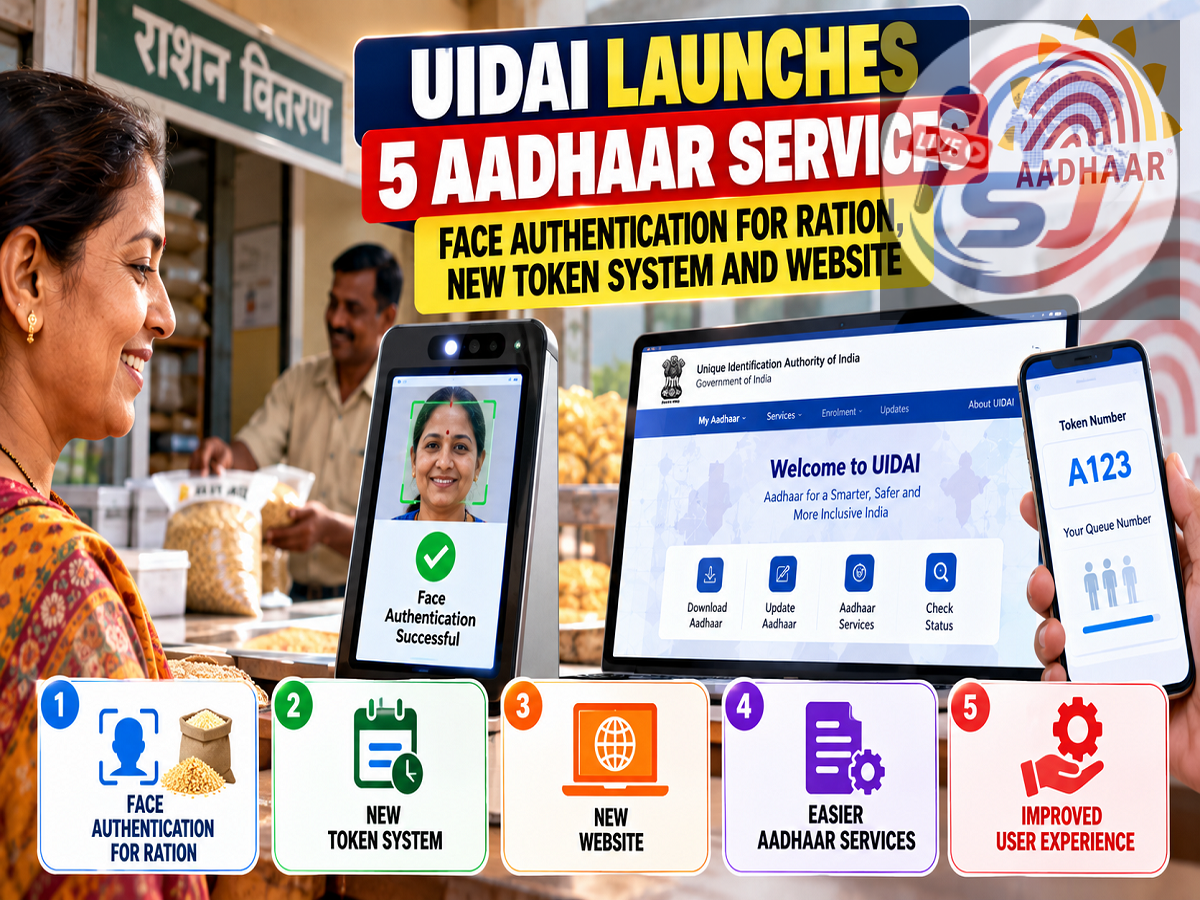
The Unique Identification Authority of India (UIDAI) has introduced five new Aadhaar-related initiatives aimed at making authentication and citizen services simpler, more accessible and easier to use.
The initiatives include face authentication for eligible e-PDS beneficiaries, a new token-management system for UIDAI offices, the Sub-AUA/Sub-KUA (Lite) framework, SWIK Portal 2.0 and a redesigned UIDAI website.
The measures were announced during the 17th Aadhaar Day celebrations at the 'Aadhaar Samvaad' programme held in Kolkata.
Among the most notable developments is the introduction of face authentication for the Public Distribution System. The facility could particularly help beneficiaries who experience difficulty with fingerprint-based authentication while collecting ration.
However, the new system should not be interpreted as an immediate nationwide replacement of fingerprints at every ration shop. The face-authentication facility is described as a consent-based, contactless authentication option that states and Union Territories can integrate with their e-PDS systems.
UIDAI Announces Five Major Aadhaar Initiatives
The latest Aadhaar initiatives focus on both ordinary users and organisations that rely on Aadhaar authentication.
The five key developments are:
-
Face authentication for e-PDS beneficiaries
-
Token Management System for UIDAI offices
-
Sub-AUA/Sub-KUA (Lite) framework
-
SWIK Portal 2.0
-
Redesigned UIDAI website
Together, these changes are intended to improve access to Aadhaar services while reducing some of the practical difficulties faced by citizens and institutions.
1. Face Authentication for Ration Beneficiaries
One of the biggest announcements concerns the electronic Public Distribution System (e-PDS).
UIDAI has worked with the Department of Food and Public Distribution (DFPD) and the National Informatics Centre (NIC) to introduce a face-authentication option for e-PDS beneficiaries.
Under this system, facial recognition can be used as an authentication method in applicable cases instead of relying only on fingerprint verification.
This could be particularly useful for people whose fingerprints are difficult to authenticate.
Why Can Fingerprint Authentication Sometimes Fail?
Fingerprint-based Aadhaar authentication can occasionally be difficult for some beneficiaries.
Elderly people, manual labourers and individuals whose fingerprints have become faint or difficult to capture may experience authentication problems.
For someone dependent on subsidised foodgrain, repeated biometric failures can create inconvenience.
Face authentication provides another digital method of establishing identity without requiring the beneficiary to place a finger on a scanner.
Is Face Authentication Now Mandatory for Ration?
No. The announcement should not be interpreted as saying that every ration beneficiary in India must now authenticate using their face.
The facility is described as consent-based and contactless.
States and Union Territories can integrate it into their respective e-PDS systems.
Therefore, the actual availability of face authentication can depend on whether the facility has been implemented in the beneficiary's state or Union Territory and at the relevant ration-distribution point.
Consumers should check the authentication options available locally rather than assuming the system has changed everywhere at once.
How Could Face Authentication Help Beneficiaries?
The biggest advantage is that it provides an alternative to fingerprint authentication.
If a beneficiary's fingerprint is not being captured successfully, face authentication could provide another way to complete Aadhaar-based identity verification where the facility is available.
It is also contactless, which means the individual does not need to touch a biometric fingerprint scanner for authentication.
The move can therefore improve accessibility for certain groups of beneficiaries.
2. New Token Management System at UIDAI Offices
UIDAI has also introduced a Token Management System for people visiting its state and regional offices for Aadhaar-related services.
The system is intended to manage visitors more efficiently and improve the experience of people who need offline assistance.
A token-based arrangement can help organise queues and direct visitors through the service process in a more structured manner.
This could be useful for people who cannot complete a particular Aadhaar-related task online or require direct assistance from UIDAI.
What Is the Objective of the Token System?
Aadhaar is used by a very large number of people, and offices handling citizen queries can receive substantial visitor traffic.
A structured token-management system can help offices handle this flow more efficiently.
Instead of an unorganised queue, visitors can be assigned and managed through a formal token mechanism.
The broader objective is to improve access to offline Aadhaar services and make visits to UIDAI offices more convenient.
3. Sub-AUA/Sub-KUA Lite Framework Introduced
The third initiative is more relevant to organisations than to individual Aadhaar holders.
UIDAI has introduced a Sub-AUA/Sub-KUA (Lite) framework for government organisations and eligible non-government entities that need Aadhaar authentication only on a relatively limited scale.
AUA refers to an Authentication User Agency, while KUA refers to a KYC User Agency.
Under a conventional arrangement, organisations using Aadhaar authentication may require specific technical infrastructure and integration.
The Lite framework is intended to make access easier for organisations with comparatively low authentication requirements.
Organisations May Not Need Separate Infrastructure
One of the important features of the Lite framework is the possibility of using the authentication infrastructure of an existing AUA or KUA.
This means an eligible organisation with limited Aadhaar-authentication requirements may not need to create an entirely separate authentication infrastructure from scratch.
That could lower the technical and operational burden for smaller or lower-volume eligible entities.
The organisation would still need to comply with the applicable Aadhaar rules, permissions and security requirements.
4. UIDAI Launches SWIK Portal 2.0
UIDAI has also launched SWIK Portal 2.0 for entities dealing with Aadhaar authentication proposals.
The upgraded portal is intended to make the application and approval workflow more digital and streamlined.
Eligible non-government entities can use the platform to submit relevant proposals electronically.
These proposals can then be forwarded online to the appropriate ministry or government department.
What Does SWIK Portal 2.0 Do?
The portal is aimed at simplifying the process associated with seeking approval for permitted Aadhaar-authentication use cases.
Instead of relying heavily on offline paperwork and communication, eligible entities can use a more structured online workflow.
The change is therefore mainly an administrative and institutional reform rather than a new service that an ordinary Aadhaar holder needs to use every day.
For citizens, its indirect benefit could come from more efficient implementation of approved Aadhaar-enabled services.
5. UIDAI Launches Redesigned Aadhaar Website
The fifth major development is a redesigned UIDAI website.
The new website has been developed to make Aadhaar-related information, documents, assistance and digital services easier to find.
Accessibility has received particular attention.
The redesigned platform includes features such as screen-reader support, adjustable font sizes, improved colour contrast and keyboard navigation.
These additions can make the website easier to use for people with different accessibility requirements.
Aadhaar Website Supports 13 Languages
Language accessibility is another major feature of the redesigned platform.
According to the supplied information, the website currently supports 13 languages, including Hindi and English.
There are plans to expand language support further to 23 languages.
Greater language coverage can make Aadhaar-related information easier to understand for people who are more comfortable using regional languages.
What Aadhaar Users Should Know
For most Aadhaar holders, the most immediately relevant announcement is likely to be face authentication for ration-related e-PDS services.
But users should keep one important distinction in mind.
The introduction of the technology does not mean every Fair Price Shop across India will instantly stop using fingerprints.
Implementation can depend on the state or Union Territory and integration with the local e-PDS infrastructure.
Similarly, the Token Management System is primarily relevant to people visiting UIDAI offices, while Sub-AUA/Sub-KUA (Lite) and SWIK Portal 2.0 are largely aimed at institutions using Aadhaar authentication.
The redesigned website, meanwhile, has broader relevance for virtually anyone looking for Aadhaar information or services online.
Aadhaar Users Should Remain Alert to Fraud
Whenever new Aadhaar services are introduced, fraudulent messages can also circulate claiming that users must immediately update their Aadhaar or face suspension.
People should be cautious about such claims.
Never disclose an OTP, banking password, UPI PIN, debit-card PIN or other financial credentials to someone claiming to provide an Aadhaar service.
Users should rely on authorised UIDAI channels for Aadhaar-related updates and services.
Face authentication for ration should also not be confused with a request to send a selfie, photograph or Aadhaar copy to an unknown person through WhatsApp or another messaging application.
Five New Aadhaar Initiatives at a Glance
| UIDAI Initiative | What It Is Designed to Do |
|---|---|
| e-PDS Face Authentication | Provides a consent-based contactless authentication option for ration beneficiaries |
| Token Management System | Improves management of visitors at UIDAI offices |
| Sub-AUA/Sub-KUA (Lite) | Simplifies Aadhaar authentication access for eligible low-volume entities |
| SWIK Portal 2.0 | Streamlines submission and processing of eligible authentication proposals |
| Redesigned UIDAI Website | Improves accessibility, navigation and multilingual access |
Bottom Line
UIDAI's five new initiatives are designed to make Aadhaar services more accessible for both citizens and organisations.
The most consumer-focused development is face authentication for e-PDS beneficiaries, which can provide an alternative where fingerprint authentication is difficult. Importantly, the system is consent-based and its availability will depend on implementation by states and Union Territories.
The new Token Management System aims to improve visits to UIDAI offices, while the Sub-AUA/Sub-KUA (Lite) framework and SWIK Portal 2.0 are intended to simplify Aadhaar authentication processes for eligible organisations.
Meanwhile, UIDAI's redesigned website offers improved accessibility features and currently supports 13 languages, with expansion to 23 languages planned.
Together, the initiatives indicate a shift toward making Aadhaar authentication and related services more accessible, digital and user-friendly without relying on a single authentication method for every situation.