
Smart Soil Testing 2026: Farmers Can Check Soil Health in 5 Minutes Using Mobile Devices, Know How It Works
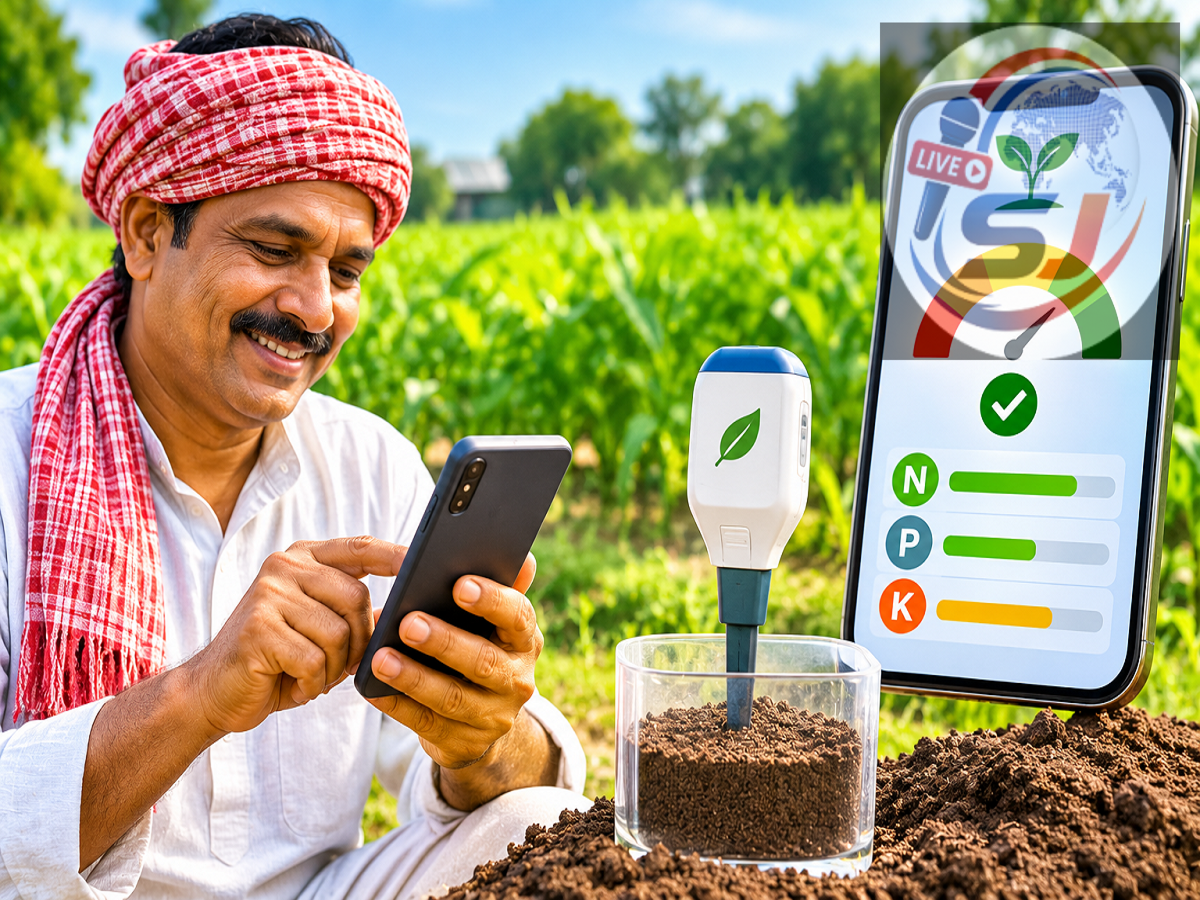
Smart Soil Testing Technology 2026: Indian farmers may soon find it easier to understand the health of their agricultural land without waiting several days for laboratory reports. Portable soil-testing devices connected to mobile applications can analyse small soil samples and provide information about nutrients, soil quality and fertiliser requirements within minutes.
Prime Minister Narendra Modi recently highlighted this technology while addressing the Kisan Tak Bharat Agriculture Conference at Bharat Mandapam in New Delhi on November 12, 2026. He explained how artificial intelligence (AI), advanced sensors and mobile-based devices could help farmers make better decisions about crop selection and fertiliser application.
According to an Aaj Tak report published on November 15, 2026, several soil-testing devices are already available in India. These include NutriSens, developed by Maharashtra-based Proximal Soilsens Technologies, IIT Kanpur's Bhu-Parikshak and Soilo Essence 5.
Such innovations could help farmers reduce unnecessary fertiliser expenses, monitor soil nutrients and adopt more sustainable agricultural practices.
AajTak+1
PM Modi Highlights Mobile-Based Soil Testing Technology
During the agriculture conference, Prime Minister Modi discussed the importance of understanding soil requirements before applying fertilisers.
He pointed out that farmers sometimes use fertilisers based on traditional habits or recommendations from neighbouring farmers rather than the actual nutrient requirements of their fields.
This practice can increase cultivation expenses and may negatively affect soil quality over time.
The Prime Minister highlighted emerging sensor-based technologies that can provide soil information through mobile applications.
With suitable equipment, farmers can analyse a small soil sample and receive guidance about which crops may be suitable and what fertilisers could be required.
The technology combines portable testing instruments, digital applications and, in some systems, AI-assisted analysis.
Press Information Bureau
NutriSens Soil Testing Device: Check Soil Quality With Just 1 Gram of Soil
Scientist’s Device Helps Farmers Check Soil Health in Just a Few Minutes
One of the innovations attracting attention is NutriSens, a compact soil-testing device developed by Dr Rajul Patkar, co-founder of Proximal Soilsens Technologies.
The device is designed to simplify soil analysis and make testing accessible to farmers without requiring them to visit a laboratory for every routine assessment.
According to NITI Aayog's Frontier Tech platform, NutriSens can analyse approximately one gram of soil and generate results in less than five minutes.
The information is displayed through a connected mobile application, helping users understand soil conditions and potential fertiliser requirements.
NITI Frontier Tech Hub
How Does NutriSens Soil Testing Technology Work?
NutriSens uses a sensor-based testing process to measure important soil properties.
A small soil sample is collected and prepared using the equipment supplied with the testing kit.
The prepared sample interacts with specialised sensor strips, which detect chemical properties associated with soil nutrients.
The electronic reader processes the signals and sends the results to a connected mobile application.
The system can then display soil health information and recommendations.
Importantly, the smartphone itself does not directly analyse soil. The testing is performed by the separate sensor device, while the phone displays and helps interpret the results.
Which Soil Nutrients Can NutriSens Measure?
The manufacturer states that NutriSensX measures six important soil parameters.
| Soil Parameter |
Why It Matters |
|---|---|
| pH Level |
Indicates soil acidity or alkalinity |
| Electrical Conductivity (EC) |
Helps assess soluble salt concentration |
| Nitrate |
Provides information about an available form of nitrogen |
| Phosphate |
Helps assess phosphorus availability |
| Potassium |
Important for plant growth and crop development |
| Organic Carbon |
Indicates an important component of soil fertility |
These measurements can help farmers understand whether their fields require changes in nutrient management.
However, fertiliser recommendations should also consider crop type, expected yield, local conditions and other soil characteristics.
SoilSens
NutriSens Price: How Much Does the Device Cost?
According to the Aaj Tak report, the NutriSens device is priced at approximately ₹35,000 to ₹60,000, depending on the product configuration.
NITI Aayog's Frontier Tech platform reports that the technology has reached an estimated 10,000 to 15,000 farmers across eight Indian states.
It also states that a device can perform approximately 3,000 tests annually and that the reported cost of an individual soil test can be reduced from around ₹500 to ₹300.
These are reported figures rather than a guarantee of identical costs or performance for every user.
AajTak+1
IIT Kanpur's Bhu-Parikshak Can Test Soil in 90 Seconds
Chemical Engineering Department
Another notable innovation is Bhu-Parikshak, a portable soil-testing device developed by IIT Kanpur.
Introduced in 2021, the device uses Near-Infrared Spectroscopy technology to analyse soil characteristics.
Unlike certain chemical-based testing systems, Bhu-Parikshak uses near-infrared light to examine a prepared dry soil sample.
The device requires approximately five grams of dry soil and can produce an analysis in around 90 seconds.
Results can be accessed through a mobile application using a connected device.
This approach aims to reduce the time and effort involved in obtaining basic soil information.
Soilo Essence 5: Another Portable Soil Testing Option
Soilo Essence 5 is another device mentioned in the report.
It is designed to examine soil using 16 testing parameters and reportedly takes approximately eight minutes to generate results.
The device can connect to a mobile phone through Bluetooth, allowing farmers or agricultural service providers to access the report digitally.
According to the report, the system also supports offline operation, which may be useful in agricultural areas with limited internet connectivity.
Its exact selling price was not provided in the cited report.
Comparison of Portable Soil Testing Devices
| Device |
Sample/Testing Method |
Reported Testing Time |
|---|---|---|
| NutriSens |
Approximately 1 gram of soil; sensor-based analysis |
Under 5 minutes |
| Bhu-Parikshak |
Approximately 5 grams of dry soil; near-infrared technology |
Around 90 seconds |
| Soilo Essence 5 |
Portable testing across 16 parameters |
Around 8 minutes |
The devices use different testing methods, so their speed alone should not be used to determine which provides the most appropriate results for a particular farm.
How Can Soil Testing Help Farmers Reduce Fertiliser Expenses?
Soil testing helps farmers understand the nutrient status of their agricultural land.
Without reliable information, fertilisers may be applied in quantities that are either insufficient or excessive.
Excessive fertiliser use can increase cultivation costs and contribute to environmental problems, while nutrient deficiencies can restrict crop growth.
With suitable testing and agronomic advice, farmers can make more informed decisions about nutrient application.
For example, if a soil test indicates that a field already contains sufficient potassium, the farmer may not need to apply the same quantity of potassium fertiliser as in previous seasons.
Similarly, identifying deficiencies can help farmers choose an appropriate nutrient management strategy.
However, soil-test results must be interpreted correctly. A single reading does not automatically establish the exact fertiliser requirement for every crop.
Can a Small Soil Sample Represent an Entire Field?
Although modern devices can analyse very small samples, collecting representative soil remains essential.
Soil conditions may vary across different parts of the same field due to irrigation, previous crops, fertiliser application and other factors.
Agricultural experts generally recommend collecting samples from multiple representative locations and preparing a composite sample according to the testing method.
Farmers should follow the manufacturer's instructions and consult agricultural specialists when necessary.
Portable testing devices may also require calibration and comparison with laboratory measurements to establish their reliability under local soil conditions.
What Should Farmers Check Before Buying a Soil Testing Device?
Farmers and agricultural service providers should examine the technical specifications before investing in portable testing equipment.
Important considerations include the number of soil parameters measured, accuracy, calibration requirements, cost per test, consumable availability and mobile application compatibility.
It is also advisable to check whether the manufacturer has validated the device against recognised laboratory testing methods.
India's soil health assessment framework includes several important parameters, such as pH, electrical conductivity, organic carbon and essential macro- and micronutrients.
A device measuring only a limited number of parameters may be useful for specific purposes but may not replace a comprehensive laboratory soil analysis.
Digital Agriculture Could Make Farming More Efficient
The development of portable soil-testing equipment reflects the growing use of technology in Indian agriculture.
AI-assisted advisory systems, digital soil reports and compact sensors can help make agricultural information more accessible.
Such tools may be particularly useful for farmer producer organisations, agricultural entrepreneurs, cooperatives and rural service providers that conduct testing for multiple farmers.
However, affordability, technical training, reliable calibration and access to expert advice will remain important for wider adoption.
Final Takeaway
Portable soil-testing devices such as NutriSens, Bhu-Parikshak and Soilo Essence 5 demonstrate how modern technology can simplify agricultural soil analysis.
NutriSens can reportedly analyse a one-gram sample in under five minutes, while IIT Kanpur's Bhu-Parikshak uses near-infrared technology to generate results in approximately 90 seconds.
These innovations could help farmers make better-informed decisions about fertiliser application, soil management and crop planning.
However, the accuracy and usefulness of the results depend on correct sampling, device calibration and appropriate interpretation.