
SEBI Warns Investors Against WhatsApp Stock Tip Scams: How Fake Trading Groups Can Steal Your Money
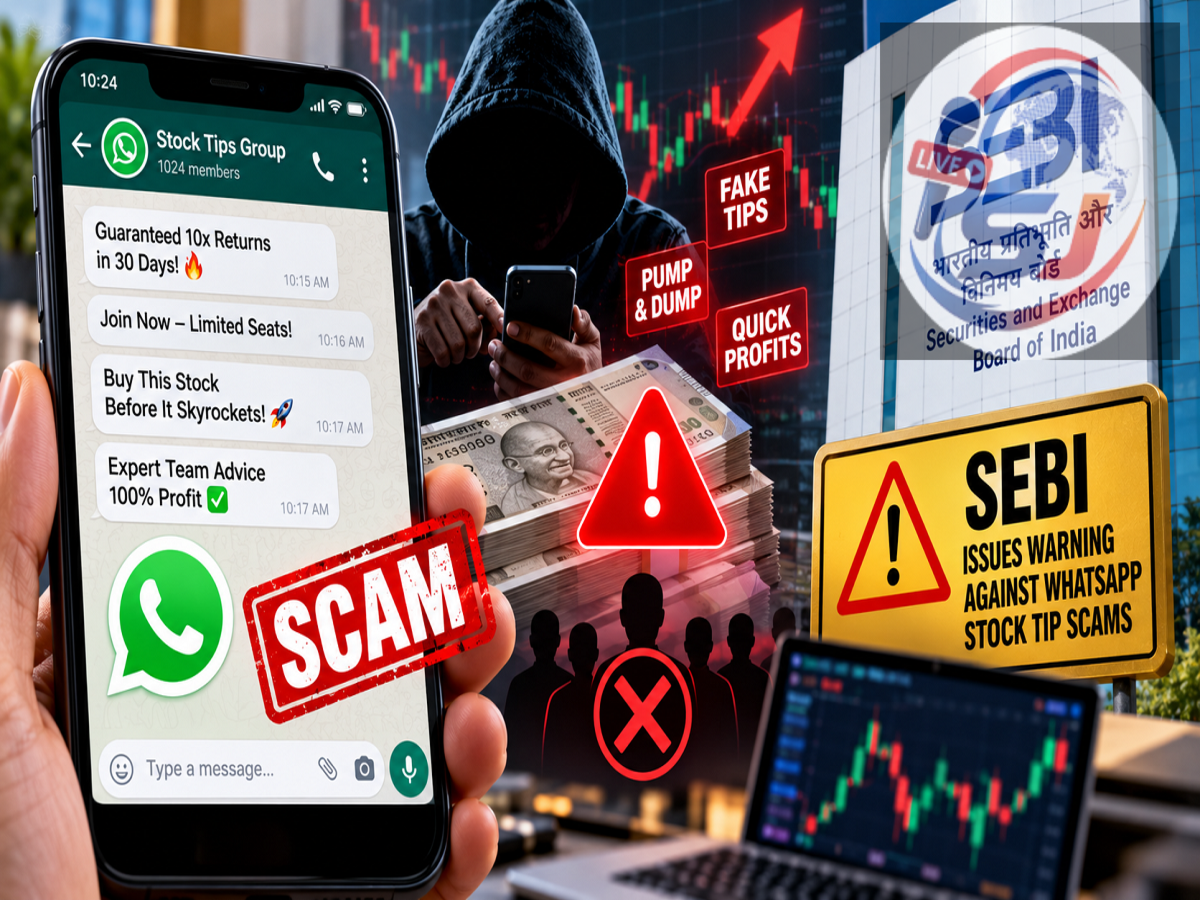
SEBI WhatsApp Fraud Alert 2026: If you regularly receive WhatsApp messages promising free stock market tips, guaranteed profits or exclusive investment opportunities, you should exercise caution. India's securities market regulator, the Securities and Exchange Board of India (SEBI), has reportedly warned investors about fraudulent investment groups that use social media platforms to promote unauthorised trading advice and suspicious investment schemes.
According to a report published on October 23, 2026, SEBI issued an alert on Thursday, October 22, highlighting the risks associated with invitation-only WhatsApp groups operated by individuals claiming to be experienced market professionals.
These groups often attract investors with free recommendations, impressive profit screenshots and promises of unusually high returns.
However, the individuals behind some of these operations may not be registered with SEBI, and their activities may involve attempts to obtain investors' money or sensitive financial information.
The warning is particularly important for new investors who rely on social media for stock market information.
SEBI Alert: Why Free WhatsApp Stock Tips Can Be Dangerous
Stock market discussions have become increasingly common on WhatsApp, Telegram, Instagram and other digital platforms.
While investors can legitimately exchange general market information, problems arise when unknown individuals begin providing specific trading recommendations, promising profits or directing members towards unfamiliar trading applications.
According to the reported SEBI warning, certain fraudulent groups present themselves as investor education communities.
They may claim that their services are completely free and that their only objective is to help ordinary people understand the stock market.
However, the real intention in some cases may be to build trust before persuading participants to transfer funds, disclose confidential information or trade through unauthorised platforms.
Investors should remember that free advice is not automatically reliable or legally authorised.
A person offering investment recommendations may be subject to SEBI registration requirements depending on the nature of the activity.
How Fraudulent WhatsApp Trading Groups Operate
The source report describes a pattern in which scammers create private, invitation-only WhatsApp communities.
These groups may be operated through unfamiliar or international mobile numbers.
The administrators often introduce themselves as professional traders, research analysts or representatives of investment organisations.
Initially, they may share general stock market commentary, educational messages and apparently successful trading recommendations.
The purpose is to make the group appear knowledgeable and trustworthy.
Once members begin following the discussions, administrators may promote specific shares, encourage frequent trading or introduce a separate investment platform.
In more serious cases, users may be asked to deposit money into accounts controlled by fraudsters.
Some fake trading platforms display artificial profits to encourage further deposits, even when no genuine securities transactions have taken place.
What Is Astroturfing? SEBI Highlights a Common Scam Technique
One of the tactics discussed in the report is known as astroturfing.
Astroturfing involves creating the false appearance of genuine public support or independent endorsements.
In the context of investment fraud, scammers may use several coordinated accounts to make a trading group appear successful and credible.
For example, one participant may post a screenshot claiming to have earned a substantial profit.
Another may praise the group's administrator for providing an accurate stock recommendation.
Several additional accounts may then share similar messages, creating the impression that numerous independent investors are making money.
However, these accounts may actually be controlled by the same group of fraudsters or their associates.
This manufactured social proof can influence inexperienced investors who assume that positive feedback from multiple participants must be genuine.
The important lesson is that screenshots, testimonials and group messages are not reliable evidence of actual trading performance.
Why Scammers Share Fake Profit Screenshots
Fraudulent investment groups frequently use images showing unusually large trading profits.
These screenshots may display account balances, daily gains or supposedly successful transactions.
However, such images can be edited or generated using fabricated trading interfaces.
Even genuine-looking transaction records do not establish that a person consistently earns profits or that the investment platform is legitimate.
Scammers may use these images to create a fear of missing out, commonly known as FOMO.
When group members repeatedly see claims of large returns, they may feel pressured to invest quickly before an apparent opportunity disappears.
This emotional pressure can lead people to skip important checks.
No genuine stock market investment can guarantee consistent profits without risk.
Fake WhatsApp Groups May Reappear After Being Banned
The report also highlights another technique used by fraudulent group operators.
When a suspicious WhatsApp group is removed or blocked, its administrators may contact existing members and invite them to join a replacement group.
The message may claim that the previous community was closed because of stricter social media policies or technical problems.
Members are then encouraged to continue receiving free stock recommendations through a new invitation link.
This approach allows scammers to maintain contact with potential victims even after their earlier group becomes unavailable.
Investors should not assume that a replacement group is legitimate simply because they were previously part of the original community.
Repeated changes in group names, administrators, mobile numbers or invitation links can be warning signs.
Seven Warning Signs of a Fake Stock Market WhatsApp Group
| Warning Sign |
Why Investors Should Be Careful |
|---|---|
| Guaranteed or unusually high returns |
Market investments cannot promise risk-free profits |
| Unknown administrators |
Their identity and regulatory status may be difficult to verify |
| Fake-looking profit screenshots |
Images and transaction records can be manipulated |
| Pressure to invest immediately |
Urgency may prevent proper verification |
| Requests to install unfamiliar trading apps |
The platform may be fraudulent or unsafe |
| Requests to transfer funds to personal accounts |
Money may not reach a legitimate regulated intermediary |
| Demands for login details or OTPs |
Sensitive information can be used to compromise accounts |
Not every investment discussion group is fraudulent, but the presence of several warning signs should prompt additional caution.
How to Check Whether a Stock Market Adviser Is Registered With SEBI
Before acting on paid investment advice or specific recommendations from an unfamiliar individual, investors should verify the person's regulatory status.
SEBI maintains information about registered market intermediaries, including investment advisers, research analysts and stockbrokers.
Investors can visit the official SEBI website to access regulatory information and intermediary registration details.
It is important to distinguish between different categories of financial service providers.
A registered stockbroker facilitates securities transactions, while registered investment advisers and research analysts perform different regulated functions.
Registration in one category does not automatically authorise an individual or organisation to provide every type of investment service.
Investors should also confirm that the name, registration number, contact details and website of the person or entity match official records.
Fraudsters sometimes impersonate genuine registered intermediaries.
Therefore, seeing a SEBI registration number in a WhatsApp message is not sufficient proof of legitimacy.
Why You Should Avoid Unknown Trading Apps
Some investment scams involve directing victims to download trading applications through links shared in private messages.
These applications may imitate genuine brokerage platforms.
They can display market prices, portfolio balances and apparently profitable trades to create an illusion of legitimate investing.
However, the displayed transactions may not correspond to actual orders executed on a recognised stock exchange.
Investors may discover the fraud only when they attempt to withdraw their funds.
Scammers may then demand additional payments under the pretext of taxes, withdrawal charges or account verification.
Investors should avoid downloading financial applications from unknown links or unofficial websites.
Before opening an account, they should independently verify the brokerage's identity, registration and official application details.
What Information Should Investors Never Share?
Fraudsters may attempt to collect sensitive financial information after gaining a group member's trust.
Investors should never share trading account passwords, one-time passwords, transaction PINs or other confidential authentication credentials with unknown individuals.
They should also avoid providing unnecessary details about their portfolio holdings, account balances or identification documents.
A genuine intermediary may require information through secure official processes, but investors should not disclose such details through unsolicited WhatsApp conversations.
Any request to transfer money to a personal bank account for stock trading should be treated with particular caution.
What Should You Do If You Have Already Joined a Suspicious Group?
Joining a WhatsApp group does not automatically mean that an investor's bank account or trading account has been compromised.
However, anyone who has interacted with a suspicious group should review the situation carefully.
If no money or confidential information has been shared, the investor can leave the group, block suspicious contacts and report the group through WhatsApp's reporting features.
If trading credentials have been disclosed, the investor should immediately change passwords and contact the legitimate broker through official channels.
If funds have been transferred, the investor should contact the relevant bank or payment provider without delay.
Preserving screenshots, transaction references, mobile numbers and chat messages may help investigators examine the incident.
Where Can Investors Report Stock Market Fraud?
Investors can report suspected securities market misconduct through SEBI's official complaint mechanisms.
SEBI's SCORES investor grievance portal is available for eligible securities market complaints.
For suspicious investment offers, investors can also use SEBI's investor information resources to identify appropriate reporting channels.
Where the incident involves cyber-enabled financial fraud or unauthorised transfers, victims should promptly call India's cybercrime helpline at 1930.
A complaint can also be submitted through the National Cyber Crime Reporting Portal.
Prompt reporting may help authorities investigate fraudulent transactions and potentially limit further financial damage.
However, recovery of transferred money is not guaranteed.
How Investors Can Protect Their Savings
Investors should approach stock market recommendations with a clear understanding of risk.
Before purchasing shares, they should consider the company's financial performance, business prospects, valuation and suitability for their investment goals.
Recommendations from unknown social media accounts should never replace independent research.
Investors should also avoid making decisions solely because other members of a group claim to have earned profits.
Diversification, appropriate position sizing and long-term financial planning can help manage certain investment risks, although they cannot eliminate the possibility of losses.
Most importantly, investors should use verified financial platforms and independently confirm the identity of anyone offering investment services.
Final Takeaway: Free Stock Tips Can Become an Expensive Trap
The reported SEBI warning highlights how fraudulent WhatsApp communities can use fake testimonials, fabricated profit screenshots and impersonation tactics to target retail investors.
By presenting themselves as experienced market professionals, scammers may persuade people to follow unauthorised trading recommendations or transfer money through suspicious platforms.
Investors should be particularly cautious of guaranteed returns, unknown trading applications and requests for confidential account information.
Checking regulatory registration, using official brokerage channels and reporting suspicious activity can help reduce the risk of financial fraud.
Disclaimer: This article is based on the supplied October 23, 2026, news report. The specific October 22 SEBI alert has not been independently verified against the original regulatory communication. This article is for investor awareness only and does not constitute investment advice. Securities market investments involve financial risk.