
PUC Certificate Rules 2026: Check Your Car or Bike's Expiry Date Online and Avoid a ₹10,000 Fine
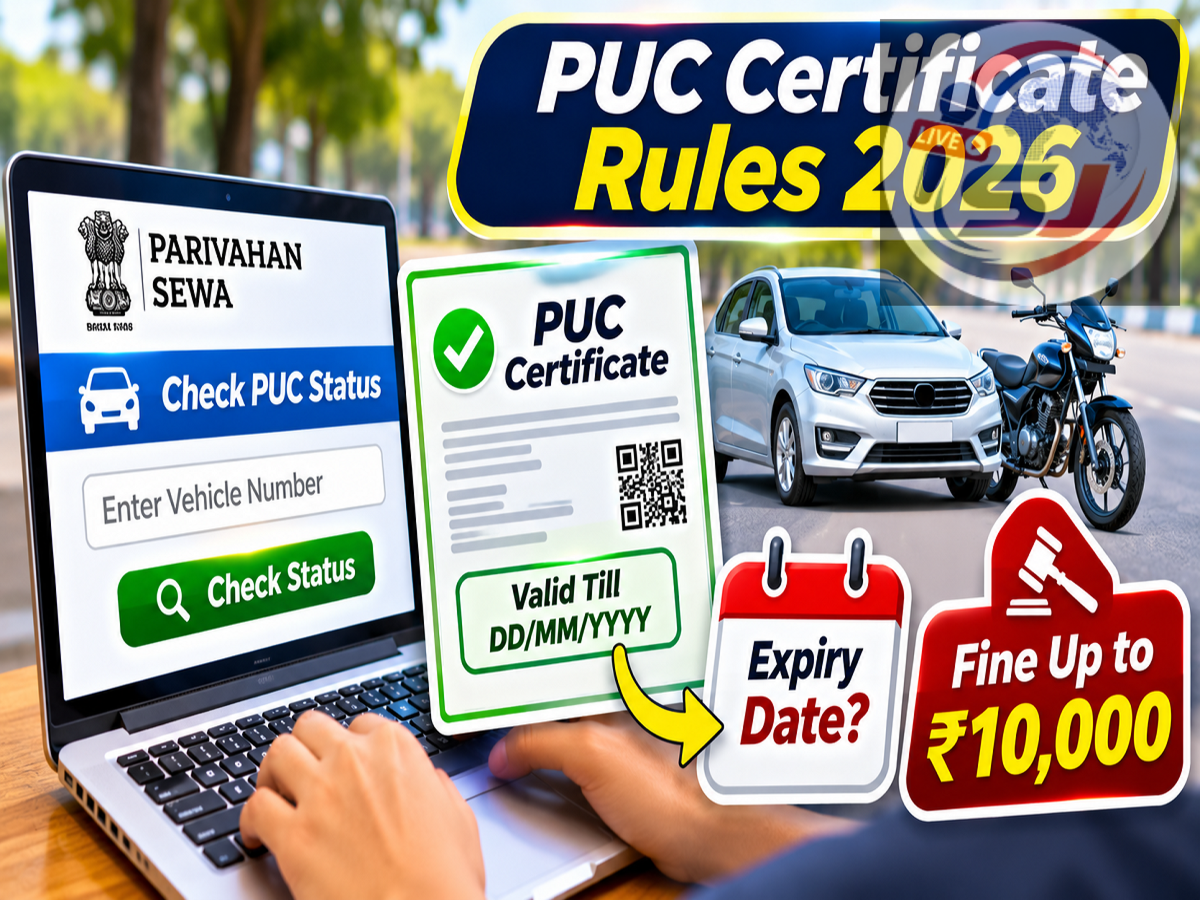
PUC Certificate New Rules 2026: Vehicle owners across India should pay attention to the latest changes concerning Pollution Under Control (PUC) certificates. The Ministry of Road Transport and Highways has revised the validity framework for vehicle pollution certificates in November 2026, introducing different validity periods based on emission standards, vehicle age and usage category.
Under the revised framework, eligible BS-VI private vehicles can receive PUC certificates valid for up to three years. Meanwhile, vehicles complying with older emission standards may require more frequent testing.
The changes make it important for car and motorcycle owners to check their existing PUC certificate expiry dates and understand when renewal is required.
Fortunately, vehicle owners can verify their PUC details online through the government's Parivahan portal without visiting a pollution testing centre.
What Has Changed in PUC Certificate Rules in November 2026?
The revised rules introduce a system that determines PUC certificate validity according to a vehicle's Bharat Stage emission category, age and whether it is used privately or commercially.
One of the biggest changes concerns BS-VI vehicles. Eligible private vehicles up to six years old can receive certificates valid for three years, while older BS-VI vehicles have shorter validity periods.
The rules also specify different renewal intervals for vehicles complying with BS-I, BS-II, BS-III and BS-IV emission standards.
Another important change concerns early renewals. Vehicle owners who renew their certificates during the final 10 days before expiry can retain the benefit of the remaining validity period.
PUC Certificate Validity Chart 2026: Check the New Rules
The revised framework specifies the following certificate validity periods for different vehicle categories.
| Vehicle category | PUC certificate validity |
|---|---|
| BS-I, BS-II and BS-III vehicles | 3 months |
| BS-IV vehicles | 6 months |
| BS-VI private vehicles up to 6 years old | 3 years |
| BS-VI private vehicles over 6 and up to 10 years old | 1 year |
| BS-VI private vehicles over 10 years old | 6 months |
| BS-VI commercial vehicles up to 6 years old | 2 years |
| BS-VI commercial vehicles over 6 and up to 10 years old | 1 year |
| BS-VI commercial vehicles over 10 years old | 6 months |
Important: Not every BS-VI vehicle qualifies for three-year validity. The applicable period depends on the vehicle's age and usage category.
Vehicle owners should always check the expiry date recorded on their current PUC certificate.
How to Check PUC Certificate Validity Online Using Your Mobile
Checking your vehicle's PUC certificate status is a simple online process.
You will generally need your vehicle registration number and the last five characters of its chassis number.
Follow these steps:
-
Open the official Parivahan PUC portal at https://puc.parivahan.gov.in/.
-
Select the PUC Certificate option.
-
Enter your complete vehicle registration number.
-
Provide the last five characters of the chassis number.
-
Enter the CAPTCHA displayed on the screen.
-
Click the option to view your PUC details.
-
Check the certificate number, issue date and expiry date.
-
Download or print the certificate if the portal provides that option.
The online service allows vehicle owners to verify their recorded PUC status without visiting a testing centre merely to check the expiry date.
If the certificate has expired, the vehicle must undergo the applicable pollution test at an authorized testing centre to obtain a new certificate.
What Happens If You Renew Your PUC Certificate Before Expiry?
The amended regulations clarify how the validity period of a renewed certificate will be calculated.
If a vehicle owner renews the certificate during the final 10 days before its expiry, the renewed certificate becomes effective from the expiry date of the existing certificate.
For example, suppose a PUC certificate expires on December 20, 2026. If the owner renews it on December 15, the new validity period will begin on December 20 rather than December 15.
However, if the certificate expires and the owner renews it afterward, the new validity period begins from the actual renewal date.
This provision helps vehicle owners renew their certificates shortly before expiry without losing the remaining validity period.
Will Existing PUC Certificates Automatically Receive Extended Validity?
No. Vehicle owners with certificates issued before the revised regulations came into force should not assume their expiry dates have automatically changed.
The government has introduced a transitional provision under which the revised validity periods apply to previously issued certificates from their first renewal after the amendment takes effect.
The changes were notified through the Central Motor Vehicles (Sixteenth Amendment) Rules, 2026, dated November 13, and came into force on November 16, 2026.
Until renewal, vehicle owners should follow the expiry date recorded on their existing certificate unless an official direction states otherwise.
Can You Be Fined ₹10,000 for an Expired PUC Certificate?
Driving without a valid PUC certificate can attract penalties under the Motor Vehicles Act.
Section 190(2) provides for penalties relating to violations of prescribed road safety, noise and air pollution standards.
Depending on the violation and applicable enforcement provisions, penalties can include a fine of up to ₹10,000 and other legal consequences.
Vehicle owners should therefore avoid driving with an expired certificate and complete the required emission test before the validity period ends.
Why Is a PUC Certificate Important?
A Pollution Under Control certificate confirms that a vehicle's emissions were within the prescribed limits when it underwent testing.
The certificate is an important part of India's vehicle pollution monitoring system.
Regular emission testing can help identify vehicles producing excessive pollutants because of engine problems, poor maintenance or malfunctioning emission-control equipment.
Although the revised rules allow longer intervals for qualifying newer BS-VI vehicles, owners must still maintain their vehicles properly and comply with emission standards.
Conclusion
The November 2026 PUC rule changes introduce different certificate validity periods based on emission standards, vehicle age and usage.
Eligible BS-VI private vehicles can qualify for validity of up to three years, while BS-IV vehicles have six-month validity and BS-I to BS-III vehicles require renewal every three months.
Vehicle owners can check their certificate expiry dates through the official Parivahan PUC portal using their registration and chassis details.
Checking the expiry date in advance and renewing the certificate on time can help avoid unnecessary penalties.
Disclaimer: Vehicle owners should follow the expiry date recorded on their current certificate and verify the applicable rules through the official Parivahan portal.