
New Calling Rules From November 1, 2026: Unknown Callers' Names to Appear Without Truecaller, Check CNAP Details
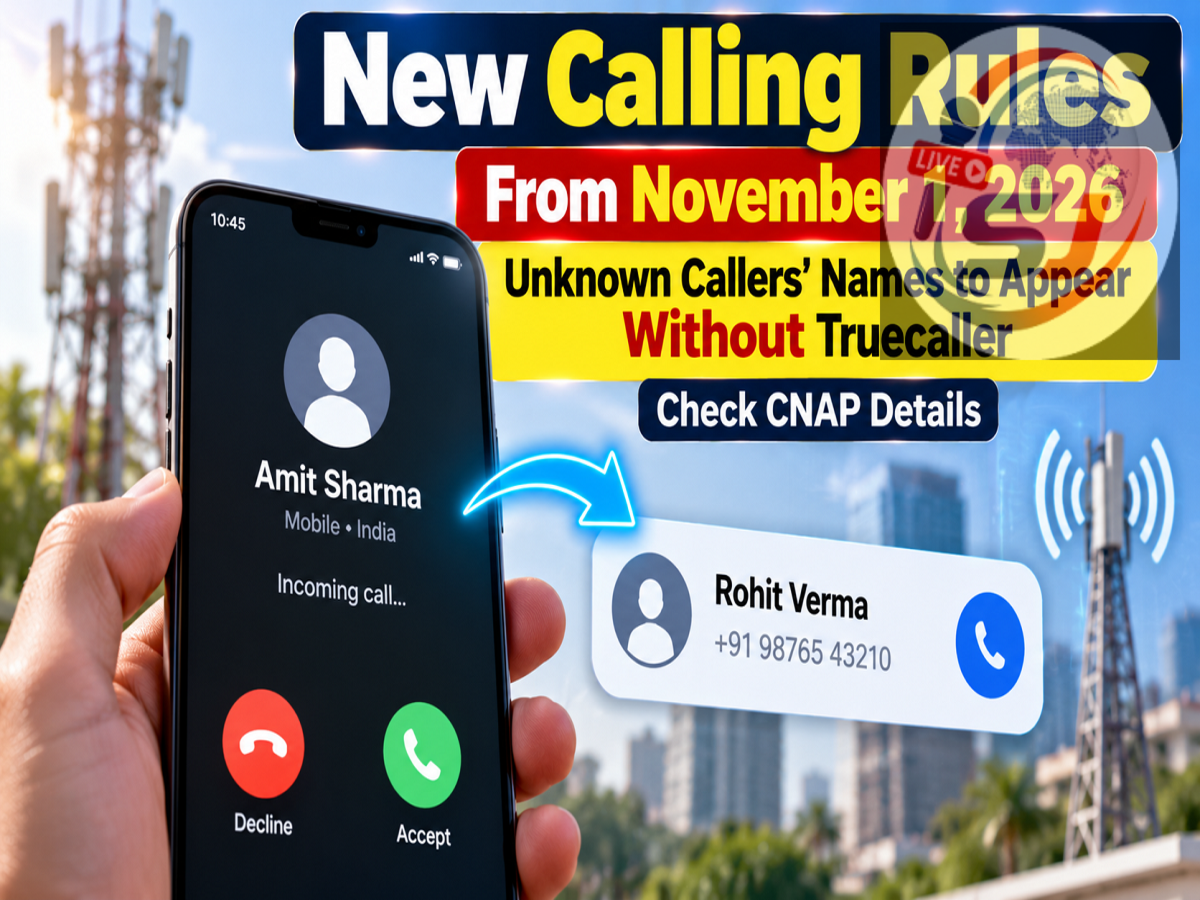
Mobile Calling Rules 2026: Millions of mobile phone users in India are set to experience a major change in how incoming calls appear on their smartphones. From November 1, 2026, telecom operators have been directed to introduce a new caller identification facility that can display the registered name of a person calling from an unfamiliar number.
The facility, known as Calling Name Presentation (CNAP), is being introduced under directions issued by the Department of Telecommunications (DoT).
Unlike conventional caller identification applications, CNAP uses subscriber information maintained by telecom service providers. This means users may be able to identify unfamiliar callers without installing third-party applications such as Truecaller.
The initiative is intended to improve transparency in telephone communications and help consumers make more informed decisions before answering unknown calls.
However, the name displayed through CNAP should not be treated as an absolute guarantee that a caller is genuine.
New Caller ID Rules: What Changes From November 1?
According to the DoT circular dated October 13, 2026, licensed telecom operators must introduce CNAP services across eligible 4G and newer-generation mobile networks from November 1.
The system will display the incoming telephone number along with the caller's name, where applicable.
Major telecom companies, including Reliance Jio, Bharti Airtel, Vodafone Idea and BSNL, fall within the scope of the directions for their covered services.
CNAP Rules 2026: Key Highlights
| Particulars |
Details |
|---|---|
| New service |
Calling Name Presentation (CNAP) |
| Implementation date |
November 1, 2026 |
| Issuing authority |
Department of Telecommunications |
| Networks initially covered |
4G and newer-generation mobile networks |
| Main function |
Display caller name alongside phone number |
| Source of caller name |
Telecom operator's subscriber records |
| Separate application required |
No |
| Separate activation request |
Not required under the direction |
| Main objective |
Improve caller identification and help address fraud concerns |
What Is CNAP and How Does It Work?
CNAP is a network-based caller identification facility designed to display the name associated with an incoming telephone number.
Currently, when someone receives a call from an unsaved number, the screen may display only the telephone number unless a caller identification service provides additional information.
Under CNAP, the recipient's telecom network can obtain the caller-name information from the originating operator's subscriber database.
For example, suppose a person receives a call from an unfamiliar Indian mobile number.
Instead of displaying only the number, the phone may also show the name recorded against that connection in the telecom operator's subscriber records.
This information is generally linked to the details provided when the mobile connection was obtained.
However, the registered subscriber's name may not always be the name of the person physically using the phone at that moment.
What Name Will Appear When Someone Calls?
The DoT framework establishes different display arrangements depending on whether the incoming number is already saved.
| Incoming Call Situation |
Expected Display |
|---|---|
| Number saved in contacts |
Name saved by the recipient |
| Unknown domestic mobile number |
Name recorded in the originating operator's subscriber database |
| Unsaved international number |
International Call |
| Eligible caller using CLIR |
Caller name presentation restricted |
The name saved in the recipient's contact list takes priority over the operator-recorded name.
Therefore, if someone has saved a family member's number under a nickname, the saved nickname is expected to appear rather than the registered subscriber name.
Will Truecaller Be Required After November 1?
No. The CNAP facility is designed to operate through telecom networks rather than depending on a separate caller identification application.
This means eligible users may receive caller-name information without installing Truecaller or a similar third-party service.
However, CNAP and third-party caller identification applications are not identical.
Third-party applications may offer additional features such as spam warnings, community-generated reports and call management tools.
CNAP primarily focuses on presenting caller-name information associated with telecom subscriber records.
Consequently, the introduction of CNAP does not automatically mean that every feature of a third-party caller identification app will become unnecessary.
Will CNAP Work on Jio, Airtel, Vi and BSNL?
The directions apply to telecom service providers holding the relevant access-service licences or authorisations.
This includes major operators serving Indian mobile subscribers.
The implementation requirement covers eligible 4G and higher-generation wireless networks across service areas.
Users should nevertheless understand that the availability of a new telecom feature can depend on network compatibility, technical implementation and the operator's rollout arrangements.
The November 1 requirement should not be interpreted as confirmation that every device will display a caller's name under every possible calling condition.
Will the New Caller Name Facility Work on 2G and 3G Phones?
The initial DoT direction specifically covers 4G and newer-generation wireless networks.
Implementation on 2G, 3G and fixed-line telephone networks will be considered separately.
Therefore, users of older network technologies should not assume that CNAP will become available to them on November 1.
The government has not established a common implementation date for those older services in the cited circular.
Will Users Need to Activate CNAP or Download an App?
The DoT direction requires operators to provide the service without a separate request from individual subscribers.
As a result, ordinary mobile users are not expected to submit a special application merely to receive CNAP.
They should also be cautious about websites or messages claiming that a payment, OTP or additional app installation is necessary to activate the service.
Users should rely on their telecom operator's official communications for any device-specific information.
Can Businesses Display Their Company Names?
The CNAP framework also includes provisions for eligible business and bulk mobile connections.
Telecom operators may allow qualifying business users to request a preferred name rather than relying solely on the individual subscriber name.
Such requests may involve a registered trademark or a trade name recorded on the GST portal.
The operator must verify the supporting information before approving the preferred display name.
This arrangement could help consumers recognise calls from legitimate businesses, although the availability of the option depends on the relevant procedures established by telecom operators.
Can CNAP Reduce Spam Calls and Online Fraud?
One of the main objectives of CNAP is to improve the information available to consumers when they receive unfamiliar calls.
The facility could make it easier to recognise some callers and assess whether an incoming call deserves attention.
However, displaying a registered name is not the same as authenticating the caller's intentions.
Fraudsters may still attempt impersonation, misuse legitimate connections or deceive recipients through social engineering.
For example, a caller may claim to represent a bank, government department or courier company and request sensitive financial information.
Even if a name appears on the screen, users should independently verify suspicious requests.
CNAP should therefore be viewed as an additional identification measure, not a complete solution to telephone fraud.
What About Privacy and Personal Information?
Displaying names associated with mobile numbers raises legitimate questions about subscriber privacy.
The DoT directions include provisions intended to protect caller-name information.
Telecom operators have been instructed to adopt a security-focused mechanism that prevents the retention of caller-name identity after a call is completed.
The framework also recognises existing Calling Line Identification Restriction (CLIR) arrangements, under which eligible subscribers' names are not presented.
Operators are expected to establish grievance mechanisms for problems involving the service, including incorrect caller-name information.
What Should You Do if the Wrong Name Appears?
A name shown through CNAP may be incorrect or outdated if the relevant subscriber records are inaccurate.
Affected users should contact their telecom operator through official customer service or grievance channels.
The operator may require verification before correcting the subscriber information.
Users should avoid sharing identity documents, banking details or OTPs with unknown individuals who claim they can update CNAP records.
Important Safety Tips for Mobile Users
Even after CNAP becomes available, consumers should continue following basic phone-security precautions.
-
Never disclose OTPs, UPI PINs, passwords or card details during unexpected calls.
-
Verify financial requests through the bank's official customer service channels.
-
Avoid installing unfamiliar applications at a caller's request.
-
Do not assume a displayed name proves that the caller is trustworthy.
-
Report suspected telecom fraud through authorised government reporting channels.
For suspected cybercrime, consumers can use the National Cyber Crime Reporting Portal or contact the national cybercrime helpline at 1930.
Final Takeaway
India's new Calling Name Presentation framework is scheduled to take effect from November 1, 2026, for eligible 4G and newer-generation mobile networks.
The facility is designed to show the registered caller's name alongside an incoming number, helping users identify unfamiliar callers without depending entirely on third-party applications.
The service is expected to be provided automatically by telecom operators, with no separate activation request required from ordinary subscribers.
Although CNAP may improve caller identification, users should continue verifying suspicious calls and protecting their personal and financial information.
Disclaimer: This article reflects the DoT directions and reporting available as of October 23, 2026. Actual availability may vary by network, device and implementation status.