
Mobile Snatching Scam 2026: Delhi Man Loses ₹85,576 Through Credit Card Fraud After Phone Theft
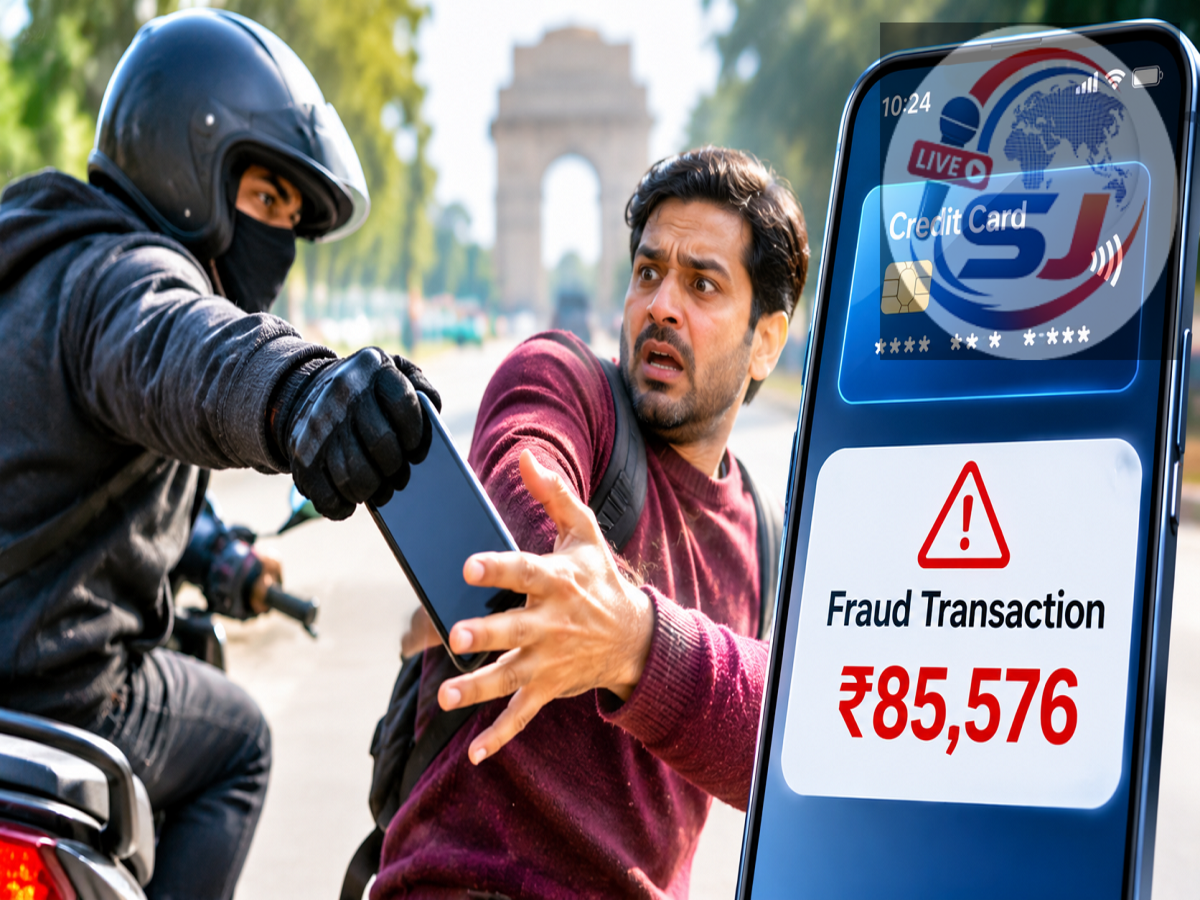
Mobile Theft and UPI Fraud Alert 2026: Losing a smartphone is no longer just about the cost of replacing the device. Criminals are increasingly combining mobile phone theft with digital financial fraud, putting bank accounts, credit cards and personal information at risk. A recent incident reported from northeast Delhi demonstrates how a stolen, unlocked smartphone can potentially become a gateway to financial crime.
According to a report published by Live Hindustan on November 17, 2026, a 30-year-old tax practitioner from Delhi allegedly lost ₹85,576 after two scooter-borne criminals snatched his unlocked mobile phone. The suspects reportedly managed to reactivate his blocked SIM, alter telecom account information and misuse financial services linked to his mobile number.
The incident highlights the importance of protecting smartphones, SIM cards, banking applications and account recovery settings against unauthorised access.
Delhi Mobile Snatching Case: What Happened in Bhajanpura?
The incident reportedly occurred on November 1, 2026, at approximately 10:30 PM near Moral Hospital at the main intersection of C-Block, Yamuna Vihar, in northeast Delhi.
The victim, identified as 30-year-old tax practitioner Saqib Suhail, a resident of Dilshad Colony, was returning from a function with his uncle Mohammad Ubaid and cousin Mohammad Salik.
While standing near the road, he was reportedly using his unlocked smartphone to book a cab.
At that moment, two individuals riding a scooter allegedly approached and snatched the phone from his hand before escaping towards Khajuri Chowk.
The victim contacted the police through the emergency response system. A mobile snatching complaint was registered, and an investigation was initiated.
However, according to the report, the financial consequences became apparent after the initial theft.
Criminals Allegedly Reactivated the Blocked SIM Twice
Following the incident, Suhail reportedly took immediate steps to deactivate his mobile number and SIM card.
He was concerned that the stolen phone, which had been unlocked when snatched, could provide access to personal accounts and sensitive information.
Despite these precautions, the suspects allegedly managed to reactivate the blocked SIM.
When the victim discovered the reactivation, he again requested the telecom operator to block the number.
According to the complaint described in the report, the SIM was subsequently reactivated for a second time without his authorisation.
The suspects also allegedly changed the alternate contact number registered with the telecom provider.
This reportedly made it more difficult for the victim to regain control of his mobile connection and prevent further misuse.
The exact process through which the unauthorised SIM reactivations occurred has not been independently established.
Credit Card Fraud: ₹85,576 Allegedly Stolen
The report states that the criminals subsequently misused financial services associated with the victim's mobile number.
Two credit card accounts were reportedly affected.
REPORTED FINANCIAL LOSS
₹85,576
First credit card
₹66,112
Second digital credit card
₹19,464
Amounts reported by Live Hindustan, November 17, 2026.
According to the report, the money was taken through five transactions.
The suspects were also accused of manipulating call-forwarding arrangements to redirect communications associated with the victim's number.
However, ordinary voice call forwarding does not automatically redirect SMS-based OTPs. The precise mechanism used to intercept or obtain authentication information remains unclear from the available account.
The case illustrates how control over a smartphone and its associated mobile number can create multiple opportunities for financial fraud.
Why Is an Unlocked Smartphone Particularly Vulnerable?
A smartphone that is stolen while unlocked can present additional security risks.
Unlike a locked device, an unlocked phone may allow immediate access to applications, messages, saved documents and account settings, depending on the security measures configured.
If banking applications are already authenticated or sensitive notifications are visible, criminals may attempt to exploit that access.
Mobile numbers are also widely used for account verification, password recovery and transaction-related communications.
Therefore, protecting the smartphone alone may not be sufficient. Users should also secure their SIM, telecom account, banking applications and recovery information.
Five Important Security Measures to Protect Your Phone
1. Enable SIM PIN Protection
A SIM PIN adds another layer of protection to a physical SIM card.
When enabled, the SIM generally requires the correct PIN after a restart or when inserted into another compatible device.
On supported Android phones, users can look for SIM lock settings under the device's security options.
On iPhones, the feature is generally available under Settings → Cellular/Mobile Service → SIM PIN.
Users should obtain the correct default SIM PIN from their operator before making changes. Repeated incorrect attempts can lock the SIM and require a PUK code.
SIM PIN protection does not prevent every form of SIM-swap or telecom account fraud, but it can help protect a physical SIM from unauthorised use.
2. Activate Theft Protection Features
Many modern Android smartphones include theft-protection features designed to reduce unauthorised access.
On supported devices, Google's Theft Detection Lock can attempt to identify certain snatching-like movements and automatically lock the screen.
Users can search for Theft Protection within their Android settings.
The feature's availability depends on the device and software version, and it cannot detect every theft.
iPhone users should enable Find My and Stolen Device Protection where available.
These features can help protect sensitive settings and support recovery efforts after a device is stolen.
3. Secure Telecom Applications
Mobile operator applications may provide access to account information, recharge services and certain connection-management functions.
Users should protect these applications using available biometric authentication, strong passwords and device security features.
It is also advisable to review the recovery mobile number and email address registered with the telecom provider.
If the operator offers additional account-security measures, users should consider enabling them.
4. Hide Sensitive Notifications on the Lock Screen
One-time passwords, banking alerts and personal messages may appear in smartphone notifications.
Displaying sensitive information on the lock screen can increase the risk of unauthorised viewing.
Android and iPhone users can adjust notification settings to hide message previews when the device is locked.
This is particularly useful for banking, email and authentication applications.
5. Protect Banking and UPI Applications Separately
Users should enable all available security features for banking and payment applications.
These may include biometric login, app-specific passcodes and transaction authentication.
UPI PINs should never be shared with anyone.
A stolen smartphone does not automatically allow someone to complete UPI transactions, as additional authentication is generally required. Nevertheless, an unlocked device combined with compromised credentials can increase the risk of fraud.
What to Do Immediately If Your Smartphone Is Stolen
Emergency action checklist
0/7 completed
Contact the police and report the theft
Call your telecom operator to suspend the SIM
Contact banks to block cards and secure UPI access
Report any financial fraud through 1930
Use official device-finding tools to lock or erase the phone
Request IMEI blocking through the Sanchar Saathi CEIR service
Change important account passwords from a trusted device
These steps should be taken as quickly as possible. Banking and telecom accounts may require separate actions even after the stolen device has been remotely locked.
How to Block a Stolen Mobile Phone Using the CEIR Portal
The Indian government's Central Equipment Identity Register (CEIR) service allows users to request blocking of a lost or stolen mobile device using its IMEI number.
The service is accessible through the official Sanchar Saathi portal.
Users generally need to provide relevant information about the missing device, mobile number and police complaint, along with other required details.
Once a valid blocking request is processed, the device can be restricted from using participating Indian mobile networks.
However, IMEI blocking does not erase personal data, automatically disable banking accounts or guarantee physical recovery of the phone.
How to Report UPI and Credit Card Fraud in India
Anyone who discovers unauthorised financial transactions should immediately contact the relevant bank or card issuer.
Customers should request that affected payment instruments be blocked and register a formal fraud complaint.
Suspected financial cybercrime can also be reported through India's national cybercrime helpline at 1930 or the National Cyber Crime Reporting Portal.
Victims should preserve transaction references, bank notifications, complaint numbers and relevant communication records.
Under RBI's customer-protection framework, liability for unauthorised electronic banking transactions depends on the circumstances, including how the compromise occurred and how promptly the incident was reported.
A refund is not automatic in every case, making timely reporting especially important.
Avoid Using an Unlocked Phone Near Busy Roads
The Delhi incident also highlights the physical safety risks associated with using smartphones in public areas.
People frequently hold their phones near roads while booking taxis, checking maps or speaking with someone.
This can create opportunities for criminals travelling on motorcycles or scooters.
When using a phone outdoors, it is safer to stand away from moving traffic and remain aware of the surroundings.
Users should avoid exposing their devices unnecessarily near road edges, especially in crowded or poorly lit locations.
Conclusion
The reported mobile snatching incident in Delhi's Bhajanpura area demonstrates how a conventional street crime can potentially develop into a more serious digital financial fraud.
According to the victim's account, criminals allegedly reactivated a blocked SIM, changed telecom account details and misused credit cards, resulting in a reported loss of ₹85,576.
The case serves as an important reminder that smartphone security must extend beyond a basic screen lock.
Enabling theft protection, securing SIM and telecom accounts, protecting financial applications and reporting suspicious activity promptly can help reduce the risk of further losses after a phone is stolen.
Note: The incident details are based on the supplied news report and describe allegations under police investigation. The technical method used by the suspects has not been independently verified.