
Lost Money to an Online Scam? Call 1930 Immediately—CyberDost Explains When Funds May Be Recovered
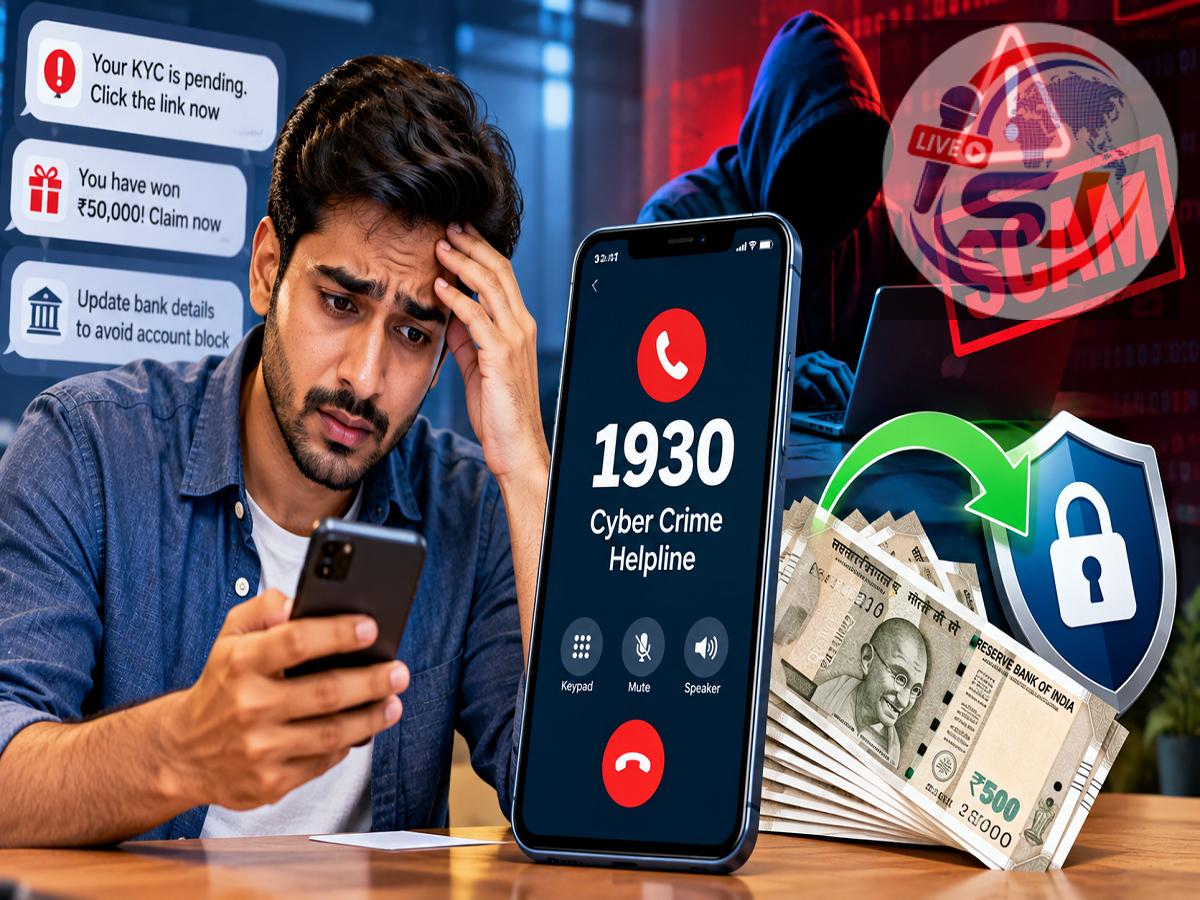
Losing money to an online scam can happen within minutes, but victims should not assume that the money is automatically gone forever. India's cybercrime awareness initiative CyberDost, associated with the Indian Cyber Crime Coordination Centre (I4C), has highlighted that money lost in certain cyber financial fraud cases may be recovered if the incident is reported quickly enough.
The most important factor is speed.
If money has been fraudulently transferred from your bank account, CyberDost advises victims to immediately call the national cyber financial fraud helpline 1930 or register a complaint through the National Cyber Crime Reporting Portal (NCRP).
Reporting the transaction quickly can give banks and cybercrime authorities an opportunity to trace the money and potentially place a hold or freeze on the fraudulent funds before they are withdrawn or moved further.
However, victims should understand that filing a complaint does not guarantee a refund. Whether the money can ultimately be restored depends on several factors, particularly whether the stolen funds can be identified and stopped in time.
What Should You Do Immediately After a Cyber Fraud?
If you notice an unauthorised transfer or realise that you have sent money to a fraudster, do not wait to see whether the money comes back automatically.
The first step should be to report the financial fraud immediately.
Victims can call:
National Cyber Financial Fraud Helpline: 1930
They can also submit a complaint through the official National Cyber Crime Reporting Portal.
While reporting the incident, keep transaction-related information ready, such as the amount lost, bank account details, transaction or UPI reference number, time of the transaction and other information requested by the authorities.
The faster accurate information is provided, the sooner the transaction trail may be examined.
Why Is Fast Reporting So Important?
Money stolen through digital fraud rarely remains in one account for long.
Fraudsters may quickly transfer the amount through multiple accounts or attempt to withdraw it. Once funds move through several layers or are withdrawn, recovering them can become substantially more difficult.
An early complaint can help trigger coordination between the relevant banks and cybercrime authorities.
If the fraudulent funds are still available in a recipient or intermediary account when the alert reaches the financial system, there may be an opportunity to hold or freeze all or part of the amount, subject to the applicable process.
This is why even a relatively short delay can matter in cyber financial fraud cases.
Can Money Lost in a Cyber Scam Really Be Recovered?
Recovery is possible in some cases, but there is no guarantee.
The outcome largely depends on what happens to the stolen money after the fraudulent transaction.
For example, suppose ₹1 lakh is fraudulently transferred from a victim's account and the incident is reported immediately. If authorities and the participating financial institutions are able to trace the transaction and ₹80,000 remains available in an account where it can be frozen, that amount may potentially become eligible for restoration through the applicable process.
But if the fraudsters have already withdrawn the money or moved it through multiple accounts before it can be stopped, recovery can become much more difficult.
Therefore, the key question is not simply whether a complaint has been filed. It is also whether the money could be successfully intercepted and frozen.
What Is the Money Restoration Module?
CyberDost has also referred to the Money Restoration Module (MRM) as part of the mechanism used for eligible cyber financial fraud cases.
The system is intended to assist the process of restoring money to victims in cases where fraudulent funds have already been successfully intercepted or frozen.
In simple terms, the process begins with tracing the fraud transaction.
Banks, financial institutions and cybercrime authorities can work together to identify where the money was transferred. If the funds or part of them are still available and can be frozen, the subsequent restoration process may be taken forward in eligible cases through the prescribed mechanism.
MRM should therefore not be understood as a system that can automatically reverse every cyber fraud transaction.
Its effectiveness depends heavily on whether the fraudulently transferred amount has been successfully stopped.
When Is Recovery More Difficult?
There are several situations in which getting the money back can become significantly harder.
If the scammer has already withdrawn the money as cash, transferred it rapidly through multiple accounts or moved it beyond the reach of an immediate bank hold, authorities may not be able to freeze the entire amount.
The same can happen when a victim waits for several hours or days before reporting the fraud.
That does not mean a delayed fraud should go unreported. Victims should still file a complaint and provide all available evidence. However, quick reporting can improve the possibility of intercepting funds before they disappear further through the transaction chain.
Keep Transaction Evidence Safe
Apart from immediately reporting the fraud, victims should preserve all relevant evidence.
This can include bank SMS alerts, UPI transaction IDs, account statements, screenshots, phone numbers, WhatsApp conversations, email messages, website details and payment receipts connected with the scam.
Do not delete conversations or transaction information simply because you have already contacted your bank.
Such records may help authorities understand how the fraud occurred and trace the movement of funds.
If you have shared banking credentials or suspect that your account or device has been compromised, contact your bank immediately through an official channel and follow its instructions for securing the account.
Beware of 'Money Recovery' Scams After the First Fraud
Cyber fraud victims should also be cautious about a second scam.
Fraudsters sometimes target people who have already lost money by claiming that they can recover the stolen amount in exchange for an advance fee, processing charge, OTP or banking information.
Do not share your OTP, UPI PIN, debit or credit card PIN, CVV or internet banking password with anyone claiming to help recover your money.
A legitimate complaint process does not require you to reveal confidential banking credentials to an unknown caller.
The First Few Minutes Can Matter
The key message for anyone facing cyber financial fraud is straightforward: report it as quickly as possible.
Call 1930 and register the incident through the official cybercrime reporting system. Also inform your bank immediately through its verified customer-care or fraud-reporting channel.
Fast reporting does not guarantee that every rupee will be recovered. But when the stolen funds are still traceable and can be frozen before being withdrawn or transferred further, there may be a better chance of restoration through the applicable banking and cybercrime process.
In a cyber financial fraud case, delaying action can give scammers more time to move the money. Acting immediately can give banks and authorities a better opportunity to stop it.