
India’s New 1601 Number Series: How It Could Help You Identify Genuine Service Calls and Avoid Spam
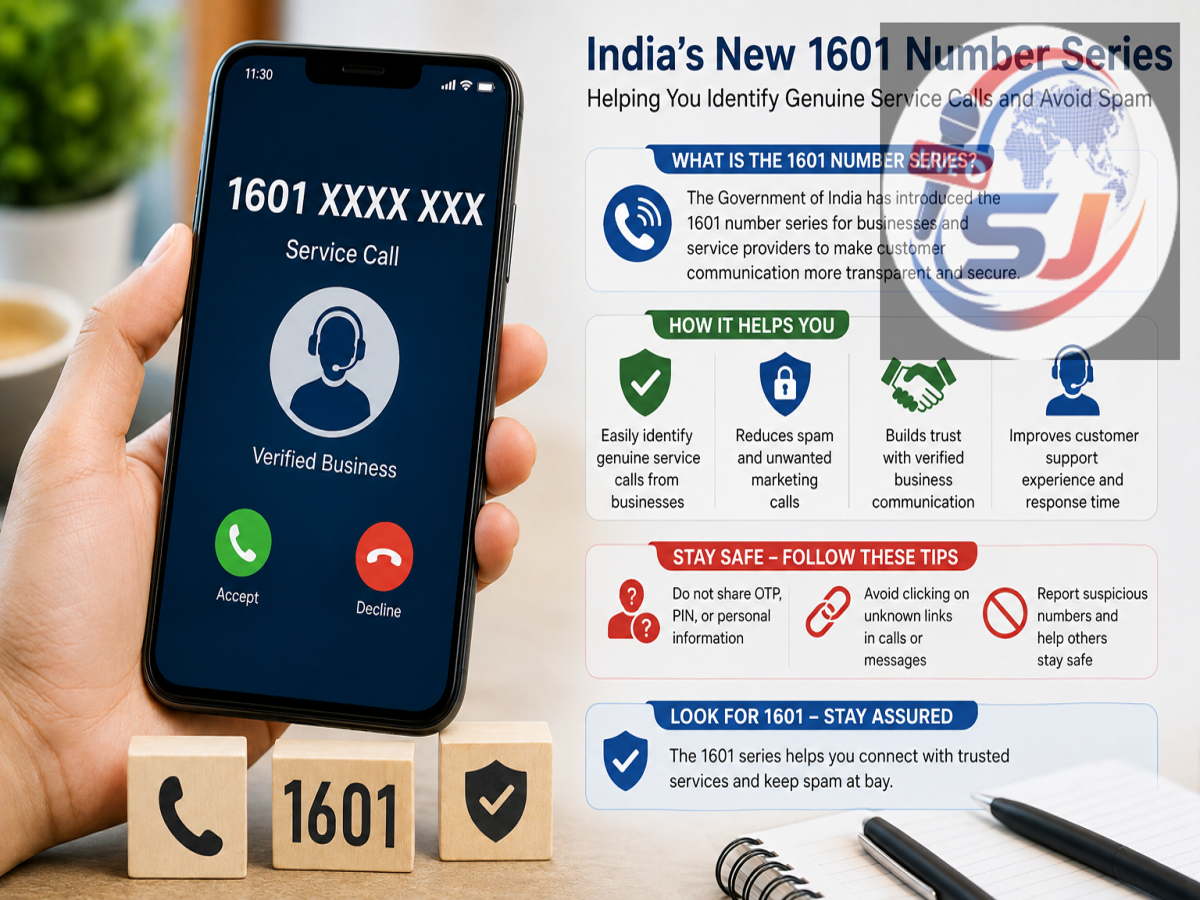
Spam and fraudulent phone calls have become a routine problem for mobile users in India. From fake delivery executives and electricity-bill scams to callers pretending to represent financial institutions, identifying whether an unfamiliar number is genuine is becoming increasingly difficult.
To address this problem, the Department of Telecommunications (DoT) has expanded the use of a dedicated numbering system for service and transactional calls. The 1601 number series is intended for eligible organisations outside certain financial and government categories, helping consumers better understand the nature of an incoming call.
The initiative could make legitimate business calls easier to recognise, but there is an important warning: a number beginning with 1601 should never be treated as an automatic guarantee that everything the caller says is safe.
What Is the 1601 Number Series?
The 1601 series is a dedicated numbering range designed for service and transactional voice calls made by eligible organisations.
Instead of contacting customers through ordinary 10-digit mobile numbers that can easily be confused with personal or suspicious calls, participating organisations can use numbers belonging to this designated range.
The idea is straightforward: when consumers become familiar with the numbering pattern, they can more easily recognise that the incoming call is intended to be service-related rather than a conventional promotional call from an unidentified mobile number.
The latest framework expands India's broader efforts to create distinct identities for legitimate commercial communications.
What Are Service and Transactional Calls?
Not every call made by a company is necessarily an advertisement.
Businesses frequently need to contact customers for genuine operational reasons. These could include updates about a service already requested, delivery coordination, appointments, billing information or other customer-related transactions.
For example, a courier company may need to call because a package is arriving. A utility provider may contact a customer regarding an existing connection or service request.
Such communications are different from unsolicited promotional calls trying to sell a new product or service.
The dedicated numbering system is intended to make that distinction clearer to consumers.
Why Was a Separate Number Series Needed?
One of the biggest problems with telephone fraud is that legitimate companies and scammers can both appear to call from unfamiliar numbers.
When genuine businesses use ordinary mobile numbers to communicate with customers, users have little information available before answering.
Fraudsters can exploit this uncertainty.
A scammer may claim to represent a courier company, electricity provider, telecom operator or another organisation while calling from what looks like an ordinary mobile number.
Creating a recognisable numbering range for legitimate service communications can therefore provide users with another useful signal.
Which Businesses Could Use the 1601 Series?
The expanded framework is aimed at eligible entities outside the banking, financial services, insurance and government sectors, subject to the applicable allocation and telecom rules.
It can potentially cover service-related communications from sectors such as utilities, logistics and courier services, among other eligible categories.
Consumers should gradually begin seeing these dedicated numbers as organisations and telecom providers implement the system.
However, the transition may not happen instantly across every business and service provider.
Does a Number Starting With 1601 Mean It Is 100% Safe?
No.
This is perhaps the most important point consumers need to understand.
A dedicated numbering range can help identify the category or source of a communication, but users should not abandon normal fraud precautions simply because an incoming number starts with 1601.
You should still be suspicious if any caller asks for sensitive information such as:
-
OTP
-
UPI PIN
-
ATM or debit-card PIN
-
CVV
-
Internet-banking password
-
Complete card credentials
-
Passwords or account-security codes
Legitimate service representatives generally do not need these confidential credentials to provide routine customer support.
Be Especially Careful With Urgent Payment Requests
Fraudsters often try to create panic.
A caller may claim that your electricity will be disconnected within minutes, your mobile connection will be blocked, your parcel is stuck, your bank account will be frozen or a payment must immediately be made to avoid a penalty.
Such urgency is frequently used to prevent victims from independently checking whether the claim is genuine.
Even if the displayed number appears legitimate, avoid making an immediate payment based solely on what the caller says.
Instead, disconnect the call and independently contact the organisation through its official app, website or verified customer-care channel.
How Can the 1601 Series Help Ordinary Users?
The biggest potential benefit is better caller identification before answering the phone.
Currently, many users simply ignore unfamiliar numbers because spam calls are so common.
That creates another problem: genuine calls related to deliveries, service requests or appointments may also be missed.
A recognisable service-call number range could eventually make the decision easier.
For example, someone waiting for an important delivery may be more willing to answer a recognisable service-category number than a completely unfamiliar ordinary mobile number.
Will the New Number Series Stop Spam Calls?
The new numbering system should not be viewed as a complete solution to India's spam problem.
Spam and scam calls can originate through many channels, and criminals continuously adapt their methods.
Instead, the 1601 series should be understood as one component of a broader telecom anti-spam framework.
Its main advantage is creating a clearer identity for legitimate service communications. If genuine businesses move away from ordinary mobile numbers for such calls, suspicious communications using regular numbers may become easier for consumers and telecom systems to scrutinise.
Promotional and Service Calls Are Not the Same
Another useful change is that consumers may gradually become more familiar with the difference between transactional/service communications and promotional calls.
A call regarding an existing transaction or requested service has a different purpose from a marketing call encouraging someone to purchase a new product.
Clearer numbering identities can help reduce confusion between the two categories.
However, consumers should still evaluate the actual conversation rather than relying exclusively on the displayed number.
What Should You Do When You Receive a 1601 Call?
Seeing 1601 at the beginning of an incoming number can provide useful context, but your security habits should remain unchanged.
Listen to why the caller is contacting you. If the conversation matches a delivery, utility service, appointment or transaction you are already expecting, it may be a legitimate service communication.
If anything appears suspicious, disconnect and verify independently.
Never install an unknown application, enable screen sharing, transfer money or reveal confidential credentials simply because a caller claims to represent a trusted organisation.
The Bigger Goal: Make Genuine Calls Easier to Recognise
India's spam-call problem cannot be solved simply by introducing another number series. However, giving legitimate service communications a distinct identity can reduce one of the biggest sources of confusion for consumers.
As adoption increases, users may find it easier to separate routine service calls from unsolicited or suspicious communications.
The important takeaway is that 1601 should be treated as an identification signal—not a universal security certificate.
Technology can help tell you more about where a call comes from, but safe behaviour still matters. Never share an OTP, UPI PIN, card PIN or password over a phone call, and independently verify unexpected requests involving money or sensitive information.