
Independence Day 2026: How India’s Technology Transformed From 1947 to the Age of AI
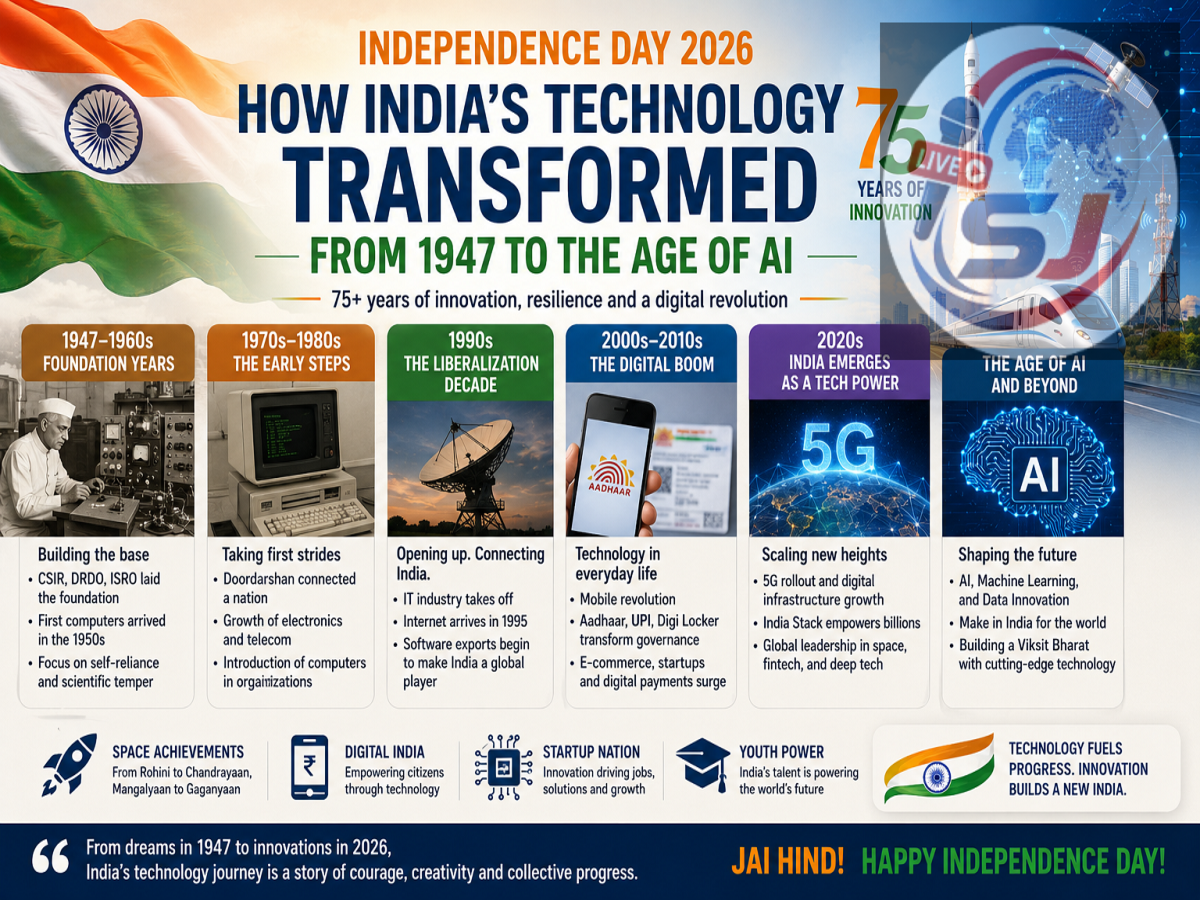
India’s Technology Journey: From an era when computers, mobile phones and the internet were unimaginable for ordinary citizens to today’s world of UPI, 5G, satellites and artificial intelligence, India has witnessed a remarkable technological transformation since Independence.
When India became independent on August 15, 1947, the country faced enormous challenges. Building basic infrastructure, expanding education, strengthening industries and improving the lives of millions were among the biggest priorities.
Technology as we understand it today was still decades away. Computers were rare globally, while smartphones, digital payments and the internet did not exist.
Fast-forward to 2026, and technology has become deeply integrated into everyday life in India. Smartphones connect people across cities and villages, QR codes enable instant payments, high-speed mobile networks deliver digital services, and artificial intelligence is opening another chapter in the country's technological evolution.
1947 Onwards: Building India’s Scientific Foundation
In the decades immediately following Independence, India focused heavily on creating scientific, engineering and industrial capabilities.
Research institutions and technical education were expanded, while the country gradually developed capabilities in strategic areas such as atomic energy, telecommunications, electronics and space research.
During the 1950s and 1960s, computing also began making its way into India. Computers of that era were enormous and expensive compared with modern machines and were primarily used by research organisations, government institutions and large enterprises.
For ordinary households, personal computing was still far in the future.
1980s and 1990s: Computers Enter Offices and Businesses
A major transformation began during the 1980s and accelerated through the 1990s as computers increasingly appeared in government departments, banks, educational institutions and private companies.
Computerisation changed how organisations stored information, processed transactions and managed operations.
At the same time, India's software industry started expanding rapidly.
Economic liberalisation during the 1990s gave Indian technology companies greater access to international markets. Indian software engineers and IT professionals increasingly began providing technology services to businesses worldwide.
This period played an important role in establishing India as a major global IT services and outsourcing hub.
The Internet Arrives in India
Another turning point came in the mid-1990s with the arrival of public internet services.
Early internet access looked very different from today's experience. Dial-up connections were slow, relatively expensive and available to only a limited section of the population.
Broadband gradually improved connectivity, but the biggest transformation arrived with mobile internet.
The expansion of 3G and particularly 4G networks, combined with increasingly affordable smartphones and data plans, brought millions more Indians online.
Digital education, video streaming, social networking, online shopping, digital banking and government services subsequently became accessible to a much wider population.
Smartphones Put a Computer in Millions of Hands
Mobile phones expanded rapidly across India during the 2000s. Early devices were mainly used for voice calls and text messages, but smartphones fundamentally changed their purpose.
A modern smartphone effectively became a pocket-sized computer.
Today, people can use a single device to access banking services, book train and flight tickets, attend online classes, participate in video meetings, shop online, watch entertainment and manage government-related services.
The spread of smartphones into smaller cities and rural areas has been particularly significant because many Indians experienced the internet for the first time through a mobile device rather than a traditional computer.
UPI Changed the Way India Pays
One of India's most visible digital transformations has been the rise of the Unified Payments Interface (UPI).
UPI made it possible to transfer money directly between bank accounts through smartphones without requiring users to enter traditional banking details for every transaction.
QR-code payments subsequently became commonplace.
From neighbourhood grocery shops and street vendors to restaurants, shopping centres and online platforms, digital payments are now widely integrated into everyday transactions.
The development demonstrated how technology could move beyond large companies and institutions and become a practical tool used in small everyday purchases.
From 4G to 5G
While 4G played a major role in making high-speed mobile internet widely accessible, the introduction and expansion of 5G marked another step forward.
5G offers significantly higher network capacity and lower latency, creating opportunities beyond faster smartphone downloads.
The technology can support areas such as industrial automation, Internet of Things (IoT) applications, connected infrastructure, cloud-based services, smart-city systems and advanced enterprise applications.
For ordinary consumers, meanwhile, 5G has made high-speed mobile connectivity increasingly accessible in supported locations.
India’s Space Technology Journey
India's technological story isn't limited to computers and telecommunications.
The country's space programme has evolved from modest beginnings into sophisticated capabilities involving satellites, launch vehicles, navigation, remote sensing and planetary exploration.
Satellite technology today supports communications, weather forecasting, disaster management, navigation, agriculture and several other critical services.
India's lunar and planetary missions have also demonstrated the growth of its scientific and engineering capabilities on the global stage.
2026: Artificial Intelligence Opens the Next Chapter
By 2026, India's technology journey has entered another significant phase: artificial intelligence.
AI tools are increasingly being adopted across software development, banking, healthcare, education, cybersecurity, customer support, research and content creation.
Generative AI has made sophisticated computing capabilities accessible even to people without advanced technical training.
Users can now interact with AI systems using everyday language to analyse information, generate images, assist with coding, translate content, summarise documents and perform a growing range of everyday tasks.
India’s Technology Journey at a Glance
| Period | Major Transformation |
|---|---|
| 1947–1960s | Scientific institutions, engineering and industrial infrastructure |
| 1960s–1980s | Space, atomic energy, telecommunications and early computing |
| 1980s–1990s | Computerisation expands across businesses and government |
| 1990s | IT services boom and public internet arrives |
| 2000s | Mobile phones become mainstream |
| 2010s | Smartphones, 4G and digital services expand rapidly |
| 2016 onwards | UPI accelerates digital payments |
| 2020s | 5G, cloud technology, advanced electronics and automation |
| 2026 | Generative AI and next-generation digital technologies expand |
From Early Computers to AI: A 79-Year Transformation
India's technological transformation between 1947 and 2026 is much bigger than the shift from computers to smartphones or from dial-up internet to 5G.
It represents technology moving from specialised laboratories and large institutions into the everyday lives of hundreds of millions of people.
A country that began its post-Independence journey with limited technological infrastructure now has significant capabilities across software, telecommunications, digital payments, space technology and emerging AI applications.
The next stage could be shaped by artificial intelligence, robotics, semiconductor manufacturing, quantum computing, advanced connectivity and new space technologies—continuing a transformation that began nearly eight decades ago.