
Fake Instagram and Facebook Accounts: 7 Warning Signs That Can Help You Spot Impersonation and Scams
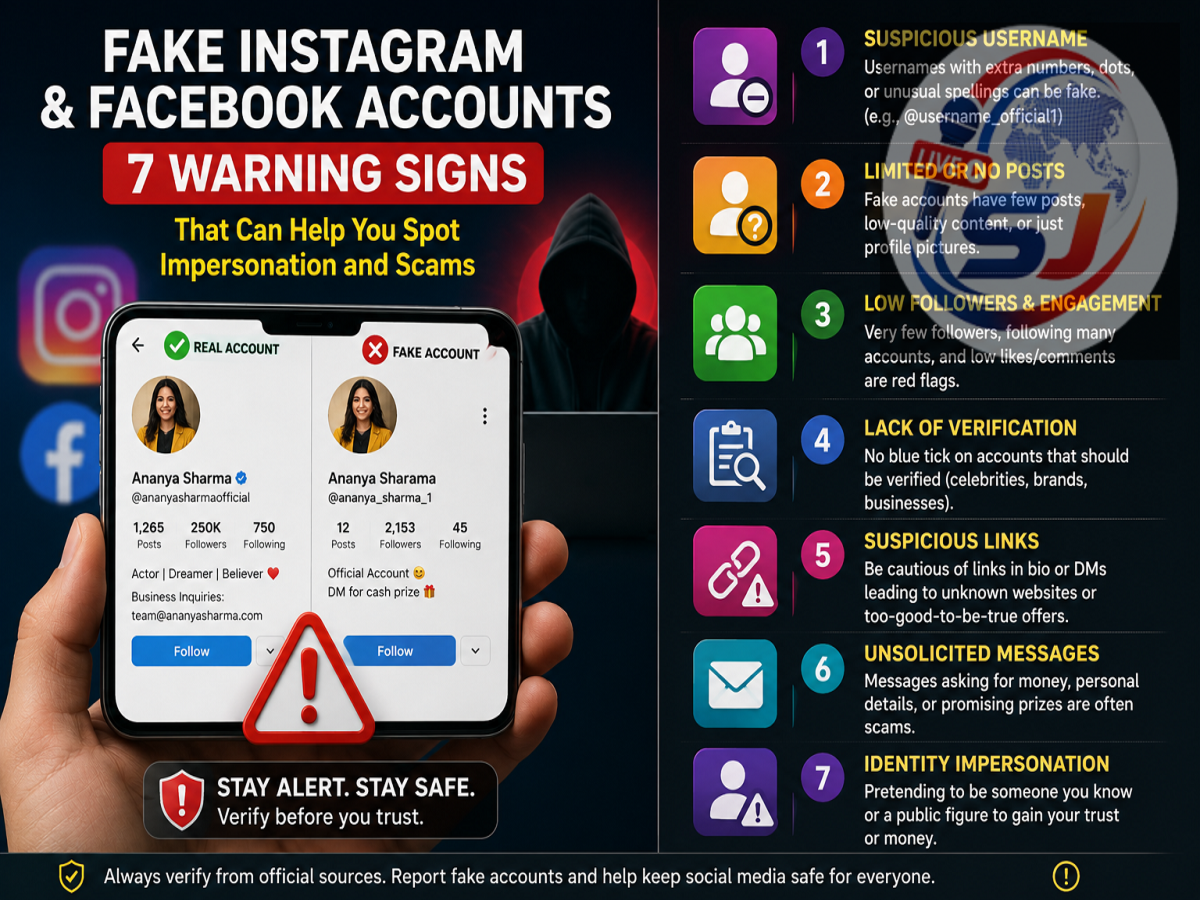
Instagram and Facebook are widely used for staying connected with friends, discovering businesses, shopping, entertainment and professional networking. However, their popularity also gives scammers opportunities to create fake profiles, impersonate genuine users and approach people with fraudulent offers.
Some fake accounts are easy to recognise, while others may copy a real person's name, photograph, bio and even posts. No single sign can prove that an account is fraudulent, but checking several details together can help you make a safer decision before accepting a follow request, replying to a message or sending money.
Here are some important warning signs to watch for.
1. Check How New the Profile Appears
A recently created profile is not automatically suspicious. Everyone has to start somewhere. However, you should be cautious if a seemingly new account has only a handful of posts but is already following hundreds or thousands of people.
Look at the overall pattern. A nearly empty profile combined with aggressive follow requests, unsolicited messages or money-related offers deserves additional scrutiny.
2. Compare Followers With Genuine Engagement
Follower count alone does not establish whether an account is authentic.
A profile may have thousands of followers but receive very little meaningful engagement. Repetitive comments, generic reactions or unusual spikes in followers can also raise questions.
At the same time, low engagement does not automatically mean an account is fake. Use this as one clue rather than definitive proof.
3. Examine the Profile Picture
Impersonators often copy photographs from genuine social-media accounts, websites or other public sources.
If a profile picture looks familiar or you suspect that it has been copied, a reverse-image-search service such as Google Lens may help identify other places where the same photograph appears.
Finding the same image elsewhere is not necessarily evidence of fraud—for example, professionals may use the same headshot across multiple platforms—but it can provide useful context.
4. Look Closely at the Username
One common impersonation technique is creating a username that looks almost identical to the genuine account.
For example, scammers may substitute similar-looking characters, insert underscores, add extra full stops or attach numbers to the end of a familiar username.
If someone claiming to be your friend, relative, celebrity or business contacts you from a new profile, compare the username carefully with the account you already know.
5. Don't Trust a Profile Just Because It Looks Professional
A convincing photograph, detailed bio and several posts can make a fake profile appear legitimate. Scammers can copy publicly available content from genuine accounts.
Verification indicators can be useful context, but users should still evaluate what an account is asking them to do. A professional-looking profile should never be treated as a reason to share passwords, OTPs or financial information.
Be particularly careful with profiles promoting unrealistic investment returns, giveaways, urgent payment requests or links asking you to log in again.
6. Be Suspicious of Unexpected Requests for Money or Personal Details
This is one of the most important warning signs.
If someone contacts you unexpectedly and asks for an OTP, password, PIN, card information, banking credentials or verification code, do not share it.
Scammers may also impersonate friends or relatives and claim that they urgently need money. Before transferring anything, contact the person through a phone number or another communication method you already trust.
Never rely solely on the identity displayed in a social-media DM.
7. Review the Account's Previous Activity
Scroll through older posts rather than judging a profile only by its latest content.
Look at tagged photographs, comments, interactions and posting history. A genuine personal account will often show activity accumulated naturally over time.
By comparison, an impersonation account may contain recently uploaded copied photographs, repetitive captions or little evidence of genuine interaction.
Mutual friends can provide another clue, although scammers can also send requests to several people within the same social circle to make their profile appear credible.
What Should You Do If You Find a Fake Profile?
Avoid interacting with suspicious accounts and do not click links they send. If the profile appears to be impersonating you or someone you know, use the reporting tools available on Instagram or Facebook and consider blocking the account.
If money is involved, verify the request independently before taking any action. If you have already shared a password, change it immediately, review active login sessions and enable two-factor authentication where available.
The most important rule is simple: a familiar photo or name does not guarantee that the person behind the account is genuine. Verify the identity before sharing sensitive information, clicking unfamiliar links or sending money.