
Fake E-Challan Scam Alert: One Wrong Link Can Put Your Bank Account at Risk, Know How to Stay Safe
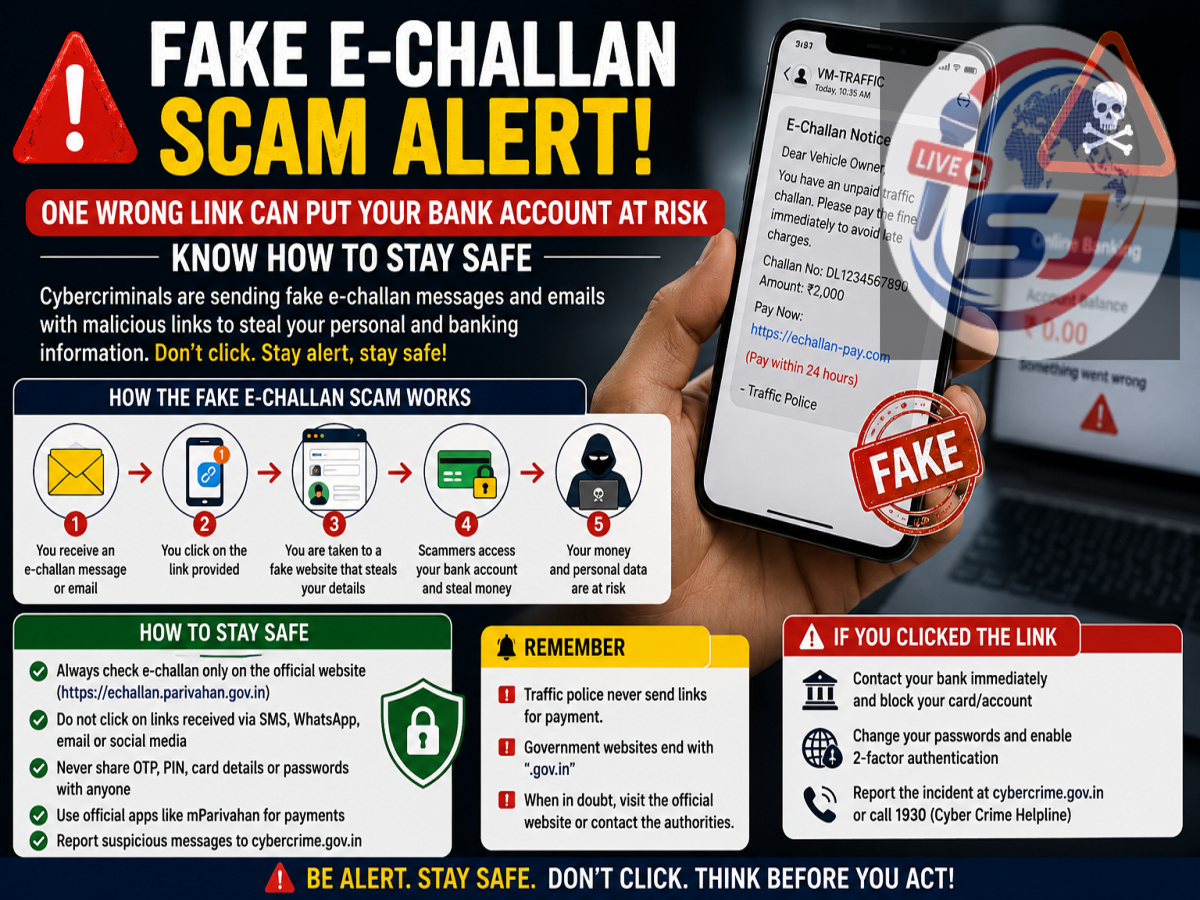
Online E-Challan Fraud: Receiving a traffic challan message on your phone can immediately cause concern, especially when it warns of a pending fine or possible legal action. Cybercriminals are exploiting exactly this fear by sending fake e-challan messages containing fraudulent payment links.
The government's official eChallan portal itself carries a warning about fraudulent websites and mobile apps impersonating its services. It says users should access eChallan services only through the official portal and that the service does not ask people to share passwords, OTPs, payment details or sensitive personal information through calls, emails, messages or links. (eChallan)
This makes it important for vehicle owners to verify every challan independently rather than immediately paying through a link received over SMS, WhatsApp or another messaging service.
How Does the Fake E-Challan Scam Work?
The fraud often starts with an SMS, WhatsApp message or another digital communication claiming that a traffic violation has been recorded against your vehicle.
The message may mention a fine and create urgency by warning that failure to pay immediately could lead to additional penalties or other action.
A payment link is then provided.
The website opened through this link may closely resemble an official government portal. The design, logo, colour scheme and payment page can be copied to make the site appear genuine.
The objective, however, is to trick the victim into entering sensitive information or making a payment to the fraudster.
Clicking a Link Doesn't Automatically Empty Your Account
There is an important distinction consumers should understand.
Merely tapping a suspicious link does not necessarily mean that your bank account will instantly be emptied. The greater danger arises when the fake website convinces you to enter banking credentials, card information, OTPs, UPI details or other sensitive information, or when a malicious app/file is installed.
Therefore, even if you accidentally open a suspicious page, do not enter any information, download anything or approve a payment request.
Close the page and independently verify whether a challan actually exists.
How to Check Whether an E-Challan Is Genuine
The safest approach is to avoid the payment link contained in the message altogether.
Instead, independently open the Ministry of Road Transport and Highways' official eChallan service.
Official Government eChallan Portal
The official portal allows users to check challan details using information such as the challan number, vehicle number or driving licence number. (eChallan)
If a message claims you have a ₹1,000 challan, for example, but no corresponding challan appears against your vehicle on the official system, that is a strong reason to treat the message as suspicious.
Warning Signs of a Fake Challan Message
Fraudulent messages can become increasingly convincing, so relying only on spelling mistakes or poor formatting is no longer enough.
Still, several warning signs deserve attention:
-
The message creates extreme urgency and demands immediate payment.
-
The link leads to an unfamiliar or misspelled domain.
-
You are asked for banking passwords, card PINs or other unnecessary credentials.
-
The sender asks you to install an APK or unknown application.
-
You are asked to share an OTP received on your phone.
-
The payment amount or vehicle details do not match your records.
-
The challan cannot be verified independently on the official eChallan portal.
The government's eChallan website specifically cautions users against fake websites and applications impersonating the official service. (eChallan)
Never Share Your OTP or Banking Password
One of the biggest mistakes a person can make after opening a fraudulent page is entering sensitive banking information.
Do not disclose your net-banking password, card PIN or other confidential credentials merely because a webpage looks official.
The official eChallan portal's fraud warning makes clear that it does not seek passwords, OTPs, payment information or other sensitive personal details through unsolicited calls, emails, messages or links. (eChallan)
If a message asks for such information, stop the transaction and verify the challan separately.
Be Especially Careful With APK Files
A fake challan message may sometimes try to persuade a user to download an app or file rather than simply visit a webpage.
This can be particularly risky on smartphones.
Never install an application sent through an unknown WhatsApp number, SMS link or unofficial website merely to check or pay a traffic fine.
Use the official government service directly instead.
What If You Have Already Made a Payment?
Speed matters if money has already been transferred to a fraudster.
Immediately contact your bank or payment provider and report the unauthorised or fraudulent transaction. You should also report financial cyber fraud through India's National Cyber Crime Reporting system.
The government's National Cyber Crime Reporting Portal lists 1930 as the national helpline for reporting online financial fraud. (Cyber Crime Portal)
National Cyber Crime Reporting Portal
Keep transaction IDs, screenshots, SMS messages, phone numbers, payment details and any other evidence related to the fraud. These details can be useful while filing the complaint.
You Can Also Report a Suspicious Link
You don't necessarily have to wait until you lose money before reporting suspicious activity.
The National Cyber Crime Reporting Portal provides a facility to report suspicious website URLs, WhatsApp or Telegram handles, phone numbers, email addresses, SMS senders and social-media URLs associated with attempted cybercrime. (Cyber Crime Portal)
That means a suspicious e-challan message can potentially be reported even before you become a financial-fraud victim.
Fake Website vs Genuine E-Challan Portal
A fake page may visually resemble the real website, so checking the address carefully is essential.
The genuine national eChallan service is operated as an initiative of the Ministry of Road Transport and Highways, Government of India. (eChallan)
Instead of searching through random links forwarded on messaging apps, manually visit the official portal and check your vehicle details there.
What Should You Do When a Challan Message Arrives?
Don't panic and don't rush to make a payment.
First check whether the vehicle number and other details mentioned in the message are correct. Then ignore the embedded payment link and independently visit the official eChallan portal.
If the challan appears in the official records, proceed using the authorised payment process shown there.
If it doesn't appear or the message asks you to install software, disclose banking credentials or make payment through an unusual channel, treat it as potentially fraudulent.
Bottom Line
Fake e-challan scams work because they combine two powerful tactics: fear and urgency. A message claiming that a traffic fine is overdue can make people click before checking whether the notice is genuine.
The safest rule is simple: never pay a traffic challan through an unverified link received in a message. Open the official government eChallan portal independently, check the challan against your vehicle and make payment only through an authorised channel.
If you have already lost money, contact your bank immediately and report the incident on the National Cyber Crime Reporting Portal or call 1930 as quickly as possible. (Cyber Crime Portal)