
eSIM in India: 4 Major Benefits and 3 Drawbacks You Should Know Before Switching
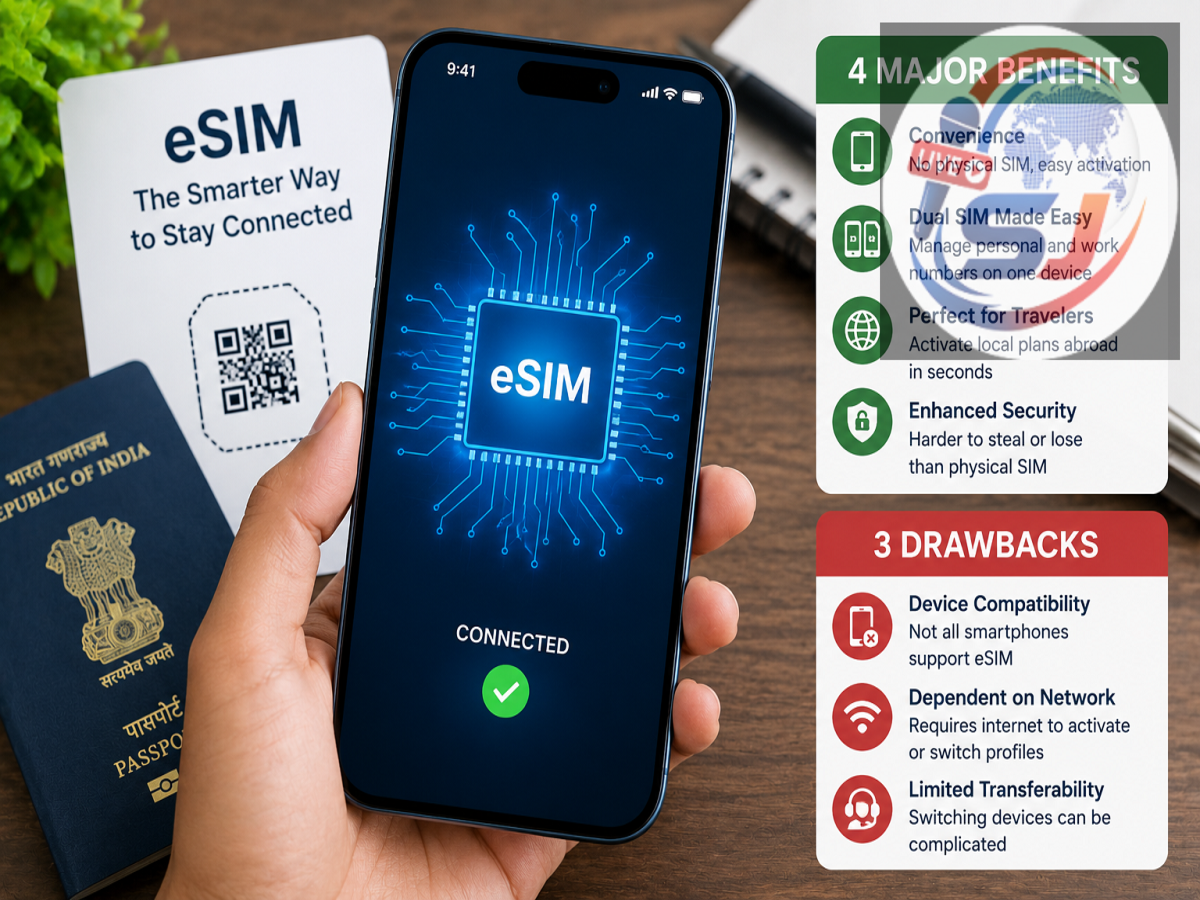
Smartphones are gradually moving away from the traditional plastic SIM card. One of the technologies driving this transition is the eSIM, or embedded SIM, which allows users to activate a mobile connection digitally without inserting a physical SIM card into their phone.
In India, major telecom operators such as Reliance Jio and Bharti Airtel offer eSIM services for supported smartphones and other compatible devices.
While eSIM technology offers several advantages, switching from a physical SIM is not necessarily the best decision for every mobile user. Device compatibility, phone-changing habits and ease of recovery are some factors worth considering.
Here are four major advantages and three potential drawbacks of using an eSIM in India.
What Exactly Is an eSIM?
An eSIM performs essentially the same basic function as a traditional SIM card, but there is no removable plastic card.
The necessary SIM hardware is built into the device, while the mobile operator's profile is activated electronically. Once the activation process is completed, users can access calls, SMS and mobile data according to their telecom plan.
The exact activation or transfer process can vary depending on the operator and smartphone manufacturer.
Advantage 1: No Physical SIM Card to Handle
One of the biggest conveniences of eSIM technology is that there is no tiny plastic SIM card to remove, insert or store.
Traditional SIM cards can occasionally become damaged or misplaced when users change phones. There is also the inconvenience of finding a SIM-ejector tool whenever the card needs to be removed.
An eSIM eliminates these physical hassles because the mobile profile is digitally provisioned on the supported device.
For users who prefer a more digital setup, this can make managing mobile connections considerably easier.
Advantage 2: Dual-SIM Setup Can Be More Convenient
eSIM technology can also make dual-SIM usage more flexible on supported smartphones.
Depending on the handset, users may be able to operate a physical SIM and an eSIM together. Some newer devices also support storing multiple eSIM profiles, although the number that can remain active simultaneously depends on the specific model.
This can be particularly useful for people who maintain separate personal and professional numbers.
Instead of carrying two phones, users may be able to manage both connections from a single compatible smartphone.
However, buyers should always check their handset's exact dual-SIM specifications because eSIM capabilities differ between models.
Advantage 3: eSIM Can Be Helpful for International Travel
Frequent international travellers are among the users who may benefit most from eSIM technology.
Instead of removing the Indian SIM card and inserting another physical SIM after reaching another country, travellers can potentially activate a compatible eSIM plan digitally.
This can allow them to keep their primary Indian connection available while using another mobile plan for local data or communication.
However, international eSIM availability, roaming support and dual-SIM functionality depend on the device and service provider.
Travellers should therefore verify compatibility before departure rather than assuming every eSIM plan will work with their smartphone.
Advantage 4: Physical SIM Theft Becomes More Difficult
A traditional SIM card can be physically removed from a lost or stolen smartphone.
With an eSIM, there is no removable SIM card for someone to simply pull out of the handset and insert into another phone.
This removes one particular physical security risk.
However, users should not assume that eSIM makes their mobile number completely immune to fraud. Account takeover, phishing, identity theft and unauthorised SIM-related requests can still pose risks.
Users should continue protecting their telecom account, email, OTPs and device credentials.
Drawback 1: Not Every Smartphone Supports eSIM
The biggest limitation remains device compatibility.
Many premium and newer smartphones support eSIM, but a significant number of older and affordable devices still depend entirely on physical SIM cards.
Even when a smartphone family supports eSIM, availability can sometimes vary by model or region.
Before converting a number, users should check two things: whether their exact smartphone model supports eSIM and whether their telecom operator supports eSIM activation for that device.
Do not rely solely on the fact that another phone from the same brand supports it.
Drawback 2: Moving Your Number to Another Phone Can Require Extra Steps
Physical SIM cards have one major advantage: they are extremely easy to move.
If your smartphone suddenly stops working, you can usually remove the SIM card and insert it into another compatible unlocked phone.
With an eSIM, switching devices may require an eSIM transfer, fresh activation or another verification process depending on the operator and handset.
For users who frequently switch between multiple smartphones, this can feel less convenient than simply moving a physical SIM card.
The situation becomes especially important if the primary phone is damaged and the user needs immediate access to calls, SMS or OTPs.
Drawback 3: Accidentally Deleting the eSIM Profile Can Cause Trouble
An eSIM profile should not be deleted casually from the smartphone's settings.
Deleting an active eSIM profile can disable access to the associated mobile connection until the service is restored or the eSIM is activated again.
This is particularly important when resetting a smartphone.
Users should carefully check whether the reset process will retain or erase the eSIM profile before proceeding.
The exact recovery procedure varies between telecom operators, so following the operator's official instructions is advisable.
Physical SIM vs eSIM: Which Is Better?
Neither option is automatically better for every user.
eSIM may be a better choice if you:
-
Own a modern eSIM-compatible smartphone
-
Want convenient dual-SIM functionality
-
Travel internationally frequently
-
Do not want to handle physical SIM cards
-
Rarely move your primary number between phones
A physical SIM may still be more practical if you frequently change devices, use older phones or want the ability to immediately move your connection to a backup handset.
Should You Switch to eSIM in India?
For users with compatible smartphones, eSIM can provide a cleaner and more flexible way to manage mobile connectivity. Dual-SIM convenience, easier management of additional connections and the absence of a removable SIM card are meaningful advantages.
But there are trade-offs.
Moving a connection between devices can sometimes involve more steps than swapping a physical SIM, and accidentally deleting an active eSIM profile can temporarily interrupt mobile services.
Therefore, users should not switch simply because eSIM is newer technology. The better choice depends on how you use your smartphone.
If you travel frequently, use two numbers and rarely change devices, eSIM can be highly convenient. If you regularly move your number between different phones or depend on an older backup handset, keeping a physical SIM may still be the simpler option.