
eMudhra Security Alert 2026: Weak Digital Certificate Keys Raise Questions About Online Safety in India
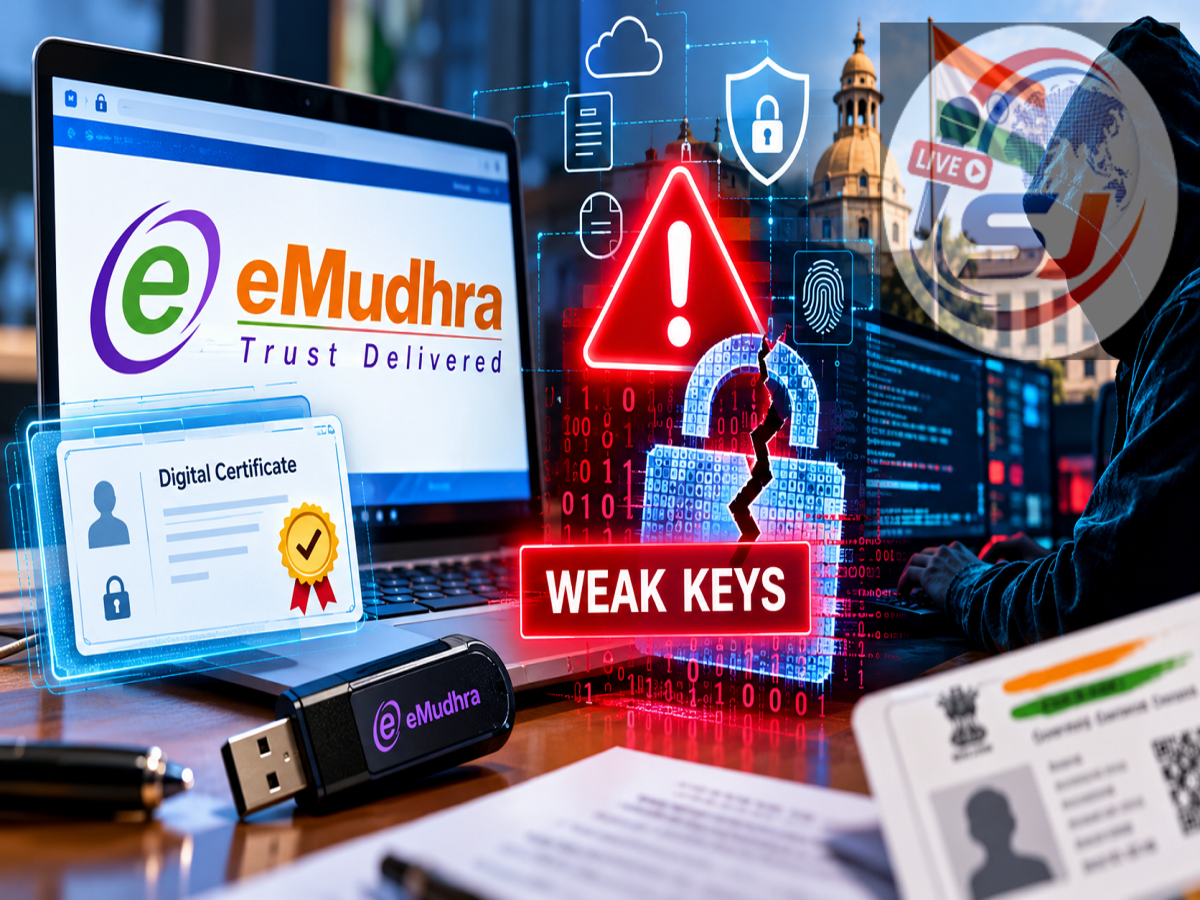
eMudhra Security Incident 2026: A serious security weakness involving digital certificates issued by eMudhra has raised concerns about the reliability of online authentication systems and the protection of digital infrastructure. The issue, highlighted in reports involving Google, Mozilla and the Indian Computer Emergency Response Team (CERT-In), has brought renewed attention to cybersecurity audits, encryption standards and the responsibilities of companies providing digital trust services.
According to the reported findings, eight intermediate Certificate Authority (CA) certificates associated with eMudhra were affected by weaknesses in the generation of their private keys. These keys are essential for establishing trust between websites, browsers and digital authentication systems.
Although the vulnerability could have allowed attackers to misuse certificate-signing capabilities under certain circumstances, there is no confirmed evidence in the supplied report of a widespread theft of Indian citizens' personal information.
CERT-In has also indicated that India's domestic digital signature and eSign services were not affected by the reported incident.
What Is eMudhra and Why Are Its Digital Certificates Important?
eMudhra is a digital trust and cybersecurity services company that provides electronic signatures, digital signature certificates and related authentication solutions.
Its services are used in different digital environments, including business transactions, electronic documentation and identity verification.
Digital certificates play an important role in establishing the authenticity of websites and software.
When users visit a secure website, their browser checks its digital certificate to determine whether the website's identity can be trusted.
This verification process relies on a system known as Public Key Infrastructure (PKI).
Within this system, Certificate Authorities issue and digitally sign certificates that help browsers and other applications authenticate websites and services.
Because these certificates are part of the internet's trust infrastructure, weaknesses in their management can create security risks extending beyond an individual company's internal systems.
What Went Wrong With eMudhra's Certificate Security?
According to the source report, the central issue involved the generation of private keys associated with eight intermediate CA certificates.
CERT-In reportedly issued an advisory on October 21, 2026, highlighting the security concern.
Private keys are confidential cryptographic values used to generate digital signatures and authenticate information.
They must be created using secure cryptographic methods that make them practically impossible to predict or reproduce without authorisation.
However, the reported eMudhra incident involved private keys generated with exceptionally weak numerical values.
One of the affected keys was reportedly associated with a value of just 4, while other reported values were below 256.
For properly generated cryptographic keys, the underlying secret values should come from an extremely large range of possible numbers.
When a private key is derived from a very small and predictable set of values, an attacker may be able to reconstruct it using publicly available certificate information.
This weakness can undermine the security guarantees that digital certificates are intended to provide.
Why Are Weak Private Keys a Serious Cybersecurity Risk?
A private key associated with a trusted Certificate Authority is a highly sensitive security asset.
If an unauthorised person obtains or reconstructs that key, they may be able to create certificates that appear to have been signed by the affected authority.
Depending on the certificate's permitted uses, browser trust settings and other technical conditions, this could enable attempts to impersonate legitimate websites.
For example, an attacker might try to present a fraudulent website as a trusted online service.
In some circumstances, compromised certificate-signing capabilities could also contribute to man-in-the-middle attacks, in which an attacker attempts to intercept or manipulate communications.
However, possession of a certificate-signing key does not automatically provide access to a user's device, banking account or encrypted communications.
Successful exploitation would depend on additional technical and operational conditions.
The reported weakness was nevertheless significant because it affected a component of the broader digital trust system.
Did the eMudhra Incident Expose Aadhaar, Banking or Government Data?
One of the most important distinctions in this case concerns the difference between a certificate security weakness and an actual personal data breach.
The reported problem involved cryptographic keys used within a digital certificate infrastructure.
It did not, by itself, establish that Aadhaar records, bank account information, passwords or government databases had been accessed.
According to the supplied report, CERT-In clarified that domestic digital signature and eSign services operating under India's relevant regulatory framework were not affected.
The reported incident concerned eMudhra's international website certificate operations.
This distinction is important because eMudhra operates in multiple digital trust environments, and a weakness in one certificate infrastructure does not necessarily compromise every service provided by the company.
At the time described in the report, there was no confirmed evidence of widespread personal data theft resulting from the incident.
Why Did Security Audits Fail to Identify the Problem Earlier?
The reported incident has also prompted questions about the effectiveness of cybersecurity audits.
According to the source material, eMudhra's relevant international operations had undergone independent security assessments.
Despite these checks, the weakness in private key generation was reportedly not identified before the issue came to public attention.
The company's initial explanation reportedly attributed the problem to an operational error during the key-generation process.
It suggested that a second set of weaker keys had been generated alongside the intended secure keys and that similarities in naming contributed to the wrong keys being used.
This explanation raises important questions about security controls, technical validation and certificate issuance procedures.
A comprehensive cybersecurity audit should examine not only whether an organisation follows documented procedures but also whether critical security processes function correctly in practice.
For Certificate Authorities, this includes secure key generation, access controls, hardware security protections, certificate lifecycle management and independent technical verification.
Google, Mozilla and CERT-In Respond to the Security Concern
According to the report, Google published findings about the affected certificates on October 20, 2026.
CERT-In subsequently issued an advisory on October 21.
Browser developers, including Google and Mozilla, reportedly took steps to restrict trust in the affected certificates.
Such measures can help prevent browsers from accepting certificates associated with compromised or otherwise untrustworthy certificate-signing infrastructure.
However, the exact protection available to users depends on their browser, operating system, software version and the specific trust-store changes implemented.
The reported response demonstrates the importance of cooperation between security researchers, browser developers, Certificate Authorities and national cybersecurity agencies.
Identifying a weakness is only one part of the response. Effective remediation also requires determining the cause, limiting possible exploitation and preventing similar failures.
Internet Freedom Foundation Calls for Greater Transparency
The Internet Freedom Foundation (IFF) reportedly raised concerns about the incident in an analysis published on October 22, 2026.
The organisation called for greater scrutiny of the company's security procedures, independent assessments and regulatory oversight.
According to the source report, IFF urged eMudhra, CERT-In and the Ministry of Electronics and Information Technology (MeitY) to support a detailed investigation and make relevant findings publicly available.
Transparency is particularly important when an incident involves systems that users rely on to establish digital authenticity.
Clear communication can help businesses, website operators and ordinary users understand whether they need to take protective action.
It can also help distinguish confirmed security failures from unverified claims about broader data exposure.
What Is the Indian Government's Responsibility?
India's digital infrastructure operates through a combination of public institutions, private technology providers, regulated service operators and international technology platforms.
The Controller of Certifying Authorities, functioning under the Ministry of Electronics and Information Technology, regulates India's domestic digital signature certification framework.
CERT-In serves as the national agency responsible for responding to specified cybersecurity incidents and issuing relevant security advisories.
However, the reported eMudhra weakness concerned international website certificate operations rather than the domestic eSign framework.
Consequently, regulatory responsibilities and the applicable technical standards may differ.
The incident nevertheless highlights the importance of effective oversight, clear incident-reporting requirements and cooperation between relevant authorities.
According to the supplied report, a special team was constituted to examine the matter.
The outcome of any investigation, including whether procedural failures or compliance issues occurred, would need to be established through official findings.
How Can Digital Certificate Security Be Improved?
The reported weakness illustrates why Certificate Authorities require particularly strong technical and operational safeguards.
Important protective measures include secure cryptographic key generation using approved random-number generation methods, appropriate hardware security modules and strict access controls.
Organisations should also implement independent validation of newly generated keys before certificates are issued.
Continuous monitoring can help detect unusual certificate activity, while effective revocation and trust-removal procedures can limit exposure when problems are discovered.
Security audits should examine real technical implementation rather than relying exclusively on written compliance documentation.
Regular penetration testing, incident-response exercises and independent cryptographic assessments can provide additional assurance.
No security framework can eliminate every possible risk, but layered controls can reduce the likelihood that a single operational mistake will affect trusted infrastructure.
What Should Internet Users Do After the eMudhra Alert?
Ordinary internet users do not necessarily need to replace their passwords or digital signatures solely because of this reported certificate incident.
However, maintaining basic cybersecurity practices remains important.
Users should keep browsers and operating systems updated so that certificate trust changes and security patches can take effect.
They should also pay attention to browser certificate warnings and avoid proceeding to websites flagged as insecure without understanding the risk.
Website administrators and businesses relying on digital certificates should review official vendor and browser security notices to determine whether their systems use affected certificate chains.
Where necessary, administrators may need to replace certificates or update their configurations in accordance with official technical guidance.
Users should also be cautious about messages claiming that their digital identity has been compromised and directing them to unfamiliar websites.
Such messages could themselves be phishing attempts.
Does the Incident Mean Digital India Services Are Unsafe?
The eMudhra case raises legitimate questions about digital infrastructure security, but it does not establish that India's entire digital ecosystem is compromised.
Digital banking, electronic signatures, government portals and online identity services operate through different technical systems and security arrangements.
A vulnerability affecting one certificate provider should therefore not be presented as proof that every government-supported digital service is unsafe.
At the same time, the incident demonstrates why digital expansion must be accompanied by strong security standards and effective accountability.
As more essential services move online, failures in authentication infrastructure can have consequences for businesses, public institutions and individual users.
Maintaining trust requires not only convenient digital services but also reliable safeguards, transparent incident reporting and timely corrective action.
Final Update: eMudhra Incident Highlights Need for Stronger Digital Trust Controls
The reported eMudhra security incident involving eight intermediate CA certificates has highlighted the risks associated with weak cryptographic key generation.
Although Google, Mozilla and CERT-In reportedly responded to the issue, questions remain about how the weakness passed through security controls and whether earlier technical validation could have prevented it.
Importantly, the supplied report does not establish widespread theft of Indian citizens' personal data, and India's domestic eSign and digital signature services were reported as unaffected.
The larger lesson is that cybersecurity depends on the reliability of the underlying systems, the quality of independent audits and the speed and transparency of incident response.
As India continues expanding digital services, strengthening these safeguards will remain essential for protecting users and maintaining confidence in online transactions.
Disclaimer: This article is based on the supplied October 23, 2026, report. The technical findings, dates and responses attributed to eMudhra, CERT-In, Google, Mozilla and IFF have not been independently verified against their original publications for this rewrite. No confirmed mass personal-data breach should be inferred from the reported certificate weakness.