
DIY Air Purifier Under ₹2,000: How to Make an Air Cleaner at Home Using a Fan and MERV 13 Filter
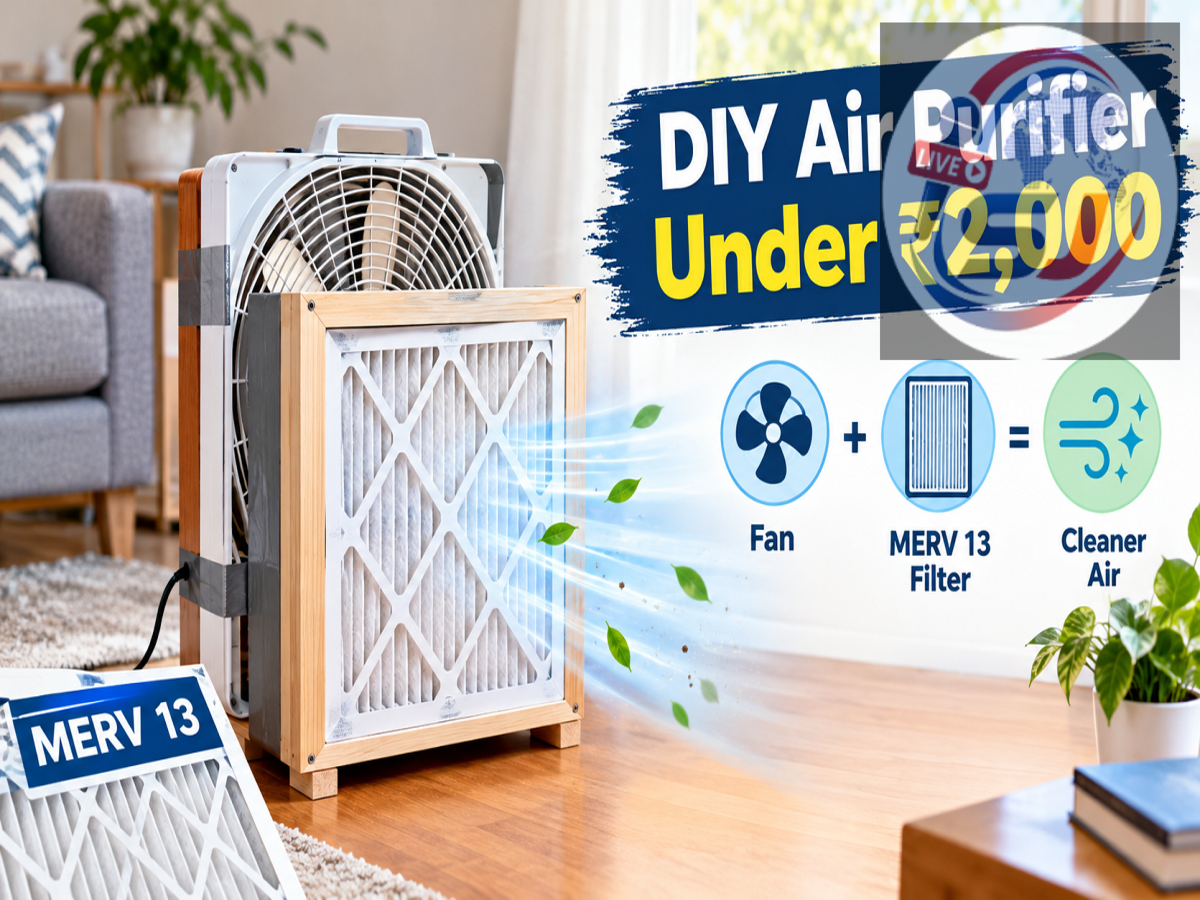
DIY Air Purifier at Home 2026: As air pollution continues to affect Delhi-NCR and several other Indian cities, maintaining cleaner indoor air has become an important concern for households. While branded air purifiers can cost several thousand rupees, a simple homemade air-cleaning device may offer a more affordable alternative for reducing airborne dust and fine particles.
A DIY air purifier can be assembled using a box fan, a high-efficiency air filter, cardboard, and strong adhesive tape. This arrangement is designed to pull polluted room air through a filter before circulating it back into the living space.
Depending on the availability and prices of materials, a basic setup may be possible for around ₹1,000–₹2,000, particularly if a suitable fan is already available. However, buying a new fan and a genuine MERV 13 filter may push the total cost above this budget.
For households seeking greater filtration capacity, another option is the Corsi-Rosenthal Box, which uses multiple filters to clean a larger volume of air.
Here is how these homemade air cleaners work, what materials are required, and which precautions should be followed.
What Is a DIY Air Purifier and How Does It Work?
A homemade air purifier is a basic filtration system that combines an electric fan with an air filter.
The fan creates airflow, drawing room air through the filter. As the air passes through the filter material, a portion of the suspended particles becomes trapped.
The filtered air is then circulated back into the room.
Such devices may help reduce indoor concentrations of airborne particles, including household dust, pollen, smoke particles, and PM2.5.
However, their performance depends on several factors, including filter efficiency, fan airflow, room size, and the quality of the assembly.
Materials Required to Build an Air Purifier at Home
For a simple single-filter design, the following components are commonly used:
| Material |
Purpose |
|---|---|
| 20 × 20-inch box fan |
Draws air through the filter |
| 20 × 20-inch MERV 13 filter |
Captures airborne particles |
| Strong cardboard |
Creates an airflow-directing shroud |
| Duct tape |
Seals gaps between the fan and filter |
| Clamps or suitable fasteners |
Securely attach components |
| Scissors or utility cutter |
Cut cardboard to the required shape |
A filter with a thickness of two to four inches can be useful because it generally provides a larger filter surface area than a thinner model of similar dimensions.
The fan and filter must be compatible in size, and the fan should be suitable for operation with the added airflow resistance.
How to Make a DIY Air Purifier: Step-by-Step Guide
How to make a DIY air filter with a box fan to protect against covid - The Washington Post
Step 1: Attach the Filter to the Fan
Place the MERV 13 filter against the air-intake side of the box fan. Check the arrow printed on the filter and ensure it points in the direction of airflow through the fan.
These DIY air purifiers are good for wildfire smoke - The Washington Post
Step 2: Seal the Edges
Use duct tape to close gaps between the filter frame and fan housing. This helps prevent unfiltered air from bypassing the filter.
How to make a DIY air filter with a box fan to protect against covid - The Washington Post
Step 3: Add a Cardboard Shroud
Cut a circular opening in a piece of cardboard and secure it around the fan's front grille without obstructing the blades or motor ventilation. A properly fitted shroud may improve effective airflow.
Corsi–Rosenthal Box Review | Tested & Rated
Step 4: Position and Operate the Device
Place the assembled unit on a stable surface with sufficient clearance around the intake and outlet. Check that all components are firmly attached before switching it on.
The filter should remain securely fitted during operation, and the device should be switched off and unplugged before cleaning or making adjustments.
What Is a Corsi-Rosenthal Box?
A Corsi-Rosenthal Box is a larger DIY air-cleaning arrangement designed to improve particle filtration by increasing the available filter area.
Instead of using one filter, a common design combines four MERV 13 filters into a box-shaped structure.
A box fan is attached to the top, while a cardboard base closes the bottom.
Air enters through the four filtered sides and exits through the fan.
This arrangement can reduce airflow resistance compared with a single-filter setup and may provide a higher volume of cleaned air.
Single-Filter Air Purifier vs Corsi-Rosenthal Box
Research conducted by the US Environmental Protection Agency (EPA) has examined the performance of different DIY air-cleaning designs.
In one reported comparison, a four-filter arrangement using one-inch MERV 13 filters achieved a Clean Air Delivery Rate (CADR) of approximately 401 cubic feet per minute.
A basic single-filter configuration achieved approximately 111 cubic feet per minute under the tested conditions.
Illustrative EPA test results: Clean Air Delivery Rate
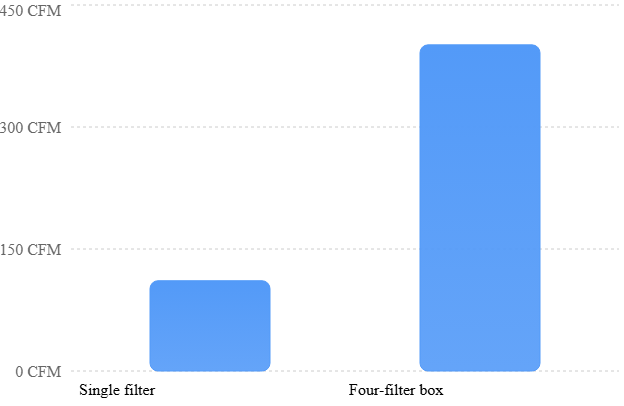
Values from the reported EPA comparison; performance varies by fan, filter and assembly.
Higher CADR means a greater volume of particle-cleaned air is delivered per minute. CFM means cubic feet per minute.
These results indicate that a well-designed multi-filter system can provide substantially greater airflow and particle removal capacity than a simple single-filter arrangement.
However, actual performance varies depending on the fan model, filter thickness, assembly quality, and operating conditions.
Can a Homemade Air Purifier Remove PM2.5 Pollution?
MERV 13 filters are designed to capture a significant proportion of smaller airborne particles, including particles in the PM2.5 size range.
PM2.5 refers to particulate matter with a diameter of 2.5 micrometres or less.
These particles can enter deep into the respiratory system and are associated with adverse health effects.
A properly assembled DIY air cleaner may reduce the concentration of these particles indoors, especially when used in a room with limited outdoor pollution entering through open doors or windows.
However, a homemade air purifier cannot eliminate all indoor air pollution.
It is also not a substitute for adequate ventilation when outdoor air quality permits, source control, or other necessary indoor air-quality measures.
Important Safety Precautions When Building a DIY Air Cleaner
Electrical and fire safety should remain a priority when assembling and operating a homemade air purifier.
Follow these precautions:
-
Use a modern, properly functioning fan with appropriate electrical safety features.
-
Avoid damaged, overheating, or unusually noisy fans.
-
Never block the fan motor's ventilation openings.
-
Keep loose tape, cardboard, and other materials away from moving blades.
-
Place the device on a stable surface away from water, curtains, and combustible materials.
-
Follow the manufacturer's operating instructions and avoid using an unsuitable fan with excessive filter resistance.
-
Inspect the filter regularly and replace it when necessary.
Children should not be allowed to handle the device's electrical components or moving parts.
How Often Should You Replace the Air Filter?
The replacement interval depends on the level of pollution, daily operating hours, filter specifications, and the amount of dust accumulated.
In heavily polluted environments, filters may become dirty faster.
Users should inspect the filter regularly and follow the manufacturer's replacement recommendations.
A heavily clogged filter can restrict airflow and reduce the device's cleaning performance.
Avoid washing disposable MERV 13 filters unless the manufacturer specifically identifies them as washable.
Can DIY Air Purifiers Remove Odours and Harmful Gases?
Basic MERV 13 filters primarily target airborne particles.
They are not designed to remove all gaseous pollutants, chemical vapours, or unpleasant odours.
Pollutants such as volatile organic compounds may require specialised filtration, including appropriate activated carbon systems.
Similarly, DIY air cleaners cannot remove carbon monoxide and should never be used as a substitute for carbon monoxide alarms or proper ventilation.
The main purpose of a fan-and-filter arrangement is to reduce airborne particulate pollution.
Is a ₹2,000 DIY Air Purifier Worth Considering?
A homemade air purifier may be a practical option for households that want to improve indoor particle filtration without purchasing a more expensive commercial device.
The single-filter design is relatively simple to assemble, while the Corsi-Rosenthal Box can provide greater cleaning capacity when suitable materials are available.
However, the total cost depends on local prices, filter availability, and whether a compatible fan is already owned.
The most important consideration is not simply the initial cost but whether the assembled device can provide adequate airflow, reliable filtration, and safe operation.
Final Takeaway
With a suitable box fan, MERV 13 filter, cardboard, and duct tape, it is possible to construct a basic homemade air cleaner that can help reduce indoor airborne particles.
For larger rooms or greater cleaning requirements, a four-filter Corsi-Rosenthal Box may offer better performance.
While a ₹1,000–₹2,000 budget may be sufficient when some components are already available, the complete setup can cost more.
A DIY air purifier can help reduce dust and PM2.5 indoors, but it cannot remove every pollutant or guarantee completely clean air.
For reliable performance, users should choose quality components, follow electrical safety precautions, and replace filters when required.
Disclaimer: DIY air-cleaner performance and costs vary according to materials, assembly, and operating conditions. Homemade filtration devices are not certified substitutes for all commercial air-cleaning systems.