DigiLocker vs Bank Locker: Which Is Safer for Your Documents and Valuables? Know 5 Key Security Rules
Protecting valuables and important documents is an essential part of financial and personal security. Jewellery, property papers, educational certificates, driving licences and other records can be difficult or expensive to replace if they are lost, damaged or stolen.
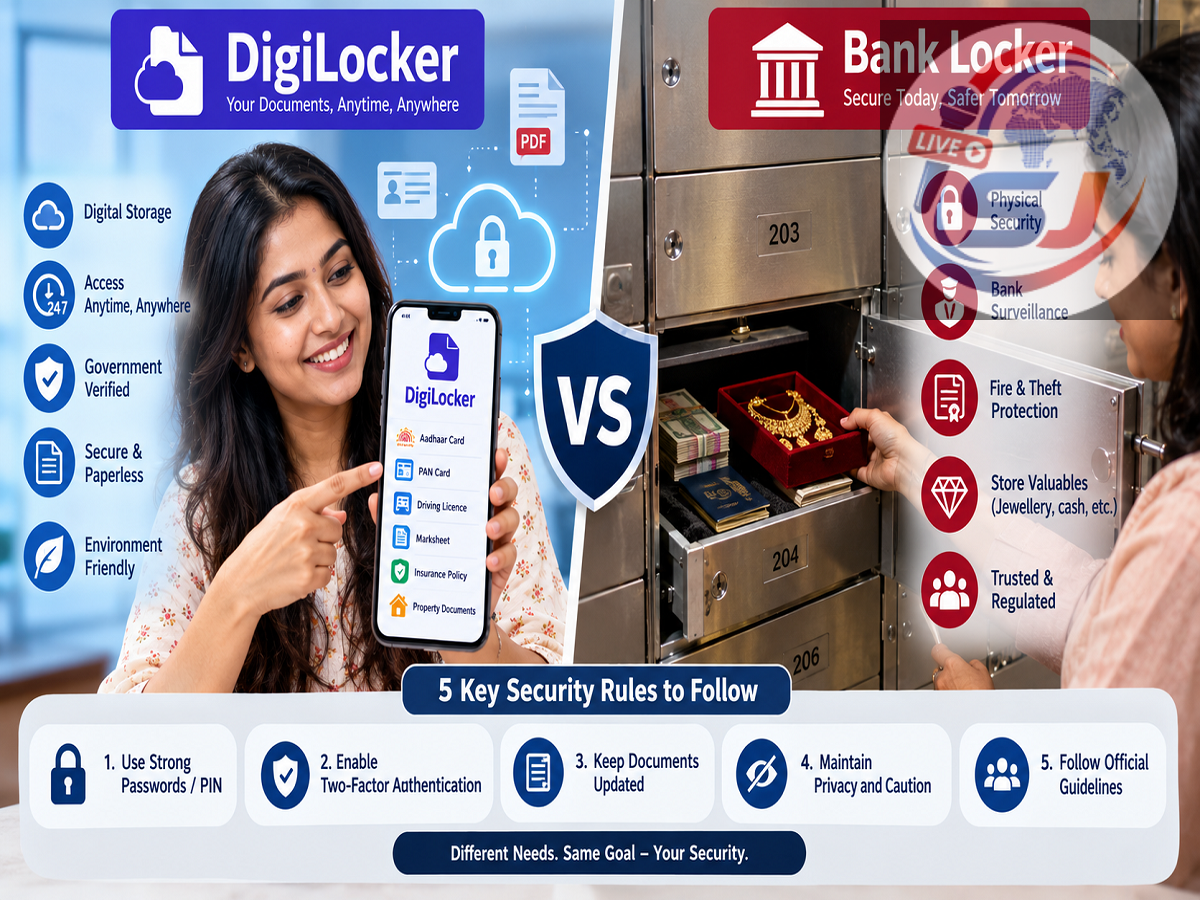
Today, people commonly hear about two very different security options: a bank safe-deposit locker and the government's DigiLocker platform.
Despite the similarity in their names, these services are not direct substitutes. A bank locker is designed primarily for storing eligible physical valuables, while DigiLocker provides digital access to documents and credentials.
Understanding what each service can—and cannot—protect is important before deciding where your valuables and records should be kept.
1. Bank Lockers Are Designed for Physical Valuables
A bank locker provides physical storage inside a bank's secured premises.
Customers typically use lockers for permitted valuables and important original documents that they do not want to keep at home. Access is controlled according to the bank's locker agreement and operating procedures.
Banks generally have physical security arrangements for locker areas, but customers should not assume that a locker comes with unlimited financial protection against every possible loss.
The customer also has to pay locker rent, which can vary according to the bank, branch location and locker size.
2. Bank Liability Is Not the Same as Full Insurance
This is an important point for anyone keeping expensive valuables in a bank locker.
Under the RBI framework, banks can face liability in specified situations involving their responsibility, including certain incidents such as fire, theft, burglary, robbery, building collapse or fraud by bank employees, subject to the applicable rules.
In specified cases, the bank's liability can be limited to an amount equivalent to 100 times the prevailing annual locker rent.
That does not necessarily equal the market value of everything stored inside the locker.
For example, jewellery kept in a locker could be worth substantially more than the compensation calculated on the basis of annual locker rent.
Customers should therefore read their locker agreement carefully and consider whether separate insurance is appropriate for high-value assets.
3. DigiLocker Is for Digital Documents, Not Jewellery
DigiLocker serves an entirely different purpose.
It is a government-backed digital platform designed to provide citizens with access to electronic documents and credentials.
Depending on issuer availability, users can access documents such as driving licences, vehicle registration certificates, educational records and other digitally issued documents through the platform.
But DigiLocker is obviously not a physical vault.
You cannot store jewellery, gold, silver, property keys or other physical assets in it.
Even when it comes to documents, users should understand the difference between an electronic record issued through the DigiLocker ecosystem and a document that a user has simply uploaded to their storage space.
4. Issued DigiLocker Documents Can Have Legal Validity
One of DigiLocker's major benefits is that eligible electronic records made available by authorised issuers can be used as legally recognised digital documents under the applicable electronic-record framework.
This can reduce the need to carry original physical documents everywhere.
For example, if an eligible document is available digitally through an authorised issuer, the user may be able to access it directly from DigiLocker whenever required, subject to the rules of the service where it is being presented.
However, users should not assume that every scanned file they personally upload automatically becomes equivalent to an issuer-generated authenticated document.
That distinction is important.
5. Is DigiLocker Completely Safe?
No digital platform should be described as absolutely immune to security threats.
DigiLocker incorporates security and authentication mechanisms intended to protect user accounts and information. But account security also depends heavily on how carefully the individual uses the service.
If a user shares an OTP, falls for a phishing website, gives someone access to their phone or uses weak security practices, the risk of unauthorised account access can increase.
Therefore, it is more accurate to describe DigiLocker as a platform with security controls rather than claiming that cyberattacks are impossible.
Protect Your Registered Mobile Number
Your registered mobile number can play an important role in account authentication.
That means the security of the phone and SIM associated with your digital accounts deserves equal attention.
Use a strong screen lock on your smartphone and do not share OTPs with anyone. Be cautious when receiving calls or messages claiming that your DigiLocker account will be blocked unless you immediately verify your identity through an unknown link.
Scammers often create urgency to persuade victims to reveal sensitive information.
Beware of Fake DigiLocker Websites and Apps
Phishing is one of the most practical risks users need to consider.
A fraudulent website may imitate the appearance of a genuine government portal and ask users to enter their mobile number, Aadhaar-related information, OTP or other credentials.
Similarly, fake applications or links sent through WhatsApp, SMS, email or social media may claim to provide document-verification services.
Users should access DigiLocker only through its official platform and authorised application.
Never install an APK file sent by an unknown person simply because it claims to provide a DigiLocker update.
DigiLocker Offers Convenience That a Bank Locker Cannot
Accessibility is one of the biggest advantages of digital document storage.
A physical bank locker normally requires the customer to visit the branch and follow its access procedures. DigiLocker, in contrast, can provide access to available digital records through supported online channels without requiring a branch visit.
This can be particularly useful while travelling or when a document needs to be retrieved quickly.
The convenience, however, comes with a responsibility to keep the account and connected devices secure.
Bank Lockers Have Their Own Limitations
Bank lockers provide strong physical-security advantages, but they are not perfect for every purpose.
Customers usually have to pay annual rent, locker availability may be limited at some branches, and access generally requires following the bank's prescribed process.
A locker also does not give you instant remote access to a document when you are hundreds of kilometres away.
Therefore, using a bank locker to store every document without maintaining appropriate digital access can sometimes be inconvenient.
DigiLocker and Bank Locker Should Work Together
The best strategy for many people is not to choose one and completely reject the other.
Instead, use each for the purpose it is designed to serve.
Valuable physical assets and important original papers that need secure physical storage may be kept in an appropriate safe location such as a bank locker, subject to the bank's terms and rules.
Eligible digital credentials, meanwhile, can be accessed through DigiLocker for convenience and easier verification.
Physical Security and Digital Security Need Different Strategies
Bank lockers and DigiLocker solve two different security problems.
A bank locker protects eligible physical items, while DigiLocker helps users access and manage eligible digital documents and credentials.
Neither should be treated as completely risk-free.
For physical valuables, understand the bank's locker agreement, liability provisions and whether additional insurance is needed. For DigiLocker, protect your registered mobile number, avoid phishing links, never disclose OTPs and access the service only through official channels.
Used correctly, the two services can complement each other—one protecting important physical possessions and the other making essential digital records easier to access when needed.