
Cyber Fraud Money Recovery: New I4C System Lets Victims Request Frozen Funds Online From Home
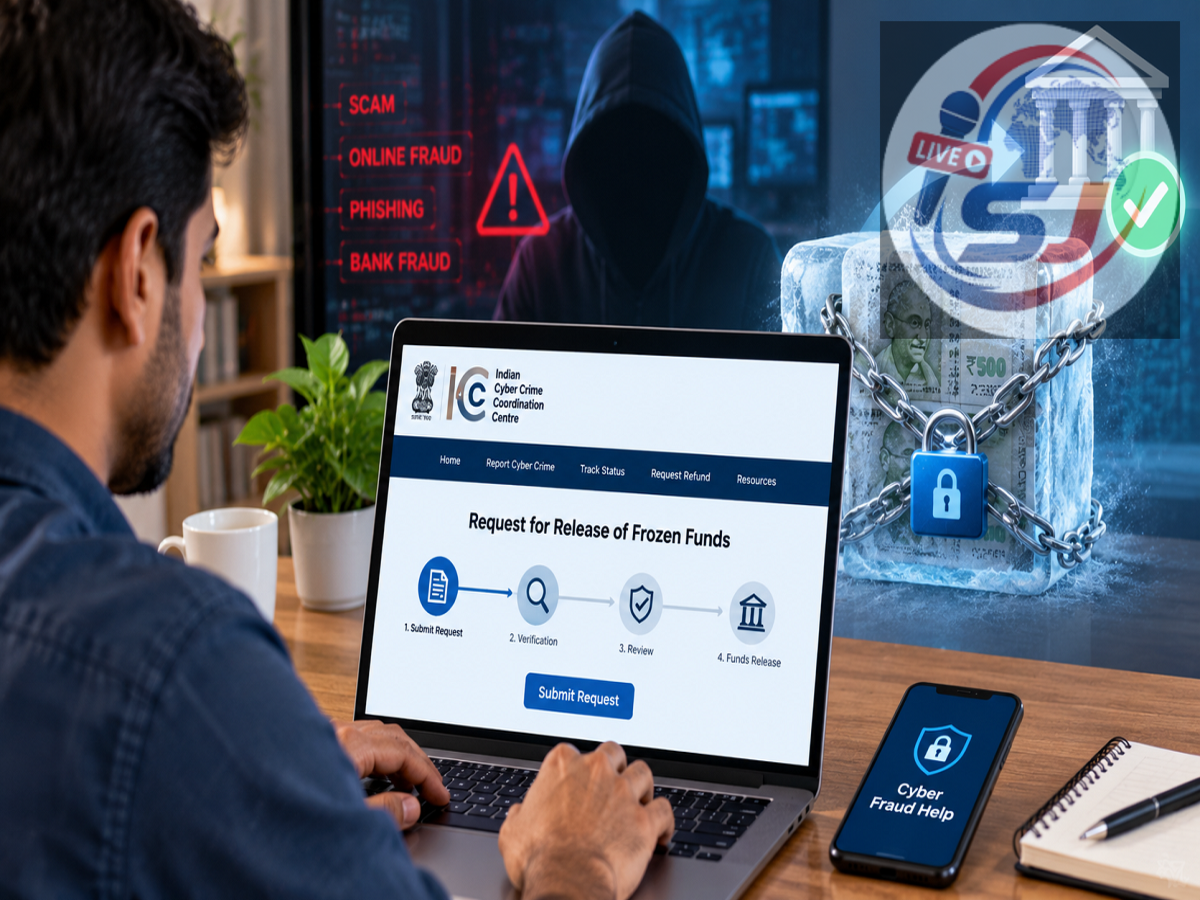
Cyber Fraud Money Recovery: People who lose money to online scams often face another lengthy process even after the suspicious transaction has been traced and the stolen amount frozen. A new initiative linked to the Indian Cyber Crime Coordination Centre (I4C) aims to make the restoration process simpler by allowing eligible cyber-fraud victims to submit an online request for the return of frozen funds.
The Money Restoration Module is designed to reduce dependence on repeated visits and paperwork when money involved in a reported cybercrime has already been intercepted or frozen.
However, victims should understand one important point: the system does not guarantee that every amount lost in a cyber fraud case will automatically be refunded. Restoration depends on whether the money has actually been traced and frozen, along with the required verification and applicable legal procedures.
What Is the I4C Money Restoration Module?
I4C operates under the Ministry of Home Affairs and coordinates efforts to combat cybercrime across India.
The Money Restoration Module focuses on one of the most difficult stages for victims—the process of getting back money that authorities and financial institutions have successfully frozen after a cyber-fraud complaint.
Until now, even when an amount was blocked in a beneficiary or suspect account, returning that money to the victim could involve multiple procedural steps.
The new system seeks to make this process more digitally accessible.
Instead of assuming that frozen money will automatically return to the original bank account, an eligible complainant can initiate a restoration request through the prescribed online process.
Why Is Quick Reporting Important?
Speed remains one of the most important factors after discovering an online financial fraud.
Scammers frequently transfer stolen money through multiple bank accounts or payment channels soon after receiving it. The longer a victim waits to report the transaction, the greater the possibility that the funds will be moved further or withdrawn.
This is why victims of UPI fraud, investment scams, fake loan schemes, impersonation fraud, digital arrest scams and other financial cybercrimes should report the incident as quickly as possible.
India's cyber-fraud reporting mechanism includes the 1930 helpline and the National Cyber Crime Reporting Portal.
Providing accurate transaction details can help banks and law-enforcement agencies identify the movement of funds and attempt to stop them before they disappear from the financial system.
How the Money Restoration Process Can Help
Suppose a victim transfers money to a fraudster and reports the incident quickly.
If authorities are able to trace the transaction and a bank successfully freezes the relevant amount before it is withdrawn or moved elsewhere, that money may remain blocked.
But freezing money and returning it to the victim are two different stages.
The Money Restoration Module is intended to help bridge this gap.
Eligible victims can submit a request for restoration through the online mechanism. The case and frozen amount can then go through the required verification and approval process before the money is restored, where permissible.
This could make the recovery journey more convenient for victims who previously had to navigate a more cumbersome offline process.
Not Every Cyber Fraud Loss Can Be Recovered
The announcement should not be interpreted to mean that the government can recover every rupee stolen through cybercrime.
A refund generally becomes possible only when the fraudulent money—or a corresponding amount—has been successfully identified and frozen.
For example, if a victim loses ₹1 lakh but authorities manage to freeze only ₹40,000 before the remaining money is moved or withdrawn, the entire ₹1 lakh should not be assumed to be immediately recoverable through the module.
The actual restoration would depend on the amount available, verification of the victim's claim and the applicable process.
This distinction is important because misleading messages claiming that "all cyber-fraud money can now be recovered online" could create unrealistic expectations.
What Should Victims Do Immediately After a Fraud?
Anyone who discovers an unauthorised or fraudulent financial transaction should act quickly.
First, contact the concerned bank or payment service and report the suspicious transaction. Request appropriate action on the account or payment instrument if necessary.
The incident should also be reported promptly through the official cybercrime reporting mechanism, including helpline number 1930 for financial cyber-fraud complaints.
Keep transaction IDs, bank statements, UPI references, phone numbers, screenshots, messages, emails and other evidence related to the fraud.
These records may be important while tracing the transaction and verifying the complaint.
Beware of Fake 'Money Recovery' Messages
The introduction of a money-restoration facility can itself become an opportunity for scammers.
Cybercriminals may impersonate government officials, police officers, banks or I4C representatives and claim that a victim's frozen money is ready to be released.
They may then demand a "processing fee," OTP, UPI PIN, card information or remote access to the victim's phone.
Such requests should be treated with extreme caution.
A person trying to recover money lost in one cyber scam should not end up becoming a victim of another.
Never disclose your OTP, UPI PIN, debit or credit card PIN, CVV, internet-banking password or other confidential banking credentials to someone claiming they can release frozen funds.
Don't Install Screen-Sharing Apps on Someone's Instructions
Fraudsters frequently persuade victims to install screen-sharing or remote-access applications under the pretext of helping them complete a refund or verification.
Once remote access is granted, criminals may be able to observe sensitive information displayed on the phone or manipulate the user into authorising additional transactions.
Use only official channels for reporting and tracking cybercrime complaints.
If someone unexpectedly contacts you promising an instant refund, verify the claim independently rather than following links or instructions provided in the message or call.
Frozen Money and Recovered Money Are Not the Same
This distinction is crucial for understanding how cyber-fraud recovery works.
When a bank account is frozen, the relevant money is essentially prevented from being transferred or withdrawn, subject to the action taken in the case.
That does not automatically establish that the entire frozen balance belongs to one particular complainant.
Authorities may need to examine transaction records, establish the trail of funds and verify claims before restoration.
The Money Restoration Module aims to streamline this later stage, but required checks remain important.
The 1930 Helpline Remains Important
The new restoration mechanism does not reduce the importance of India's existing cybercrime reporting system.
For victims, the first priority after discovering financial cyber fraud should still be rapid reporting.
Calling 1930 as soon as possible can improve the chances of action being initiated before the money is moved through additional accounts.
Victims can also file a detailed complaint through the government's cybercrime reporting portal and preserve the acknowledgement or complaint number for further follow-up.
A Digital Step Toward Faster Cyber-Fraud Relief
The I4C Money Restoration Module could make an important part of the cybercrime recovery process more convenient by enabling eligible victims to request the return of already-frozen funds digitally.
Its biggest benefit is not that it magically reverses every fraudulent transaction. Rather, it seeks to simplify the procedure once authorities have succeeded in locating and freezing money linked to a reported cybercrime.
For consumers, the basic rule remains unchanged: report financial cyber fraud immediately, preserve all evidence and use only official channels for recovery.
The faster a fraudulent transaction is reported, the better the possibility that banks and cybercrime authorities may be able to intercept at least some of the money before criminals move it elsewhere.
And if funds are successfully frozen, the new online restoration mechanism could make the next stage—getting eligible money back into the victim's hands—more straightforward than before.