
Can the Government Hack Your Phone? Truth About Call Monitoring, Camera Access and Location Tracking in India
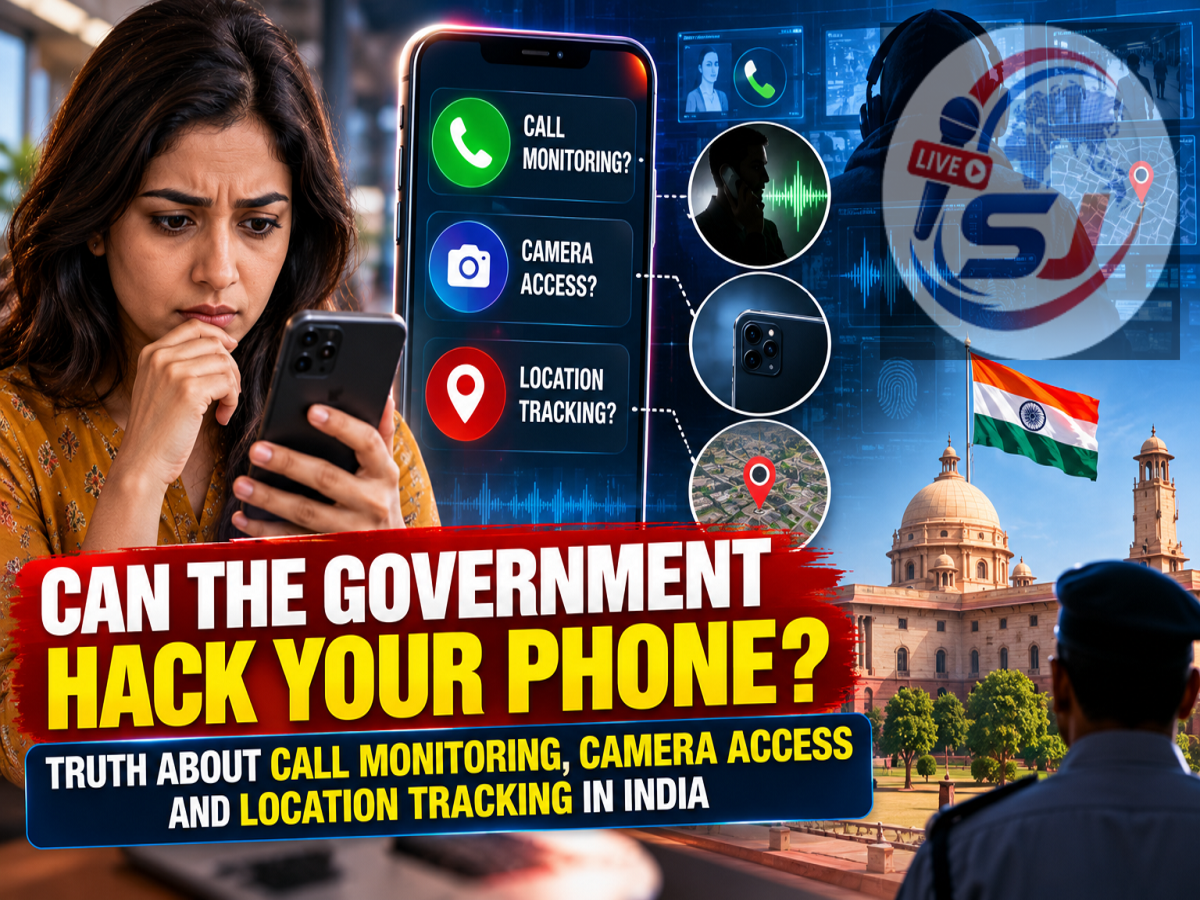
Smartphone Privacy and Government Surveillance 2026: Can the government listen to your phone calls, secretly activate your smartphone camera or track your location without your knowledge? These questions have become increasingly important as smartphones play a central role in everyday communication, banking, work and personal activities.
In India, government authorities have certain legal powers to intercept communications and conduct surveillance under specified circumstances. However, these powers are subject to legal conditions and procedures.
Having the legal authority to monitor certain communications does not automatically mean that government agencies can remotely activate the camera or microphone of every smartphone.
Advanced surveillance technologies, including sophisticated spyware, have demonstrated that smartphones can be vulnerable to targeted attacks. But there is an important difference between lawful communication interception, location tracking and hacking an individual device.
Here is a detailed explanation of what Indian law permits, what surveillance technology can do and how users can protect their digital privacy.
Can the Indian Government Listen to Your Phone Calls?
Indian law provides mechanisms for authorised government agencies to intercept certain communications under prescribed circumstances.
Section 69 of the Information Technology Act, 2000, allows the government to issue directions for the interception, monitoring or decryption of information transmitted, received or stored through computer resources, subject to statutory conditions.
Such powers may be exercised on specified grounds, including national security, public order and other legally recognised interests.
However, these actions are subject to prescribed procedures, safeguards and approval requirements.
Telecommunications interception is also governed by the applicable telecom legislation and rules.
This means that authorities may have the legal ability to intercept certain communications, but it would be incorrect to conclude that every citizen's phone calls are continuously monitored.
The existence of surveillance powers is not evidence that those powers are being exercised against a particular individual.
What Did the Government Say About Surveillance Agencies in 2018?
In December 2018, the Indian government faced public questions regarding an order identifying agencies authorised to conduct interception, monitoring and decryption under the Information Technology Act.
The government clarified that the order concerned the implementation of an existing legal framework rather than the creation of entirely new surveillance powers.
The controversy nevertheless highlighted concerns about privacy, oversight and the circumstances in which authorities may access digital communications.
The legal framework requires authorised processes, but questions about the effectiveness of oversight and the protection of citizens' rights remain important subjects of public debate.
Can the Government Remotely Activate Your Phone Camera?
Accessing a smartphone camera remotely is technically different from intercepting a telephone call.
A conventional interception mechanism does not automatically provide unrestricted access to the phone's camera, microphone, photographs or stored files.
To remotely control these features without the owner's permission, an attacker may need privileged access to the device.
Such access could potentially be obtained through malicious software, compromised credentials or exploitation of a security vulnerability.
Sophisticated spyware can sometimes gain extensive access to a smartphone, depending on the device, operating system and exploit used.
However, this does not establish that authorities can access every smartphone at will.
A claim that a specific device has been compromised requires reliable technical evidence.
What Is Pegasus Spyware and Why Is It Important?
Pegasus spyware has been at the centre of international discussions about digital surveillance and smartphone security.
Advanced spyware can potentially collect sensitive information from compromised devices, including communications and other data accessible to the software.
Some sophisticated attacks may exploit vulnerabilities without requiring the user to knowingly install a malicious application.
These technologies demonstrate that modern smartphones are not completely immune to targeted surveillance.
However, the existence of spyware does not mean that every device is infected or that ordinary users are routinely being targeted.
It is also important to distinguish allegations of surveillance from independently verified evidence of a particular device being compromised.
Can the Government Track Your Mobile Location?
Mobile location tracking can occur through several technologies.
One method involves information generated by the cellular network.
When a phone connects to mobile towers, the network may have information that can help estimate the device's location.
The precision of this estimate depends on factors such as tower density, network technology and the information available.
A smartphone may also determine its location through satellite navigation systems, assisted GPS, Wi-Fi networks and other positioning technologies.
These methods can provide more precise location information under suitable conditions.
However, access to network-based location data and access to a phone's precise GPS coordinates are not technically identical.
Whether a government authority may obtain such information depends on the applicable law, circumstances and access mechanism.
Does Turning Off GPS Stop All Location Tracking?
Disabling location services can reduce the amount of precise location information available to applications.
However, it does not necessarily prevent a mobile network from estimating the location of a connected phone.
Even when GPS is switched off, a phone generally communicates with cellular infrastructure to provide mobile connectivity.
Therefore, turning off GPS should not be treated as a guarantee that the device's location cannot be estimated through other means.
Users should also review location permissions granted to individual applications.
Some apps may request continuous location access even when it is not necessary for their primary function.
What Was the Controversy Over Always-On Location Tracking?
According to a Reuters report published in December 2025, a proposal concerning continuously enabled satellite-based location tracking on smartphones was under discussion in India.
The report indicated that major technology companies, including Apple, Google and Samsung, had raised privacy-related concerns about the proposal.
At the time of that report, the proposal had not been described as a final implemented requirement.
A proposal being considered by policymakers should not be confused with an enforceable rule.
Users should therefore be cautious about social media claims suggesting that all smartphones in India are legally required to keep GPS permanently enabled.
Why Was the Sanchar Saathi App Controversial?
The government's Sanchar Saathi initiative is intended to help users with telecom-related security services, including reporting suspicious communications and checking mobile connections.
However, a separate controversy arose in late 2025 over a government direction concerning the pre-installation of the Sanchar Saathi application on new smartphones.
The proposal attracted criticism over mandatory installation, user choice and privacy implications.
Following the controversy, the government withdrew the mandatory pre-installation direction on December 3, 2025.
The episode demonstrated how smartphone-related government policies can raise important questions about privacy and individual control over personal devices.
Nevertheless, the presence of a government application on a smartphone does not, by itself, prove that the phone has been hacked or that authorities have unrestricted remote access.
What Does India's Right to Privacy Mean for Smartphone Users?
The Supreme Court of India recognised the right to privacy as a fundamental right in its landmark 2017 judgment in Justice K.S. Puttaswamy (Retd.) v. Union of India.
The judgment established an important constitutional foundation for evaluating government actions affecting personal privacy.
However, the right to privacy is not absolute.
Restrictions may be permissible when they meet applicable constitutional requirements, including legality, legitimate purpose and proportionality.
Government surveillance measures must therefore be assessed within the relevant legal and constitutional framework.
The recognition of privacy as a fundamental right does not mean that all forms of lawful interception are prohibited.
Equally, the existence of surveillance legislation does not eliminate constitutional protections.
Call Monitoring vs Phone Hacking: Understand the Difference
| Activity |
What It Means |
Does It Automatically Mean the Phone Is Hacked? |
|---|---|---|
| Call interception |
Accessing communications through an authorised interception mechanism |
No |
| Network-based location tracking |
Estimating location using telecom network information |
No |
| GPS location access |
Obtaining location information through device or app-based mechanisms |
No |
| Camera or microphone compromise |
Gaining unauthorised or privileged access to device sensors |
May involve device compromise |
| Spyware infection |
Installing or exploiting software to obtain information or control |
Yes, it generally involves compromise |
| Government app installation |
Installing an official application |
No |
Understanding these differences can help users evaluate alarming claims about smartphone surveillance more accurately.
How Can You Protect Your Phone From Spyware and Unauthorised Access?
Although no smartphone can be guaranteed completely secure, several practical measures can reduce the risk of compromise.
-
Keep your operating system updated. Install security updates released by the device manufacturer.
-
Download apps from trusted sources. Avoid installing applications from unknown links or unofficial websites.
-
Review app permissions. Check which applications can access your camera, microphone, contacts and location.
-
Use strong device security. Enable a secure screen lock and appropriate account protection.
-
Avoid suspicious messages. Do not open unexpected attachments or links claiming to be urgent security notices.
-
Check for unusual activity. Unexpected settings changes, unfamiliar apps or security warnings may warrant further investigation, although they are not proof of spyware.
-
Use official support channels. Seek professional assistance if there is credible evidence that your device has been compromised.
Users facing a suspected targeted spyware attack may need specialist technical analysis rather than relying only on ordinary antivirus scans.
Can the Government Access WhatsApp Calls and Messages?
Applications such as WhatsApp use end-to-end encryption for personal messages and calls.
This means that the content of protected communications is designed to be accessible only to the communicating endpoints, rather than being available as ordinary readable traffic to intermediaries.
However, encryption does not prevent every possible form of surveillance.
If a device itself is compromised, an attacker may be able to access information at the endpoint.
Certain account information and metadata may also be handled differently from message content, depending on the service and applicable law.
Therefore, end-to-end encryption offers important protection but should not be confused with complete immunity from device compromise.
Can You Know Whether Your Phone Is Being Monitored?
There is no simple, universally reliable indicator that proves a phone is under government surveillance.
Battery drain, overheating or unusually high data consumption can occur for many ordinary reasons and should not automatically be interpreted as evidence of hacking.
Likewise, a phone functioning normally does not rule out every sophisticated security threat.
If a user receives a credible security alert or has specific evidence of compromise, appropriate investigation may be necessary.
For most users, maintaining updated software and limiting unnecessary permissions remains a sensible starting point.
Final Verdict: Can the Government Hack Your Phone?
Indian authorities have legal powers to conduct certain forms of communication interception and surveillance under specified circumstances.
Mobile network information may also make it possible to estimate a connected device's location.
However, legal authority to intercept communications is not the same as having unrestricted technical access to every smartphone's camera, microphone or stored information.
Remote device compromise generally requires a separate technical capability, such as privileged access, malicious software or exploitation of vulnerabilities.
The existence of these capabilities does not prove that a particular individual is being monitored.
For smartphone users, the most useful approach is to understand the difference between lawful surveillance, network-based tracking and actual device hacking while following basic digital security practices.
Disclaimer: This article provides general information about Indian surveillance laws, smartphone technology and digital privacy as of October 14, 2026. It does not constitute legal or forensic security advice.