
Are Photos Sent on WhatsApp Really Safe? Know How Encryption Works and Where Privacy Risks Remain
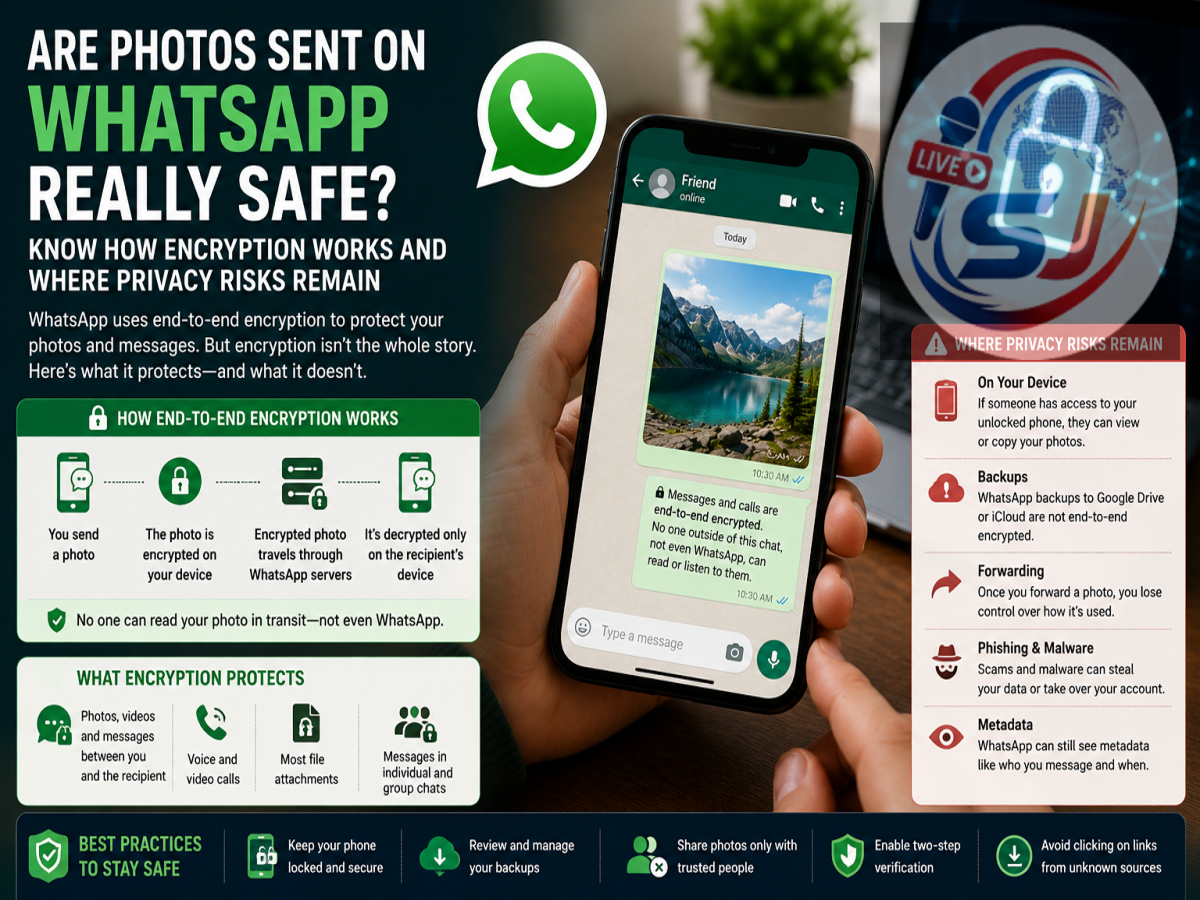
WhatsApp Photo Safety: Photos, videos and messages shared in personal WhatsApp chats are protected by end-to-end encryption by default. However, users still need to be careful while sharing private documents, financial information and personal pictures.
WhatsApp is no longer used only for casual conversations. Millions of people rely on the messaging platform every day to exchange photos, videos, screenshots, documents, bills and other important information. From family pictures to office documents, a significant amount of personal data now passes through messaging apps.
At the same time, increasing awareness about cyber fraud, phishing and account hacking has raised an important question: How safe is it to send a photo through WhatsApp?
WhatsApp provides strong encryption for personal communications, but encryption alone cannot protect users from every privacy threat. Understanding where the protection works—and where it ends—is important before sending sensitive photographs or documents.
WhatsApp Photos Are Protected by End-to-End Encryption
Messages, photos and videos exchanged through personal WhatsApp conversations are protected by end-to-end encryption by default.
In simple terms, when you send a photograph, the content is encrypted before travelling across the internet. It is designed so that the intended recipient's device can access the content.
According to WhatsApp's security model, even WhatsApp itself cannot normally read the content of end-to-end encrypted personal messages while they are being transmitted.
This provides an important layer of security against someone simply intercepting your internet connection and viewing the photograph.
Does Encryption Mean a Photo Is 100% Private?
No. This is where users need to understand an important difference.
End-to-end encryption protects the communication between the sender and recipient, but it cannot necessarily control what happens to the photograph after it reaches the recipient's device.
For example, depending on the type of message and available features, the recipient may be able to save, forward or otherwise retain the image.
Therefore, before sharing a highly personal photograph, users should consider whether they trust the person receiving it.
What Happens When a Photo Is Downloaded?
Regular photographs received through WhatsApp may be stored on the recipient's device depending on their settings and actions.
Once a copy exists on another person's phone, its security also depends on that device.
If the recipient's smartphone is stolen, compromised by malware or accessed by another person, stored photographs could potentially become exposed.
That means WhatsApp's encryption cannot substitute for good device security.
Is 'View Once' Safer for Private Photos?
WhatsApp provides a View Once option for certain photos and videos.
When this feature is used, the media is intended to be opened once rather than remaining as an ordinary media item in the conversation.
It can be useful when a sender does not want a regular photograph permanently sitting inside the chat.
However, users should not treat View Once as an absolute guarantee of confidentiality. No digital sharing method can completely prevent someone from using another device or method to capture information displayed on a screen.
Therefore, extremely sensitive material should ideally not be shared digitally unless necessary.
Think Twice Before Sending Financial Documents
Users should exercise greater caution when a photograph contains identity or financial information.
Pictures of PAN cards, Aadhaar cards, passports, bank statements, credit or debit cards and signed documents may contain information that could potentially be misused.
If such a document genuinely needs to be sent, verify the identity of the recipient and share only the information that is actually required.
Users should never send their banking PIN, password, card CVV or OTP through WhatsApp, even to someone claiming to represent a bank or financial institution.
Cybercriminals Can Pretend to Be Someone You Know
Another risk has little to do with WhatsApp's encryption technology.
Fraudsters may compromise an account or impersonate a friend, relative, employer, bank representative or company executive and then ask for money, documents or confidential information.
Because the conversation itself is encrypted, users may mistakenly assume that every request received inside WhatsApp is trustworthy.
Encryption protects the message, not necessarily the identity or intentions of the person on the other side.
If someone unexpectedly asks for financial documents, money or confidential photographs, verify the request separately before sending anything.
Check WhatsApp Linked Devices
Users should periodically review devices connected to their WhatsApp account.
Open WhatsApp and check the Linked Devices section. If you notice a computer, browser or device that you do not recognize, log it out immediately.
This is particularly important for people who regularly use WhatsApp Web or WhatsApp on shared computers.
Enable Two-Step Verification
Two-step verification can add another layer of protection to a WhatsApp account.
When enabled, WhatsApp uses an additional PIN during certain account-registration situations. Users should choose a PIN that is difficult for others to guess and should never share it.
It is also important to keep the phone's operating system and WhatsApp application updated, as updates can contain security improvements and bug fixes.
What About WhatsApp Chat Backups?
Backups deserve separate attention because protecting a message during transmission and protecting its stored backup are not exactly the same thing.
WhatsApp provides options for end-to-end encrypted backups. Users who store important or sensitive conversations should review their backup and security settings and understand how their backup is protected.
Any password or encryption credential associated with a protected backup should also be stored securely.
So, Is It Safe to Send Photos on WhatsApp?
For normal everyday conversations, WhatsApp's end-to-end encryption provides an important level of protection for photos, videos and personal messages.
But users should remember one simple principle: encryption protects the journey of the photograph; it cannot guarantee what happens after the recipient receives it.
Before sharing something sensitive, ask whether the recipient really needs it and whether you would be comfortable if another copy of that photograph existed.
For family pictures and ordinary media, WhatsApp can be a convenient way to communicate. But when it comes to identity documents, banking information or highly private photographs, a little extra caution can prevent a much bigger problem later.
Disclaimer: This information is provided for general cybersecurity awareness. WhatsApp features and security settings may change with future updates.