
Train Seat Swap Debate: Passenger Allegedly Asked ₹1,050 to Give Up Side Lower Berth
Requests to exchange berths are common during train journeys in India. Elderly passengers may ask for a lower berth, families sometimes want to sit together, and passengers travelling with children may request a more convenient seat. Usually, such exchanges happen through mutual understanding without any financial transaction.
However, a social-media post about an alleged incident in a 3AC coach has triggered a debate over whether a passenger can ask for money in return for giving up a reserved berth.
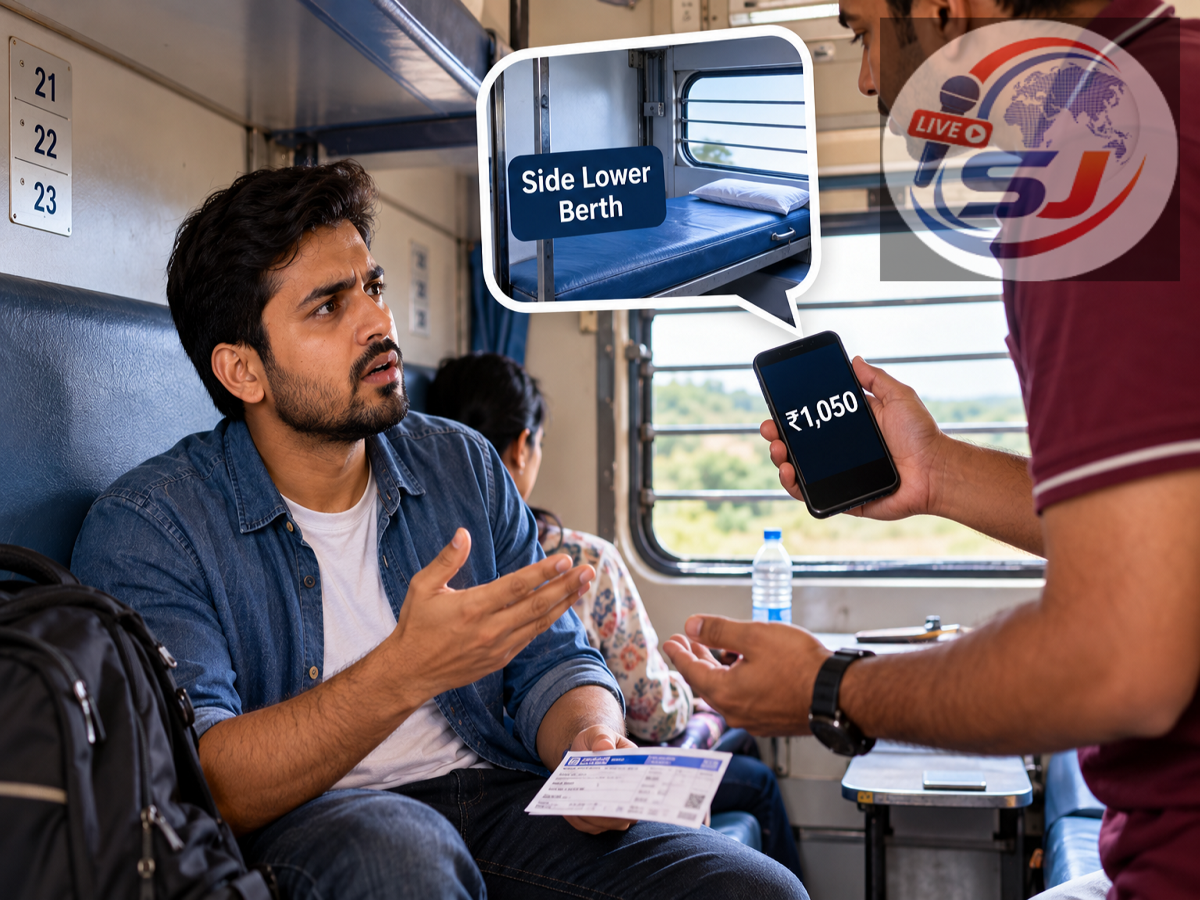
According to the viral claim, a young passenger occupying a side lower berth allegedly asked an elderly couple to pay ₹1,050 if they wanted him to exchange seats.
The incident has divided social-media users, with some focusing on courtesy towards senior citizens and others arguing that no passenger should be pressured into giving up a berth that was allotted to them.
What Happened During the Train Journey?
The incident was described in a post shared on X by a user named Pooja.
According to her account, she witnessed a conversation between an elderly couple and a younger passenger while travelling in a 3AC coach.
The younger traveller reportedly had a side lower berth. The elderly couple approached him and requested a berth exchange because a lower berth would be more convenient for them.
Instead of simply agreeing or refusing, the passenger allegedly asked for money to make the exchange.
It is important to note that these details originate from a social-media account of the incident and should be treated as claims unless independently confirmed.
Why Did the Passenger Allegedly Ask for ₹1,050?
According to the viral post, the young traveller said that he had paid ₹2,100 for his ticket.
He then allegedly calculated 50% of that amount and asked the elderly couple for ₹1,050 in return for giving up his side lower berth.
The unusual demand quickly became the main point of discussion online.
While passengers often voluntarily exchange berths, asking another traveller to pay money for such an informal arrangement is not generally how routine seat exchanges take place.
Social Media Divided Over the Incident
The viral post led to contrasting reactions.
One group argued that younger passengers should show consideration when an elderly traveller genuinely finds it difficult to use an upper or middle berth.
From this perspective, giving up a lower berth can be seen as a gesture of courtesy, particularly when the alternative berth does not cause major inconvenience to the younger passenger.
Others took a different view.
They argued that a passenger who has been officially allotted a particular berth has the right to use it and should not automatically be expected to surrender it simply because another traveller prefers that seat.
According to this argument, requesting a seat exchange is reasonable, but expecting or pressuring someone to accept the request is not.
Is a Passenger Required to Exchange a Reserved Berth?
A berth shown against a passenger's valid reservation is assigned to that passenger for the journey, subject to railway rules and any authorised changes made by railway staff.
Another passenger can certainly request an exchange, but an informal seat swap normally depends on mutual consent.
If both passengers are comfortable exchanging their allotted berths, they may agree to do so.
However, a passenger cannot ordinarily assume that another traveller must give up an allotted berth merely because the requester is older or because one berth is considered more convenient.
Courtesy and entitlement are not the same thing.
Can a Younger Passenger Refuse a Lower-Berth Request?
Yes, a younger passenger may have legitimate reasons for wanting to retain a lower berth.
The traveller may have a health issue that is not immediately visible, may need to get off the train during the night, may be travelling with luggage that requires attention, or may simply prefer to use the berth officially allotted on the ticket.
Therefore, age alone should not be used to judge whether someone has a valid reason for keeping a particular seat.
If another passenger requests an exchange, the person holding the berth can choose whether to accept or decline.
What About Asking for Money to Exchange Seats?
This is where the viral incident becomes more unusual.
An informal berth exchange between two passengers is generally based on mutual convenience rather than the private sale of an allotted railway berth.
Asking for money in return for surrendering a berth should not be confused with an official railway charge or an authorised upgrade.
A passenger's reservation does not create an independent railway service through which that passenger can officially charge another traveller for an informal seat swap.
Therefore, passengers should be cautious about treating such monetary demands as part of any recognised railway procedure.
What Should an Elderly Passenger Do If a Lower Berth Is Needed?
Senior citizens and passengers with mobility difficulties should consider indicating the appropriate berth preference while making a reservation.
However, berth preferences are subject to availability and applicable railway allocation rules, so requesting a lower berth does not always guarantee one.
If a passenger is unable to use the allotted berth safely, the matter can be discussed with the Travelling Ticket Examiner (TTE) or other authorised railway staff.
If a suitable berth is legitimately available, railway personnel may be able to assist according to the applicable rules and circumstances.
This is safer than getting into an argument with another passenger.
Don't Pressure Passengers Into Giving Up Their Seats
A common mistake during train journeys is assuming that a lower berth must automatically be surrendered to an elderly traveller.
Helping another passenger can be a considerate gesture, but an informal exchange should remain voluntary.
Similarly, passengers requesting a swap should clearly explain their difficulty and politely ask whether an exchange is possible.
If the other traveller refuses, arguments, harassment or pressure should be avoided.
Railway staff can be approached when genuine assistance is required.
Viral Story Raises a Bigger Question About Train Etiquette
The ₹1,050 demand described in the viral social-media post has attracted attention because it turns a common train interaction into a debate about passenger rights and courtesy.
The basic principle is straightforward: a seat exchange between passengers should be based on mutual agreement.
An elderly passenger can request a lower berth, and another passenger may voluntarily agree to exchange. At the same time, a person occupying an allotted berth should not be automatically pressured to give it up simply because of age.
As for demanding ₹1,050 to surrender a side lower berth, the alleged amount in this case came from the viral post and should not be mistaken for any official Indian Railways fee or recognised seat-exchange charge.