
Sugar Prices Ahead of Dussehra-Diwali: Government Raises Sales Quota to Keep Supply Stable
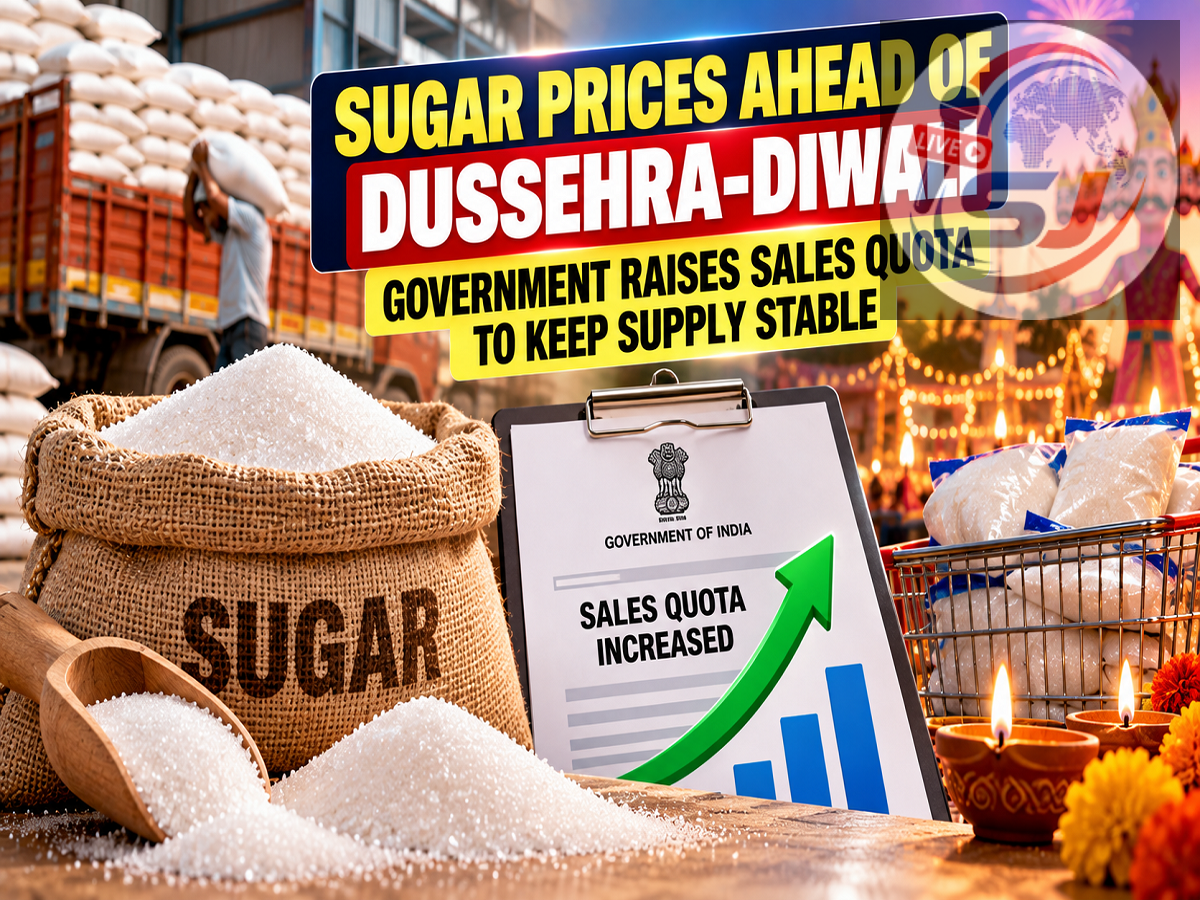
With India's festive season pushing up demand for sweets and other sugar-based products, the government has moved to increase the quantity of sugar available for sale in the market. The step is aimed at maintaining adequate supplies and limiting the risk of a sharp rise in sugar prices during the high-demand period around Navratri, Durga Puja, Dussehra and Diwali.
According to the supplied information, the Department of Food and Public Distribution has fixed the sugar sales quota for the first 15 days of October 2026 at 1.40 million tonnes, or 14 lakh tonnes.
This is higher than the 1.30 million tonnes, or 13 lakh tonnes, allocated for the comparable 15-day period in September.
The additional allocation therefore amounts to 1 lakh tonnes, an increase of roughly 7.7% over the September fortnightly quota.
The move comes as demand for sugar typically strengthens around major festivals because of increased household consumption as well as higher production of sweets and other food products.
Sugar Sales Quota Increased to 14 Lakh Tonnes
The government has raised the amount of sugar that can be released for sale during the first half of October.
The quota has been fixed at:
October 1-15, 2026: 14 lakh tonnes
The corresponding September allocation was:
September period: 13 lakh tonnes
This means an additional 1 lakh tonnes of sugar has been made available under the quota compared with the preceding period cited in the report.
The increase is intended to ensure that the market receives adequate supplies as festive consumption rises.
Why Does Sugar Demand Rise During the Festive Season?
India's festive calendar can have a significant effect on the consumption of food products.
Navratri, Durga Puja and Dussehra are followed by the Diwali period, when demand for traditional sweets and packaged food products typically increases.
Sweet shops, restaurants, food manufacturers, caterers and households can all require larger quantities of sugar during this period.
If demand increases rapidly while supplies remain tight, wholesale and retail prices can come under pressure.
By allowing more sugar to enter the market, the government aims to create a better balance between supply and seasonal demand.
However, consumers should remember that an increased quota does not guarantee that retail prices will remain unchanged. Actual prices can also depend on local supply, transportation, wholesale conditions, inventories and other market factors.
Government Now Reviews Sugar Quota Every 15 Days
An important change in the sugar-management system is the introduction of a shorter review cycle.
According to the supplied report, the government began determining sugar sales quotas on a 15-day basis from September 2026.
Earlier, quotas were generally released for an entire month at one time.
Under the newer arrangement, market conditions can be reviewed twice a month.
The government can examine demand and availability before deciding how much sugar should be released during the next period.
This provides authorities with greater flexibility to respond to sudden changes in demand.
Why Was the Fortnightly System Introduced?
One concern with a monthly allocation system was that market participants could potentially delay the release of stocks toward the end of a month.
If significant quantities were withheld while demand remained strong, availability could tighten and prices could face upward pressure.
A fortnightly system allows the government to monitor the situation more frequently.
If demand is rising faster than expected, the quota can potentially be adjusted for the following period.
Similarly, supply conditions can be assessed before the next allocation is determined.
The broader objective is to maintain smoother availability and discourage artificial supply shortages.
October Quota Compared With September
The change becomes clearer when the two allocations are compared.
| Period | Sugar Sales Quota |
|---|---|
| September comparable period | 1.30 million tonnes |
| First 15 days of October 2026 | 1.40 million tonnes |
| Increase | 0.10 million tonnes |
| Increase in Indian units | 1 lakh tonnes |
The October allocation is therefore approximately 7.7% higher than the 13-lakh-tonne September quota cited in the report.
How Does It Compare With Previous Years?
The supplied report also provides historical figures for October.
It states that the sugar sales quota for October 2025 was 2.40 million tonnes, while the figure for October 2024 was 2.55 million tonnes.
However, these figures should be compared cautiously with the latest allocation.
The 2026 figure of 1.40 million tonnes cited in the report applies specifically to the first 15 days of October, whereas the older numbers are described as monthly October quotas.
A direct comparison without acknowledging the difference in allocation periods could therefore be misleading.
Sugar Prices Had Risen Sharply in July and August
The government's latest supply decision comes after sugar prices faced significant upward pressure earlier in the year.
According to the supplied information, prices increased sharply during July and August 2026.
The rise created concerns about future availability and speculative buying in the market.
When traders or buyers expect prices to increase further, additional purchases or stock accumulation can potentially add to short-term demand.
Supply concerns can then become more pronounced, especially ahead of a major consumption period.
Government Took Steps to Improve Supply
The report says authorities responded with measures designed to improve sugar availability.
These included steps related to limits on stocks held by traders and allowing the import of raw sugar.
The objective was to improve domestic availability and ease market pressure.
Combined with the new fortnightly quota mechanism, these measures are intended to give authorities greater control over supply conditions and respond more quickly to market developments.
Retail Sugar Price Around ₹57.50 Per Kg
According to the supplied report, average retail sugar prices have eased from their earlier peak.
The current average is cited at approximately ₹57.50 per kilogram, representing a decline of around 11-12% from the recent record level mentioned in the source.
Actual prices can differ from one city, store or region to another.
Consumers may therefore find sugar selling above or below the national average depending on local market conditions.
Will Sugar Become Cheaper Before Diwali?
The higher quota should not automatically be interpreted as a guaranteed price cut.
The government's immediate objective is to improve supply and prevent excessive price pressure as festive demand increases.
If sufficient quantities remain available in wholesale and retail markets, the increased supply can help moderate sudden price increases.
But the final retail price paid by consumers depends on several factors.
These include wholesale prices, transportation costs, local inventories, regional demand and retailer margins.
Therefore, it is more accurate to say that the government is trying to keep sugar availability comfortable and curb sharp price increases, rather than guaranteeing that sugar will become cheaper.
Why the Move Matters for Sweet Shops
Sugar is one of the major ingredients used by sweet shops during the festive season.
Production of products such as laddoos, barfi, gulab jamun and several other sweets can increase significantly ahead of major festivals.
A sharp rise in sugar prices can increase input costs for manufacturers and retailers.
Those additional costs can eventually be passed on to consumers through higher prices for sweets and other food products.
Keeping sugar supplies adequate can therefore have an impact beyond the retail price of sugar itself.
What Happens After October 15?
Because the government is now following a fortnightly quota mechanism, the market situation can be reviewed again for the second half of October.
Demand, stocks, prices and overall availability can be considered before the next quantity is determined.
This is particularly relevant because the festive consumption period continues beyond Dussehra and moves toward Diwali.
If demand remains elevated, authorities will have an opportunity to reassess supply requirements rather than waiting until the end of the entire month.
Key Details Consumers Should Know
The latest decision does not impose a fixed retail price on sugar.
Instead, it controls the quantity that can be released into the market under the government's sugar-management framework.
The 14-lakh-tonne quota applies to the first 15 days of October 2026, according to the supplied information.
It is 1 lakh tonnes higher than the 13-lakh-tonne quota cited for the comparable September period.
The government intends the additional availability to help meet higher festive demand and reduce the possibility of sudden supply-driven price increases.
Bottom Line
Ahead of the peak festive season, the government has increased the sugar sales quota to 1.40 million tonnes, or 14 lakh tonnes, for the first 15 days of October 2026.
The allocation is up from 1.30 million tonnes, or 13 lakh tonnes, for the corresponding September period, meaning an additional 1 lakh tonnes can be released.
The move comes as demand for sugar and sweets typically rises around Navratri, Durga Puja, Dussehra and the run-up to Diwali.
After sharp price increases earlier in the year, average retail sugar prices are now cited at around ₹57.50 per kg, roughly 11-12% below the recent peak mentioned in the report.
The higher quota is designed to support market availability and limit sharp price pressure. It does not guarantee that sugar prices will remain unchanged or fall, as retail prices will continue to depend on demand, supply and local market conditions.
With quotas now being reviewed every 15 days, the government will also have another opportunity to assess the market and adjust sugar availability as the festive season progresses.