
School Bus Safety Tips 2026: Follow These Important Rules to Keep Children Safe on the Road
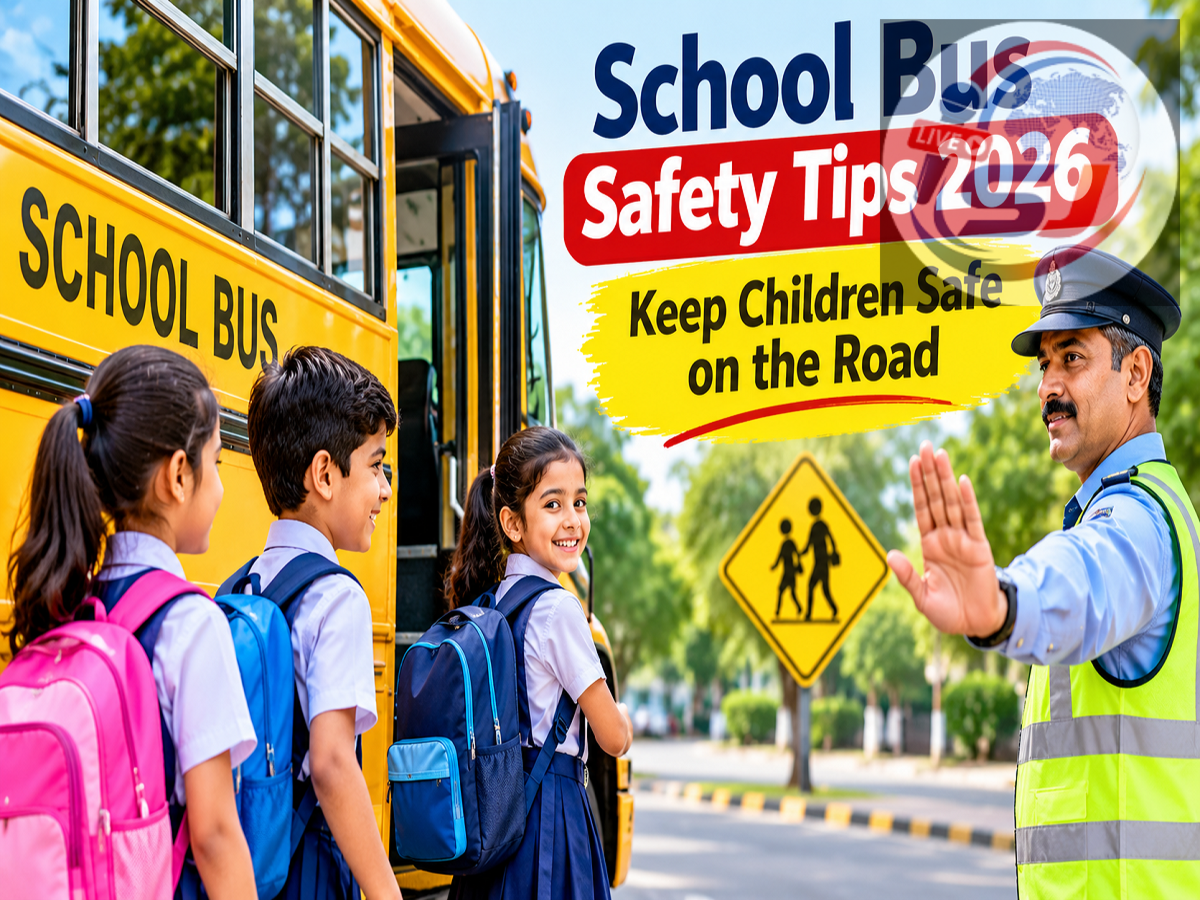
School Bus Safety 2026: Children's safety during their daily journey to and from school is a shared responsibility of drivers, parents, school authorities, and other road users. A simple mistake, such as speeding near a school or failing to check whether a child has boarded safely, can lead to serious consequences.
A road safety awareness message highlights three important precautions: following speed limits, remaining alert while driving, and ensuring that children board and exit vehicles safely.
These measures are particularly important around school entrances, bus stops, residential streets, and busy intersections where children may cross roads unexpectedly.
Responsible driving, proper supervision, and awareness of traffic conditions can significantly reduce the risk of road accidents involving schoolchildren.
Why Is Road Safety Important for Schoolchildren?
Thousands of children travel to school every day using school buses, private vans, autorickshaws, bicycles, or family vehicles.
During these journeys, children may encounter heavy traffic, crowded roads, and unsafe boarding locations.
Younger children may not always recognise approaching vehicles or accurately judge their speed and distance.
They may also become distracted while talking to friends, crossing the road, or waiting for transportation.
For these reasons, adults must take additional precautions whenever children are present near moving vehicles.
School transportation safety should not be limited to the time spent inside a vehicle. It also includes waiting, boarding, exiting, and safely reaching the school or home.
1. Follow Speed Limits Near Schools
Driving at a safe speed is one of the most effective ways to reduce the likelihood and severity of road accidents.
Motorists should observe posted speed limits, especially around schools, playgrounds, residential areas, and pedestrian crossings.
Drivers should also reduce speed when road conditions, visibility, or pedestrian activity make it necessary, even if they are travelling below the posted limit.
Children may suddenly step onto the road or move between parked vehicles.
Lower speeds give drivers more time to identify hazards and respond appropriately.
School bus and van drivers should avoid sudden acceleration, harsh braking, and risky overtaking.
Arriving a few minutes late is preferable to compromising children's safety.
2. Stay Alert While Driving
Driver attention is essential when transporting children.
Using a mobile phone, adjusting navigation settings, or engaging in other distracting activities can reduce awareness of road conditions.
Drivers should keep their attention on the road and maintain a safe distance from other vehicles.
Extra care is necessary near school gates, bus stops, and areas where children gather.
Motorists should also watch for pedestrians approaching from behind parked vehicles or roadside obstructions.
School transport drivers should ensure that mirrors and other safety equipment are properly adjusted before beginning a journey.
3. Ensure Safe Boarding and Exiting
Boarding and exiting a school vehicle can be particularly risky when children are not properly supervised.
Drivers should stop at a safe and authorised location before allowing children to enter or leave the vehicle.
The vehicle should remain stationary throughout the boarding process.
Children should be encouraged to board in an orderly manner without pushing or rushing.
Where an attendant is required, the attendant should supervise boarding and ensure that children are seated safely before the vehicle moves.
After dropping children off, drivers must check that they have moved away from the vehicle and are not standing in blind spots.
Special attention should be given to younger children who may be difficult to see from the driver's seat.
4. Check School Bus Safety Equipment
School authorities and transport operators should ensure that vehicles are maintained properly and comply with applicable transport regulations.
Important safety considerations include:
-
Functional brakes, headlights, indicators, and mirrors.
-
Properly maintained tyres.
-
Emergency exits that are accessible and operational.
-
Required first-aid and fire safety equipment.
-
Appropriate seating arrangements and applicable restraint requirements.
-
Driver qualifications and valid vehicle documentation.
Vehicle operators should conduct regular inspections and address mechanical problems promptly.
School transport requirements can vary according to state rules, vehicle type, and applicable regulations.
5. Parents Should Teach Children Basic Road Safety
Parents play an important role in helping children develop safe travel habits.
Children should be taught to wait at designated pickup locations and avoid running towards an approaching bus or van.
They should never attempt to board or exit a moving vehicle.
Parents should also explain the importance of crossing roads carefully and using designated pedestrian crossings where available.
Young children should receive appropriate adult supervision when crossing busy roads.
Children should understand that they must never stand immediately in front of or behind a school bus, where the driver may have limited visibility.
6. School Authorities Must Monitor Transport Safety
Schools should establish clear procedures for managing student transportation.
These may include maintaining accurate transport records, checking driver credentials, and ensuring that vehicles meet applicable safety standards.
Schools should also communicate pickup and drop-off arrangements to parents.
Where appropriate, designated staff or attendants can supervise students at busy school entrances.
Regular road safety awareness sessions can help students understand safe behaviour while travelling.
Any complaints involving unsafe driving, overcrowding, or improper vehicle maintenance should be investigated promptly.
7. Other Motorists Must Be Careful Around School Vehicles
Road safety is not only the responsibility of school bus drivers.
Motorists travelling near school buses and vans should remain cautious, especially when children are boarding or exiting.
Drivers should avoid aggressive overtaking and maintain sufficient space around school transport vehicles.
They should watch for children crossing near bus stops and follow applicable traffic rules.
Motorists should not assume that children will always behave predictably.
A moment of patience near a school vehicle can help prevent a serious accident.
School Transport Safety: Responsibilities at a Glance
| Responsible Person |
Important Safety Measures |
|---|---|
| School Bus Driver |
Follow speed limits, avoid distractions, stop safely |
| School Attendant |
Supervise boarding and exiting, monitor children |
| Parents |
Teach road safety, ensure safe pickup arrangements |
| School Authorities |
Check transport compliance, driver credentials, and vehicle maintenance |
| Other Motorists |
Slow down near schools and watch for children |
| Students |
Follow instructions, avoid rushing, remain seated safely |
What Should Parents Do If They Notice Unsafe School Transport?
Parents who observe repeated speeding, unsafe boarding practices, overcrowding, or dangerous driving should raise the matter with the school administration or transport operator.
They should provide specific details about the incident, including the date, location, and nature of the concern.
If the situation presents an immediate danger, appropriate local authorities should be contacted.
Parents should avoid confronting a driver in a way that creates additional risk for children or other road users.
The priority should be ensuring that the unsafe practice is corrected.
Conclusion
A safe school journey depends on responsible behaviour from everyone involved.
Following speed limits, remaining attentive, maintaining vehicles, and supervising children during boarding and exiting are practical measures that can help prevent accidents.
Parents and schools should work together to ensure that transport arrangements are safe and that children understand basic road safety precautions.
Every child deserves to reach school and return home safely. Careful driving and proper supervision can make that possible.
Editorial note: This article expands the supplied road safety awareness message into general school transport safety guidance. It does not announce any new traffic regulation, school bus penalty, or mandatory transport rule for October 2026.