
Property Rules: Can a Mother Gift a Flat to Her Son Without Her Daughter’s NOC After the Father’s Death?
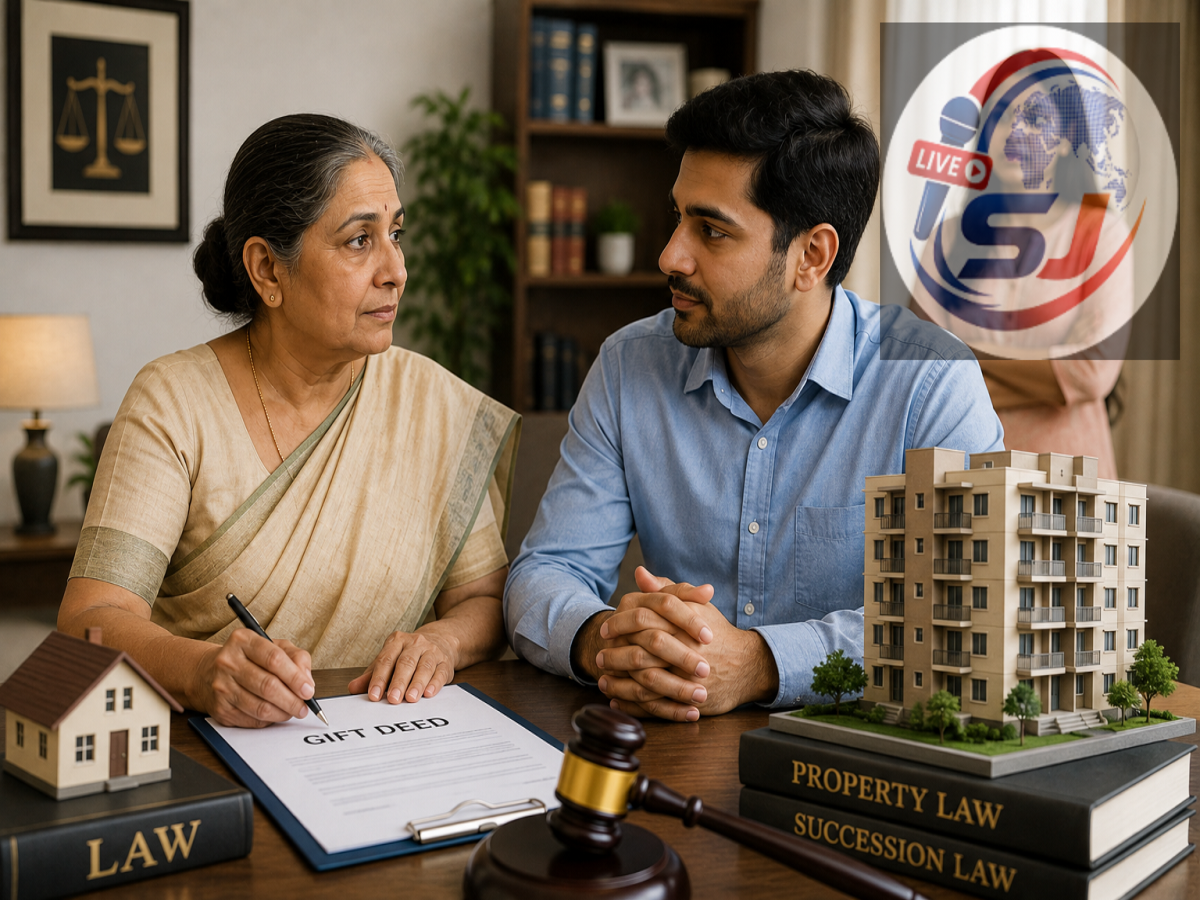
Property inheritance rules: If a flat is jointly owned by a husband and wife and the husband dies, the wife does not necessarily become the absolute owner of the entire property merely because her name remains in the society records. Whether she can gift the whole flat to her son without the daughter’s consent depends on the ownership share, the father’s Will and the applicable succession law.
Property disputes often arise because families assume that nomination, society records and legal ownership mean the same thing. They do not. After the death of one joint owner, it is important to establish who legally inherits the deceased person’s share before the entire property is sold or gifted.
What Happens When a Flat Is Jointly Owned by Husband and Wife?
Suppose a residential flat was purchased jointly in the names of a husband and wife. The first step is to check the purchase documents, particularly the sale deed, to determine their respective ownership shares.
If the document clearly specifies their shares, inheritance will apply only to the deceased husband's share. If the document does not clearly specify the proportion, the ownership position may need to be determined from the deed, contribution and other relevant legal circumstances.
For example, if the husband and wife each legally owned 50% of the flat, the wife's existing 50% remains hers after her husband's death. The question of succession arises primarily over the husband's 50% share.
Does the Wife Automatically Get the Husband’s Entire Share?
Not necessarily.
If the husband dies without leaving a valid Will, his share in the property will generally pass to his legal heirs according to the personal succession law applicable to him.
For example, under Hindu succession law, a deceased Hindu man's Class I heirs can include his widow, sons, daughters and mother. Therefore, a daughter cannot simply be excluded from her father's estate merely because the housing society has transferred records into the mother's name.
The exact division will depend on who the surviving legal heirs are.
An Example Makes the Rule Easier to Understand
Consider a flat in which the husband and wife each own 50%.
If the husband dies intestate—that is, without a Will—and is survived only by his wife, one son and one daughter, his 50% share would ordinarily be divided equally among these three Class I heirs.
Each would therefore inherit one-third of the father's 50% share, or approximately 16.67% of the entire flat.
The ownership could then effectively become:
| Legal heir | Illustrative share in entire flat |
|---|---|
| Mother | 66.67% |
| Son | 16.67% |
| Daughter | 16.67% |
This example assumes there are no other Class I heirs, such as the deceased man's surviving mother, and that the husband and wife indeed owned the property equally.
In such a situation, the mother cannot independently gift the daughter's 16.67% share to the son.
Society Transfer Does Not Necessarily Mean Absolute Ownership
This is one of the most important points for property owners.
After a member dies, a housing society may change its membership records or share certificate based on nomination and prescribed documentation. However, such an administrative transfer does not automatically settle inheritance rights among legal heirs.
A nominee is not necessarily the ultimate beneficial owner of the deceased person's entire estate. Succession rights must still be determined under the applicable law and valid testamentary documents.
Therefore, seeing only the mother's name on the society's records does not by itself prove that the daughter has lost any inheritance rights she may otherwise have.
What Changes If the Father Left a Will?
The position can be very different if the father left a legally valid Will.
If the husband validly bequeathed his entire ownership share in the flat to his wife, that share may pass to her according to the Will, subject to completion of whatever legal formalities are applicable in that case.
Once the wife acquires valid and absolute title to the husband's share, she could become the owner of the entire flat, assuming she already owned the remaining share.
As the absolute owner, she would generally be free to deal with the property, including selling it or gifting it to her son.
Is the Daughter’s NOC Required Then?
If the mother has become the absolute legal owner of 100% of the flat, she generally does not need her daughter's NOC merely because the daughter is another child of the family.
The mother can execute a valid gift deed in favour of her son, subject to registration, stamp-duty and other applicable requirements.
However, the crucial words here are absolute legal owner.
If the daughter has inherited a share in the property because the father died without a Will, the mother cannot transfer the daughter's share simply by executing a gift deed.
What If the Father Died Without a Will?
This is where the daughter's consent or participation can become important.
If the father died intestate and the daughter inherited a share, that share legally belongs to her. If the family wants the mother to become the sole owner, the daughter may need to transfer or relinquish her inherited rights through an appropriate legally valid and registered instrument, depending on the circumstances.
A simple informal NOC should not automatically be treated as equivalent to a registered transfer of ownership rights.
After all necessary inheritance shares have legally vested in or been transferred to the mother, she can deal with the property according to her wishes.
Can the Mother Gift Only Her Own Share?
Yes, this distinction is important.
Even where the mother does not own the entire flat, she can generally deal with the share that legally belongs to her, subject to the nature of the title and applicable law.
What she cannot ordinarily do is gift property belonging to another co-owner or legal heir.
Therefore, the question is not simply, "Is the daughter's NOC required?" The more important question is, "Does the daughter legally own any share in the flat?"
If the answer is yes, her ownership rights have to be properly addressed.
Will Registration and Probate Should Not Be Confused
Another common misconception is that every Will must be registered to be legally valid. Registration of a Will is generally not compulsory in India, although registration can sometimes provide additional evidentiary support.
Similarly, probate requirements have historically varied depending on the applicable succession law and circumstances. Families should therefore avoid relying on a blanket statement that every Will must—or need not—be probated.
The correct procedure should be determined from the location of the property, the deceased person's personal law, the Will and current succession rules.
What Should Families Check Before Executing a Gift Deed?
Before the mother executes a gift deed in favour of her son, the family should establish the complete chain of title. The sale deed, father's death certificate, Will if any, legal-heir details, society records and any succession or relinquishment documents should be examined.
If the daughter or another heir inherited a portion of the father's share, that interest cannot simply disappear because another person's name was entered in society records.
Once the mother's absolute ownership is legally established, however, she can generally decide whom she wants to gift her self-owned property to.
Bottom Line
Yes, a mother can generally gift the entire flat to her son without her daughter's NOC if she has legally become the sole and absolute owner of the entire property.
But if the father died without a Will and the daughter inherited a share in his portion of the flat, the mother cannot gift that inherited share to the son merely because the flat or society records are now in her name.
Therefore, before registering a gift deed, the family should get the title and succession documents examined by a property lawyer or the concerned registration authority. This can prevent a gift deed from becoming the subject of a future inheritance dispute.