
Onion Prices Double to ₹60 as State Faces Dry Conditions; Festive Food Costs Under Pressure
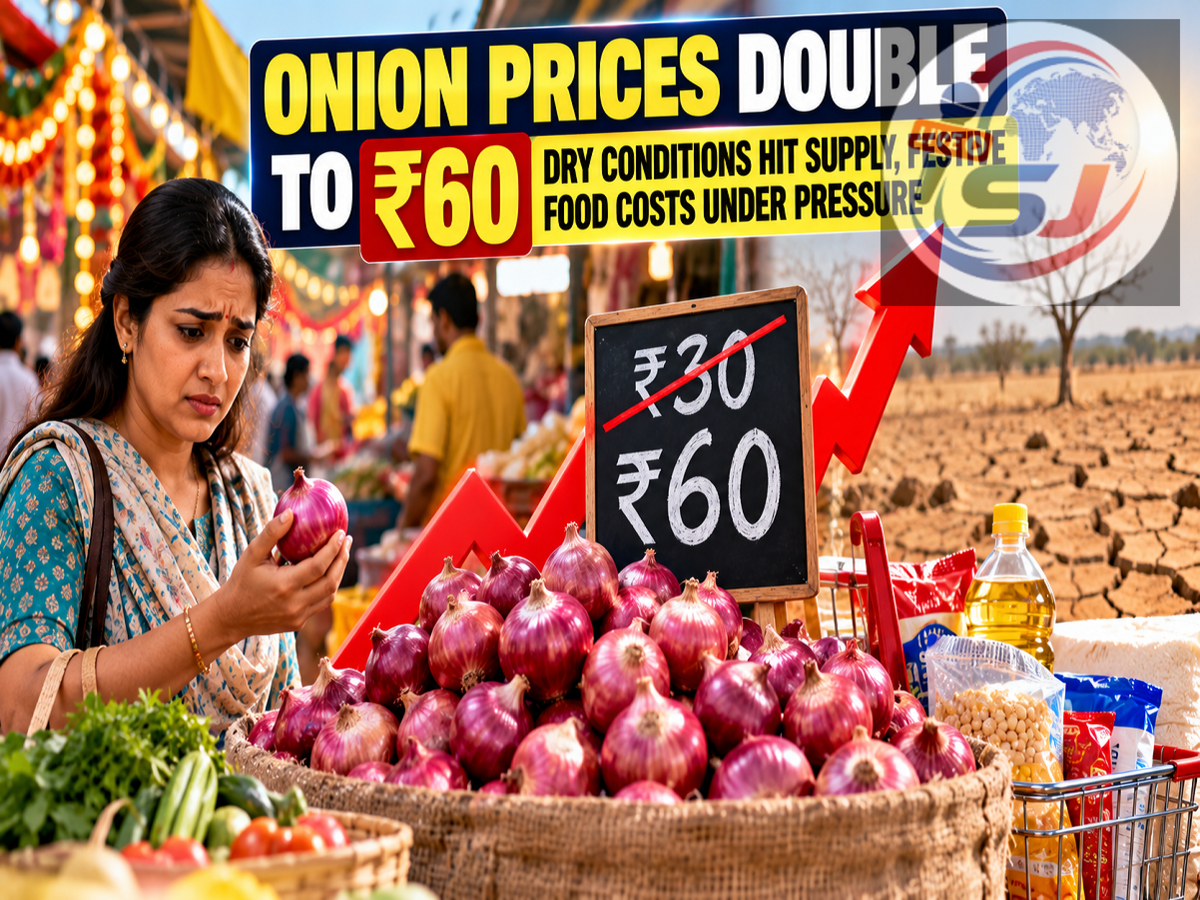
Household budgets could face fresh pressure ahead of India's festive season as onion prices rise sharply in parts of the market. Onions that were reportedly available for around ₹30 per kg are now selling near or above ₹60 per kg in some places, with dry conditions in Maharashtra being cited as a major factor behind the increase.
The price surge is particularly important because Maharashtra is one of India's biggest onion-producing states and accounts for a substantial share of the country's overall production.
According to the supplied report, Citi Research has warned that weaker-than-expected monsoon conditions could put upward pressure on food prices in India during 2026.
The impact may not remain limited to onions. Sugar, rice and pulses are also among the food categories being watched as rainfall shortages in important agricultural regions raise concerns about crop yields and future supplies.
Onion Prices Jump From Around ₹30 to ₹60
The most immediate impact for consumers is visible in onion prices.
According to the supplied information, prices in the affected market have almost doubled compared with the previous year's level, with onions that were selling for roughly ₹30 now reaching around ₹60 per kg or more.
Actual retail rates can differ significantly depending on the city, quality, variety and local supply conditions.
The increase comes at an inconvenient time for households because demand for food items can strengthen during the festive season.
Restaurants, caterers and food businesses can also face higher input costs when prices of essential vegetables rise sharply.
Why Maharashtra Matters for Onion Prices
Maharashtra plays a major role in India's onion supply chain.
The state is reported to account for roughly 40% of India's onion production, making weather conditions there particularly important for national availability and prices.
If production or market arrivals from Maharashtra decline, the effect can spread to wholesale markets in other states.
The supplied report attributes the recent price pressure partly to drought-like conditions in Maharashtra.
Lower rainfall can affect planting, crop development and yields, while uncertainty over future production can influence wholesale prices even before the final harvest becomes available.
Weak Monsoon Raises Concerns Over Food Inflation
The issue goes beyond one vegetable.
Citi Research, as cited in the supplied report, has warned that weaker monsoon conditions could increase pressure on food prices.
The report states that rainfall in states responsible for a large share of India's onion, pulse and rice production has been significantly below normal.
It says states collectively producing roughly three-fourths of the country's onions, two-thirds of its pulses and around half of its rice have experienced rainfall deficits of more than 10%.
If such shortages materially affect crop yields, consumers could eventually see the impact in retail food prices.
However, rainfall deficiency does not automatically translate into an equivalent decline in agricultural production. Irrigation, reservoir levels, crop variety, sowing patterns and subsequent rainfall can all influence the final harvest.
Kharif Sowing Area Down Around 1.2%
Despite concerns over rainfall, the overall area planted with kharif crops has reportedly remained close to normal.
According to the supplied information, total kharif sowing area is approximately 1.2% lower than last year.
This suggests that farmers have still managed to plant a substantial portion of the expected acreage.
The bigger concern is whether crops already planted will receive enough water during crucial stages of development.
A crop can be sown on time but still produce a lower yield if rainfall remains inadequate during important growth periods.
August CPI Data Shows Pressure on Food Prices
The supplied report also refers to August Consumer Price Index data released by the Ministry of Statistics and Programme Implementation (MoSPI).
Food prices showed upward pressure during the period, with the report linking part of the trend to weaker monsoon conditions.
Price volatility reportedly continued into September.
Onions were not the only commodity under pressure. Prices of items such as sugar, rice and pulses were also reported to have strengthened.
These products have an important role in household food expenditure, meaning simultaneous increases across several categories can have a noticeable impact on monthly budgets.
Nearly Half the Country Facing Drought-Like Conditions, Report Claims
The severity of dry conditions is another major concern highlighted in the supplied report.
According to the cited analysis, by the end of September 2026, more than 49.4% of the country was experiencing conditions classified as drought-like under the methodology referenced by the report.
For comparison, it cites a figure of around 30% for 2023.
The report further says that roughly 10% of the country was facing more severe conditions.
These figures should be read in the context of the methodology and dataset used to define drought conditions; they do not necessarily mean that half of India's districts have been formally declared drought-affected by governments.
Maharashtra Among the Most Affected States
Maharashtra is highlighted as one of the states facing particularly difficult conditions.
The report says around 84% of Maharashtra was experiencing drought-like conditions under the cited assessment.
Separate data referenced from IIT Gandhinagar and government sources indicates significant stress across several parts of the state.
According to the supplied article, 265 out of Maharashtra's 358 talukas were identified as drought-affected, representing around 74% of the state's talukas.
It further states that approximately 37% of the area was experiencing particularly severe drought conditions.
The exact classifications can vary depending on whether the figures refer to meteorological drought, soil moisture, agricultural drought or an official administrative declaration.
Punjab Also Faces Serious Rainfall Stress
Punjab is another major agricultural state highlighted in the report.
According to the cited assessment, around 80% of Punjab was experiencing drought-like conditions.
Punjab plays an important role in India's agricultural supply, particularly in foodgrain production.
Any sustained weather-related disruption in major farming states can therefore attract attention from policymakers and commodity markets.
Rainfall Reportedly 12% Below Long-Term Average
The supplied report states that India's rainfall has been approximately 12% below the long-term average, describing it as the biggest monsoon shortfall since 2015.
It links the weaker rainfall primarily to El Niño conditions.
The significance of a rainfall deficit depends not only on the national percentage but also on where and when the rain falls.
A moderate national deficit can create substantial agricultural problems if the shortage is concentrated in major crop-producing regions or occurs during critical stages of crop development.
Conversely, irrigation and adequate reservoir storage can sometimes reduce the impact of rainfall shortages in certain areas.
How Higher Onion Prices Affect Household Budgets
A jump from ₹30 to ₹60 per kg represents a 100% increase in the purchase price.
For example, a household buying 5 kg of onions in a month would have spent around:
5 kg × ₹30 = ₹150
At ₹60 per kg, the same quantity would cost:
5 kg × ₹60 = ₹300
That means an additional ₹150 per month for onions alone in this simple example.
The actual impact will depend on the price in the consumer's city and the quantity purchased.
If prices of pulses, rice, sugar and other essential foods rise at the same time, the cumulative increase in a family's monthly grocery bill can be considerably larger.
Will Onion Prices Rise Further?
It is too early to state with certainty that onion prices will continue rising.
Future prices will depend on several factors, including crop arrivals, rainfall, production estimates, stored inventory, transportation and government measures.
If supplies improve, prices could stabilise or decline.
On the other hand, prolonged dry conditions or weaker-than-expected crop output could keep prices under pressure.
Consumers should therefore treat predictions of a specific future onion price cautiously.
Festive Demand Could Add to Short-Term Pressure
The timing of the price increase is important.
The October-November festive period can increase demand for several food products as households, restaurants, caterers and sweet shops prepare for celebrations.
If stronger demand coincides with limited supply, wholesale prices can face additional pressure.
This does not mean prices must necessarily rise throughout the festive season, but the supply-demand situation will remain important to watch.
What Could Help Bring Onion Prices Down?
Improved market arrivals are one of the most important factors that could ease prices.
If adequate quantities reach wholesale markets from major producing states, supply pressure can reduce.
Government measures such as releasing buffer stocks, managing inventories or taking other supply-side steps can also influence market availability when necessary.
Weather conditions during the remaining crop cycle will also matter.
A clearer picture of production and arrivals could eventually reduce uncertainty in wholesale markets.
Key Numbers From the Report
| Indicator | Figure Cited |
|---|---|
| Earlier onion price | Around ₹30/kg |
| Current price cited | Around ₹60/kg or more |
| Approximate increase | Around 100% |
| Maharashtra's share of onion production | Around 40% |
| Kharif sowing area vs last year | Around 1.2% lower |
| National rainfall deficit cited | Around 12% |
| Country under drought-like conditions | More than 49.4% |
| Maharashtra under drought-like conditions | Around 84% |
| Maharashtra talukas cited as affected | 265 of 358 |
| Punjab under drought-like conditions | Around 80% |
Bottom Line
Onion prices have reportedly climbed from around ₹30 to ₹60 per kg or more in some markets, creating fresh pressure on household grocery budgets just as the festive season begins.
Dry conditions in Maharashtra are being cited as an important factor because the state accounts for roughly 40% of India's onion production.
The concern extends beyond onions. The supplied report, citing Citi Research and other datasets, points to rainfall shortages in several major agricultural regions and warns of possible pressure on rice, pulses, sugar and other food prices.
However, consumers should avoid assuming that every food item will necessarily become more expensive. Final prices will depend on crop output, market arrivals, local availability, government measures and weather conditions over the coming weeks.
For now, the sharp rise in onion prices is a reminder of how quickly weather-related supply disruptions in major producing states can reach the household kitchen budget.