
November 1 Rule Changes 2026: Delhi Vehicle Restrictions, Caller ID and LPG Price Updates Explained
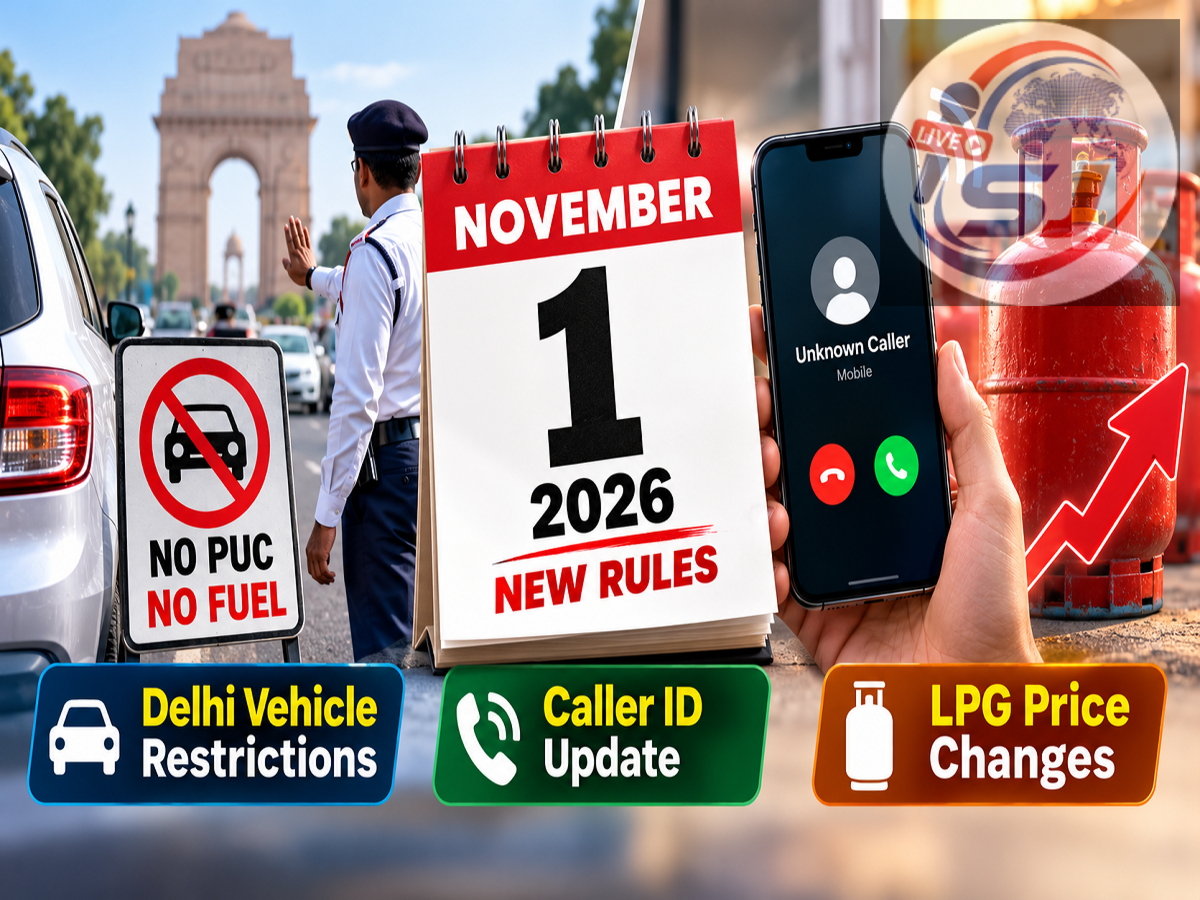
November 1 Rule Changes 2026: Several important developments could affect motorists, mobile phone users and household budgets as India enters November 2026.
The key areas to watch include possible pollution-related vehicle restrictions in Delhi, the rollout of caller identification technology and the next review of LPG cylinder prices.
CNG, PNG and aviation fuel prices may also be revised depending on decisions by the relevant suppliers.
However, not every proposed or expected change should be treated as a confirmed nationwide rule taking effect on November 1.
Consumers should distinguish between officially notified regulations, planned technology rollouts and routine price reviews.
Here is what these developments could mean for the public.
November 1, 2026: Important Changes at a Glance
| Area | Reported Development | What Consumers Should Know |
|---|---|---|
| Delhi vehicle restrictions | Possible restrictions on certain non-BS6 vehicles | Exact vehicle categories and exemptions require official confirmation |
| Caller identification | Wider rollout of network-based caller name display | Availability may vary by telecom operator and network |
| Domestic LPG | Possible November price revision | No increase should be assumed before official rates are announced |
| Commercial LPG | Monthly price review expected | Rates may rise, fall or remain unchanged |
| CNG and PNG | Possible supplier-specific price changes | Not necessarily revised nationwide on November 1 |
| Aviation turbine fuel | Periodic price revision | May affect airline operating costs |
Delhi Pollution Rules: Will Non-BS6 Vehicles Be Banned?
Air pollution remains a major concern in Delhi and the surrounding National Capital Region, particularly during the winter months.
To control emissions, authorities may introduce or strengthen restrictions on certain categories of vehicles.
The supplied report claims that restrictions on non-BS6 vehicles will apply from November 1, 2026, until January 31, 2027.
It also suggests that BS6-compliant vehicles, electric vehicles and CNG-powered vehicles would be permitted under the proposed arrangement.
However, the precise scope of these restrictions must be verified through an official notification issued by the relevant transport or pollution-control authorities.
A restriction on the entry of specified vehicles into Delhi is not necessarily the same as a complete ban on all non-BS6 vehicles already operating within the city.
Similarly, rules for commercial vehicles, private cars, diesel vehicles and vehicles registered outside Delhi may differ.
Vehicle owners should therefore avoid assuming that every older petrol or diesel vehicle will automatically be prohibited.
What Is BS6 and Why Does It Matter?
Bharat Stage VI, commonly known as BS6, is an emission standard introduced to reduce pollutants released by motor vehicles.
The standard establishes limits for harmful emissions from vehicles.
BS6-compliant vehicles generally incorporate technology designed to meet stricter emission requirements than earlier Bharat Stage standards.
However, a vehicle's compliance category is only one factor in determining whether it may operate during a particular pollution-control period.
Restrictions can also depend on fuel type, vehicle age, registration location, commercial use and the specific orders in force.
Vehicle owners should check their registration certificate and applicable transport department notifications.
Will Older Vehicles Face Heavy Fines?
The supplied report suggests that violations of the proposed Delhi restrictions could result in significant penalties.
However, it does not identify the specific legal provision or officially notified fine amount.
The penalty for a violation depends on the applicable law and the type of restriction breached.
Motorists should not rely on unverified figures circulating through social media.
Before travelling to Delhi, particularly in a vehicle registered outside the capital, drivers should review official traffic and transport advisories.
Caller ID Rules: Will Unknown Callers' Names Appear Automatically?
Another development attracting attention is the proposed expansion of network-based caller identification services.
The technology is commonly associated with Calling Name Presentation, or CNAP.
CNAP is intended to display caller name information through supported telecom network systems.
Unlike conventional third-party caller identification applications, network-based caller name presentation relies on information handled through telecom operators and the relevant technical framework.
The supplied report suggests that a wider rollout could begin on November 1, 2026, for supported 4G and 5G services.
However, actual availability may depend on operator readiness, compatible devices, network arrangements and regulatory implementation.
Users should not assume that the feature will become available on every mobile phone simultaneously.
Will Truecaller Become Unnecessary?
Network-based caller identification could provide an additional way to recognise unfamiliar callers.
However, it would be premature to conclude that third-party applications will become unnecessary.
Applications such as Truecaller offer various features that may include spam detection, user-generated reporting and call management.
CNAP and third-party caller identification services may operate differently.
Furthermore, displaying a caller name does not guarantee that the call is safe.
Fraudsters may still attempt impersonation or other forms of deception.
Mobile users should continue verifying suspicious requests and should never disclose OTPs, banking passwords or UPI PINs.
LPG Cylinder Prices: What Could Change on November 1?
LPG prices are another area consumers commonly monitor at the beginning of each month.
Oil marketing companies periodically review LPG cylinder prices.
Commercial LPG prices are frequently revised at the beginning of a month, while domestic LPG prices can remain unchanged for longer periods.
The supplied report suggests that new rates may be announced on November 1, 2026.
However, a price review does not automatically mean a price increase.
Prices could rise, fall or remain unchanged depending on the decisions announced by suppliers.
Consumers should wait for official price lists before calculating any change in their household expenses.
Domestic vs Commercial LPG: What Is the Difference?
Domestic LPG cylinders are commonly used for household cooking.
Commercial LPG cylinders are generally supplied to restaurants, hotels and other business establishments.
Their prices and applicable arrangements differ.
| LPG Category | Common Cylinder Size | Typical Use |
|---|---|---|
| Domestic LPG | 14.2 kg | Household cooking |
| Commercial LPG | 19 kg | Restaurants and commercial kitchens |
Prices also vary between cities because of factors such as transportation and local charges.
Customers should check rates applicable to their own location rather than relying on prices quoted for another city.
Will CNG and PNG Prices Increase in November?
Compressed Natural Gas (CNG) is widely used in vehicles, while Piped Natural Gas (PNG) is supplied to eligible households and commercial consumers.
Their retail prices are determined by the relevant gas suppliers and can vary by geographical area.
Unlike a single nationwide government-controlled monthly price announcement, CNG and PNG revisions may occur at different times across different distribution networks.
Therefore, the start of November does not guarantee a price change in every city.
Consumers should check announcements from their local gas distribution company.
Any confirmed increase could affect vehicle running costs or household gas expenditure, while a reduction could provide relief.
Aviation Fuel Prices May Also Be Reviewed
Aviation turbine fuel, commonly known as ATF, is an important operating expense for airlines.
Its prices are periodically revised based on relevant market and pricing factors.
Changes in ATF prices can influence airline costs.
However, a rise in aviation fuel prices does not necessarily mean that passenger ticket prices will increase immediately.
Airfares depend on several factors, including demand, competition, route availability and airline pricing decisions.
What Should Consumers Do Before November 1?
Motorists planning to enter Delhi should verify the latest pollution-related vehicle restrictions through official transport and traffic advisories.
Mobile phone users should check their telecom operator's announcements regarding caller identification features.
LPG customers should review official rates from their supplier once the November price update is published.
CNG and PNG users should consult their local gas distribution company for applicable prices.
Most importantly, consumers should avoid relying on viral messages claiming that every rule or price change has already been confirmed.
Final Update
November 1, 2026, could bring developments affecting vehicle movement in Delhi, telecom services and fuel prices.
The reported Delhi vehicle restrictions and caller identification rollout require confirmation of their precise implementation details.
Meanwhile, LPG, CNG and PNG prices should be checked against official supplier announcements rather than predicted increases.
The main takeaway is that consumers should verify official notifications before assuming that a new restriction or higher charge will apply from November 1.
Editorial note: This article distinguishes reported changes from confirmed measures. The supplied report does not include the relevant Delhi restriction order, final CNAP rollout notification or November fuel price circulars. Exact enforcement dates, exemptions, penalties and revised rates should be verified before publication as established facts.
Fact-check for publication: The Delhi vehicle restriction and CNAP rollout have now been corroborated by recent reporting. The Delhi restriction specifically targets vehicles registered outside Delhi that fall below BS6 standards, with exemptions including CNG, electric and emergency vehicles. It is not a blanket ban on every non-BS6 vehicle.
The DoT has also directed telecom operators to introduce CNAP from November 1 on 4G and newer networks.
November LPG, CNG and PNG prices remain unconfirmed as of October 25. The article should describe these as possible revisions, not announced price hikes.