
LTCG Tax Relief 2026: Finance Minister Signals Review of Capital Gains Tax, Will Investors Get a Tax Cut?
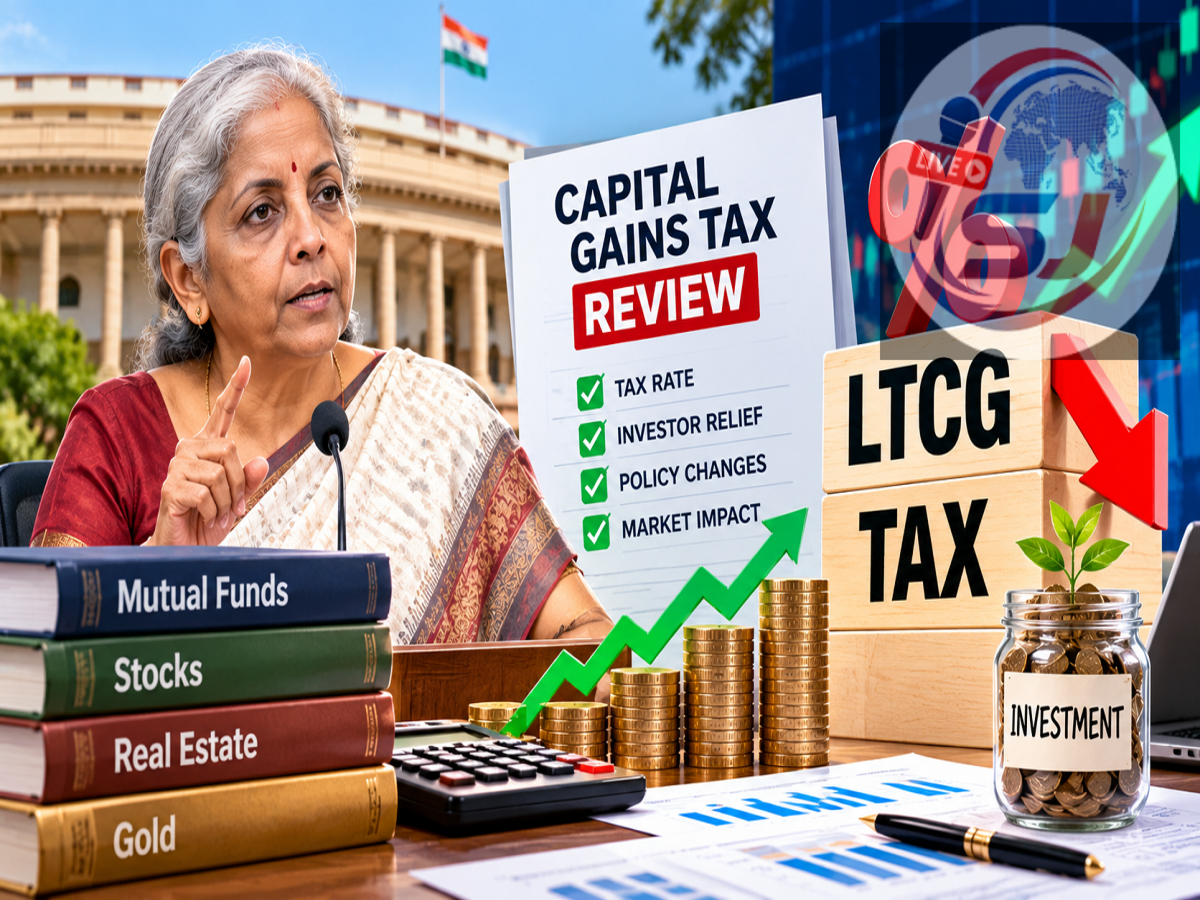
LTCG Tax Latest Update 2026: Investors hoping for relief from Long-Term Capital Gains (LTCG) tax may have a reason to follow the upcoming Union Budget discussions closely. Finance Minister Nirmala Sitharaman has indicated that the government is willing to consider suggestions from domestic and international investors regarding capital gains taxation and other stock market-related taxes.
Speaking at the Bloomberg New Economy Forum in New Delhi on October 13, 2026, the Finance Minister acknowledged concerns surrounding LTCG tax, Securities Transaction Tax (STT), and differences in taxation across various investment categories.
However, the government has not announced any reduction or removal of LTCG tax. The Finance Minister's remarks indicate openness to consultation rather than a confirmed change in tax policy.
The development comes as investors and market analysts continue to debate whether India's capital gains tax structure should be modified to encourage long-term investment and attract foreign capital.
What Did Nirmala Sitharaman Say About LTCG Tax?
During her remarks at the Bloomberg New Economy Forum, Finance Minister Nirmala Sitharaman addressed questions about the taxation of stock market investments.
She indicated that the government would consider different opinions and recommendations during the consultations held before the Union Budget.
These discussions could include the existing LTCG tax structure, Securities Transaction Tax, and the treatment of different investment asset classes.
Investors have raised concerns about the tax burden associated with equity investments and whether the current framework provides sufficient incentives for holding investments over longer periods.
The Finance Minister's comments suggest that such concerns may form part of the government's wider discussions with stakeholders.
However, no specific proposal to reduce tax rates, increase exemptions, or abolish LTCG tax was announced.
What Is Long-Term Capital Gains Tax?
Long-Term Capital Gains tax is imposed on profits earned from selling certain capital assets after holding them for a specified minimum period.
These assets can include listed shares, mutual funds, property, and other investments.
The applicable tax rate depends on the type of asset, its holding period, and the relevant provisions of the Income-tax Act.
For example, eligible listed equity shares and equity-oriented mutual fund units generally qualify as long-term capital assets when held for more than 12 months.
If an investor sells these assets at a profit after the required holding period, the gains may attract LTCG tax.
The tax is calculated on the taxable capital gain rather than the entire sale proceeds.
What Is the Current LTCG Tax Rate on Shares in India?
Under the tax framework described in the report, eligible long-term gains from listed equity shares and equity-oriented mutual funds are taxed at 12.5%, subject to applicable conditions.
An annual exemption threshold of ₹1.25 lakh is available for qualifying long-term capital gains under Section 112A.
This means that the first ₹1.25 lakh of aggregate eligible gains during a financial year is not subject to LTCG tax under that provision.
Only the amount exceeding the exemption threshold becomes taxable.
Here is an illustrative calculation:
| Particulars |
Amount |
|---|---|
| Long-term capital gains |
₹3,00,000 |
| Annual exemption threshold |
₹1,25,000 |
| Taxable LTCG |
₹1,75,000 |
| LTCG tax at 12.5% |
₹21,875 |
In this example, an investor earning ₹3 lakh in eligible long-term equity gains would have a basic LTCG tax liability of ₹21,875 before any applicable surcharge and cess.
The calculation assumes that the investment qualifies for the relevant tax treatment and satisfies the required conditions.
What Is Securities Transaction Tax and Why Is It Being Discussed?
Securities Transaction Tax, commonly known as STT, is a separate tax imposed on specified transactions involving securities.
It generally applies to certain purchases and sales of securities through recognized stock exchanges, depending on the transaction category.
Unlike LTCG tax, which is associated with taxable profits, STT is linked to the execution of qualifying securities transactions.
Investors and market participants have questioned whether the combined effect of transaction taxes and capital gains taxation makes investing more expensive.
The Finance Minister's remarks indicate that concerns regarding STT may also be discussed during the pre-Budget consultation process.
However, there has been no official announcement confirming changes to STT rates.
Will LTCG Tax Be Removed for Small Investors?
One of the biggest questions among retail investors is whether the government will eliminate LTCG tax for individuals investing relatively small amounts in the stock market.
At present, there is no confirmed decision to introduce such an exemption.
According to the report, Minister of State for Finance Pankaj Chaudhary informed the Lok Sabha on July 20, 2026, that the government had no immediate proposal to abolish LTCG tax for domestic and small investors.
He also indicated that tax rates are periodically reviewed while considering Budget priorities and prevailing economic conditions.
This earlier clarification remains important when interpreting the Finance Minister's latest remarks.
While the government may examine suggestions, consultation does not necessarily lead to a reduction in tax rates.
Any actual change would require an official announcement and the relevant legislative process.
Why Has SBI Research Suggested Removing LTCG Tax?
SBI Research has reportedly recommended changes to India's equity taxation framework amid concerns about foreign portfolio investment outflows.
According to the figures cited in the report, foreign portfolio investors withdrew more than ₹2.61 lakh crore from Indian equities during 2026 up to the reported period.
The report also referred to foreign investor withdrawals of approximately ₹1.66 lakh crore during 2025.
Such capital outflows have renewed discussions about India's attractiveness as an investment destination.
SBI Research reportedly suggested extending the qualifying holding period for long-term equity investments to two or three years while considering the removal of LTCG tax on such investments.
The proposal aims to encourage investors to retain equity investments for longer periods and potentially attract more stable foreign capital.
However, this remains a recommendation from a research report rather than an approved government policy.
Could Changes to LTCG Tax Attract More Foreign Investment?
Capital gains taxation is one of several factors considered by international investors when allocating money across different markets.
A reduction in tax costs could potentially improve post-tax investment returns.
Supporters of tax relief argue that a more favorable capital gains framework may encourage long-term participation in Indian equities.
However, investment decisions also depend on company valuations, economic growth, currency movements, interest rates, global liquidity, and geopolitical developments.
Therefore, reducing LTCG tax would not automatically guarantee an increase in foreign investment.
Policymakers must also consider the effect of any tax reduction on government revenue and the overall tax structure.
Government Securities Already Have Separate Tax Relief for Certain Foreign Investors
The report also highlights tax provisions introduced in 2026 for specified foreign portfolio investors investing in eligible government securities.
Under the relevant conditions, certain foreign investors may receive exemptions on qualifying interest income and capital gains connected with these securities.
The provisions apply to eligible investments from April 1, 2026, subject to the statutory requirements.
The objective is to attract long-term institutional capital, including investment from pension funds, insurance companies, and sovereign wealth funds.
However, this relief is limited to qualifying government securities and eligible investors.
It should not be confused with a general exemption from LTCG tax on listed equity shares or equity mutual funds.
What Could Change in the Next Union Budget?
The upcoming pre-Budget discussions may provide an opportunity for investors, financial institutions, and industry representatives to submit recommendations concerning capital gains taxation.
Possible topics of discussion could include the current LTCG tax rate, exemption limits, holding-period requirements, STT, and differences in taxation across asset classes.
However, these are areas of potential consultation, not confirmed government proposals.
Investors should avoid making financial decisions based on speculation that the tax will be reduced or removed.
Until an official amendment is announced and becomes effective, the existing applicable tax provisions continue to govern investment transactions.
What Should Retail Investors Do Now?
Investors planning to sell shares or equity mutual funds should calculate their potential tax liability using the rules applicable to their transactions.
They should consider the relevant holding period, acquisition cost, eligible exemptions, and any applicable surcharge or cess.
Maintaining accurate records of investment purchases and sales can also simplify capital gains calculations when filing income tax returns.
Investors expecting future tax relief should remember that policy discussions can take time and may not result in any change.
Investment decisions should primarily reflect financial goals, risk tolerance, and portfolio requirements rather than expectations of an unannounced tax benefit.
Conclusion
Finance Minister Nirmala Sitharaman's latest remarks have brought renewed attention to the possibility of reviewing India's Long-Term Capital Gains tax framework.
The government has indicated that it is prepared to hear suggestions from domestic and international investors regarding LTCG tax, Securities Transaction Tax, and taxation across different investment categories.
SBI Research has also recommended considering the removal of equity LTCG tax as part of broader efforts to encourage long-term capital flows.
Nevertheless, no LTCG tax reduction or abolition has been announced as of October 13, 2026.
For investors, the next important development will be the government's official position during the upcoming Budget process.
Disclaimer: This article is intended for general financial and tax awareness. The tax calculations are illustrative, and actual liabilities depend on individual circumstances and applicable laws. Investors should consult a qualified tax professional before making investment or tax-planning decisions.