
LPG Cylinder Comparison 2026: 5 kg vs 14.2 kg—Which Is Cheaper and Better for Your Family?
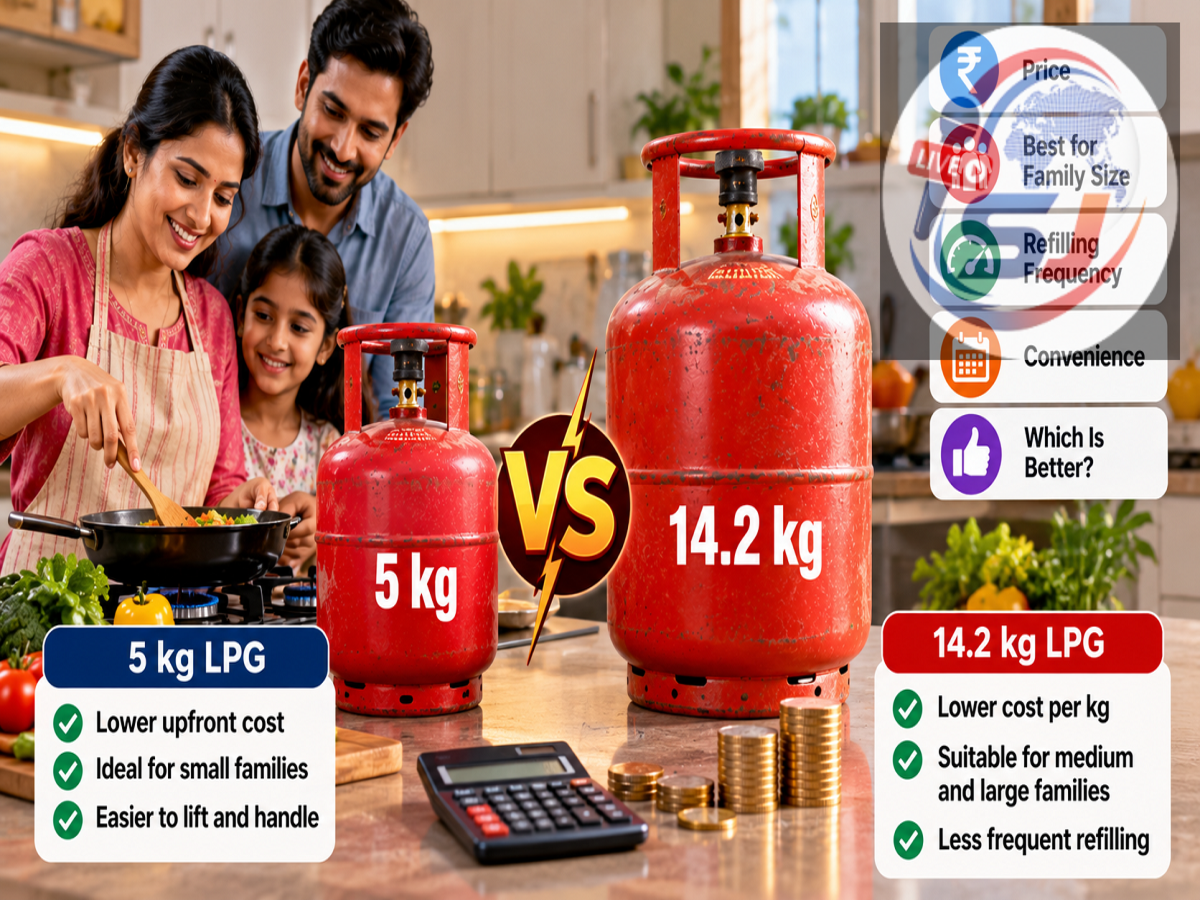
LPG Cylinder 5 kg vs 14.2 kg: Choosing the right cooking gas cylinder can make a noticeable difference to your household budget. While the standard 14.2 kg domestic LPG cylinder remains a popular choice for families across India, smaller 5 kg cylinders are becoming an attractive option for students, working professionals and people living alone.
Both cylinders serve the same basic purpose, but they differ in gas capacity, refill costs, portability and suitability for daily cooking.
A 5 kg cylinder generally requires a smaller payment per refill, while a 14.2 kg domestic cylinder often provides better value when the cost is calculated per kilogram of gas.
However, the cheapest option is not necessarily the most convenient for every household.
Before choosing between the two, it is important to understand their advantages, limitations and long-term costs.
5 kg vs 14.2 kg LPG Cylinder: Key Differences
The biggest difference between these two cylinders is the amount of LPG they contain.
A standard domestic cylinder contains 14.2 kg of cooking gas, while a smaller cylinder contains 5 kg.
This means a 14.2 kg cylinder holds approximately 2.84 times as much gas as a 5 kg cylinder.
Here is a comparison:
| Feature |
5 kg LPG Cylinder |
14.2 kg LPG Cylinder |
|---|---|---|
| Gas Capacity |
5 kg |
14.2 kg |
| Initial Refill Payment |
Usually Lower |
Usually Higher |
| Cost Per Kilogram |
May Be Higher |
Often Lower |
| Portability |
Easier to Move |
Heavier |
| Refill Frequency |
More Frequent |
Less Frequent |
| Best Suited For |
Individuals, Students, Small Households |
Families, Regular Cooking |
| Storage Space |
Requires Less Space |
Requires More Space |
| Availability |
Depends on Product and Distributor |
Widely Used for Domestic Connections |
The actual cost difference depends on whether the 5 kg cylinder is supplied under a domestic connection or sold as a free-trade LPG product.
Why Is a 14.2 kg LPG Cylinder Better for Families?
For households with three, four or more members, a 14.2 kg LPG cylinder is generally the more practical option.
It contains substantially more gas, reducing the frequency of refill bookings.
Families that prepare breakfast, lunch and dinner at home may find a larger cylinder more convenient.
Another advantage is the potentially lower price per kilogram compared with small free-trade LPG cylinders.
This can make the 14.2 kg cylinder more economical for households with regular cooking requirements.
How Long Can a 14.2 kg Cylinder Last?
According to the supplied report, a 14.2 kg cylinder may last approximately 30 to 45 days in a household with moderate gas consumption.
However, this is only an illustrative estimate.
The actual duration depends on several factors, including the number of family members, cooking frequency, burner efficiency and the types of dishes prepared.
A household that cooks three meals daily may use gas much faster than a household that cooks only once a day.
When Should You Choose a 5 kg LPG Cylinder?
A 5 kg cylinder may be more suitable for people who have relatively low cooking gas requirements.
For example, students living in rented accommodation, working professionals staying alone and individuals who cook occasionally may not need a large cylinder.
A smaller cylinder also requires less space and is easier to transport.
This can be useful for people who frequently change accommodation or have limited kitchen space.
Another advantage is that the total refill payment is generally lower because the cylinder contains less gas.
However, consumers should remember that paying less for a refill does not always mean paying less for each kilogram of LPG.
Which LPG Cylinder Is Cheaper Per Kilogram?
To determine which cylinder offers better value, consumers should compare the refill price per kilogram rather than looking only at the total refill amount.
The calculation is straightforward:
Cost per kilogram = Total refill price ÷ Quantity of LPG
For example, consider the following hypothetical prices:
| Particulars |
5 kg Cylinder |
14.2 kg Cylinder |
|---|---|---|
| Illustrative Refill Price |
₹500 |
₹950 |
| LPG Quantity |
5 kg |
14.2 kg |
| Cost Per Kilogram |
₹100 |
₹66.90 |
In this example, the 14.2 kg cylinder is approximately ₹33.10 cheaper per kilogram.
If someone purchased 15 kg of LPG through three 5 kg refills, the total would be ₹1,500.
At the illustrative 14.2 kg rate, a similar quantity of LPG would cost approximately ₹1,003.
The prices above are hypothetical examples used to explain the calculation. They are not verified October 2026 market prices.
Actual LPG rates vary depending on the city, supplier, cylinder category and applicable taxes or subsidies.
Is a 5 kg Cylinder Always More Expensive?
Not necessarily.
The price comparison depends on the type of 5 kg cylinder being purchased.
Some small LPG cylinders are offered through domestic connection arrangements, while others are sold as free-trade LPG cylinders.
Free-trade cylinders may have different pricing structures from standard domestic LPG refills.
Therefore, consumers should check the exact refill price and calculate the cost per kilogram before making a decision.
The initial cost of obtaining the cylinder, including any applicable deposit or equipment charges, should also be considered.
Which Cylinder Is Better for a Family of Four?
For a family of four that regularly prepares meals at home, a 14.2 kg domestic LPG cylinder will usually be the more convenient choice.
The larger gas capacity reduces the need for frequent refills and may offer a lower unit cost.
A 5 kg cylinder could still be useful as a backup, provided it is obtained and used through an authorised supplier with compatible equipment.
However, keeping additional LPG cylinders must comply with applicable storage and safety requirements.
Which Cylinder Is Better for Students and Tenants?
Students, tenants and people living alone may prefer a 5 kg cylinder because of its smaller size and lower refill payment.
A compact cylinder can be easier to accommodate in a small kitchen.
For people who cook only occasionally, the smaller capacity may be sufficient.
However, users should check whether their landlord or housing arrangement permits LPG cylinder use and whether the kitchen has adequate ventilation.
Safety should always take priority over convenience.
What About LPG Subsidies?
LPG subsidy eligibility is another factor that can influence the effective cost of cooking gas.
Eligible Pradhan Mantri Ujjwala Yojana beneficiaries may receive financial assistance on qualifying domestic LPG refills under applicable government rules.
However, subsidy eligibility, refill limits and cylinder categories are subject to official conditions.
Consumers should not assume that every 5 kg or 14.2 kg cylinder automatically qualifies for the same subsidy.
The final cost should be compared after accounting for any benefit the household is legally entitled to receive.
Important Safety Tips for LPG Users
Regardless of cylinder size, LPG should always be purchased from authorised distributors or approved retail outlets.
Consumers should ensure that the cylinder, regulator and hose are suitable for the intended installation.
Cylinders must be kept upright in a properly ventilated location and away from excessive heat.
Never attempt to transfer LPG from one cylinder to another at home.
If you suspect a gas leak, turn off the regulator if it is safe to do so, avoid operating electrical switches, ventilate the area and contact the authorised emergency service.
Final Verdict: 5 kg or 14.2 kg—Which Should You Buy?
Choose a 14.2 kg cylinder if:
You have a family of three or more, cook regularly and want fewer refills with potentially lower gas costs per kilogram.
Choose a 5 kg cylinder if:
You live alone, cook occasionally, have limited kitchen space or prefer smaller refill payments.
Ultimately, the 14.2 kg cylinder generally offers better value for regular family cooking, while the 5 kg cylinder is more convenient for low-consumption households.
Before purchasing, compare the actual refill price per kilogram, initial connection charges and availability in your area.
Based on an ABP Live report updated October 9, 2026. Cylinder prices, subsidy eligibility and refill availability vary by location and supplier.