
LIC Claim Rejected After Policyholder’s Death; Consumer Commission Orders Nearly ₹10 Lakh Payment
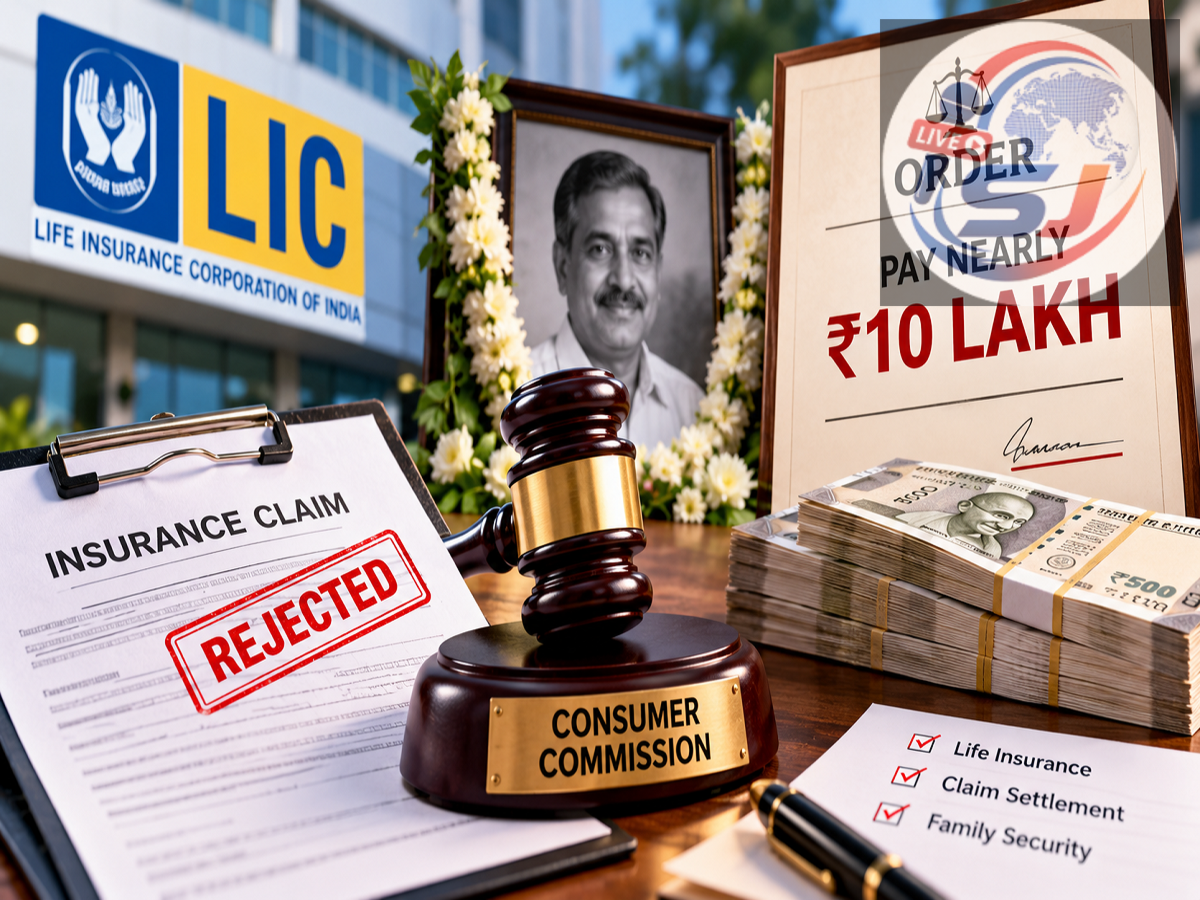
LIC Insurance Claim Case: An insurance claim dispute in Ghaziabad has resulted in relief for the nominee of a deceased policyholder after the district consumer commission directed Life Insurance Corporation of India (LIC) to make the payment. The case involved a policyholder who died roughly 13 months after purchasing a life insurance policy, following which his wife’s claim was rejected on allegations of non-disclosure of pre-existing health conditions.
According to the case details cited in the report, the Ghaziabad District Consumer Disputes Redressal Commission directed LIC to pay the policyholder’s nominee within 30 days.
The dispute is significant for insurance consumers because the commission examined an important question: when an insurer rejects a death claim on the ground that the policyholder concealed a medical condition, who is responsible for establishing that allegation?
Policyholder Died About 13 Months After Buying LIC Policy
The complaint was filed by Ghaziabad resident Neelam Marwah on January 3, 2017.
According to the details presented before the commission, her husband, Pavnish Marwah, had purchased an insurance policy on November 27, 2013, carrying a sum assured of ₹9.95 lakh.
About 13 months later, on December 5, 2014, Marwah fell ill and was subsequently admitted to a hospital, where he died.
Following his death, his wife approached LIC to claim the insurance benefit as the nominee. However, the insurer declined to settle the death claim.
Why Did LIC Reject the Insurance Claim?
According to the report, LIC informed the nominee that the claim had been rejected because the policyholder had allegedly failed to disclose pre-existing health problems when taking the policy.
LIC's counsel maintained before the commission that after receiving the claim, the insurer examined the relevant documents and made its decision in accordance with the terms and conditions of the insurance policy.
A rejection notice was reportedly issued on March 30, 2016.
The nominee was not satisfied with the decision and subsequently challenged it before the insurer's regional office in Kanpur. However, that appeal was also rejected on July 30, 2016.
Neelam Marwah then sought relief from the consumer commission, disputing the allegation that her husband had concealed relevant pre-existing medical conditions.
Consumer Commission Examines LIC's Evidence
After considering the arguments from both sides and reviewing the documents placed on record, the Ghaziabad consumer commission examined whether LIC had adequately established its allegation of material non-disclosure.
The commission acknowledged the established principle that an insurance contract is based on “utmost good faith.” This generally requires applicants to provide material information relevant to the insurer's assessment of risk.
However, according to the reported findings, the commission held that this principle alone does not allow an insurer to reject a claim arbitrarily.
Where an insurance company alleges that a policyholder concealed an important medical condition, the insurer must substantiate that allegation with adequate evidence.
What Must an Insurer Establish in Such a Dispute?
According to the commission's reasoning as reported, an insurer alleging concealment of health information needs to establish several important elements.
It must show that the medical condition actually existed and that it was material to the insurance risk at the time the policy was purchased.
The insurer would also need to establish that the policyholder was aware of the condition and had deliberately withheld the relevant information.
The commission further considered whether the alleged medical condition had a meaningful connection with the insured risk or the policyholder's death.
In this case, the commission concluded that LIC had failed to establish the necessary elements on the basis of the documents presented before it.
The decision therefore went in favour of the complainant.
LIC Directed to Pay Nominee Within 30 Days
According to the report, the commission directed LIC to make the payment to the policyholder's nominee within 30 days.
The reported order included a death claim amount of ₹9.9 lakh. It also provided ₹5,000 as compensation toward mental harassment and legal expenses, according to the case details cited in the report.
The complaint was considered by a bench comprising commission president Anil Kumar Pundir and members Shailja Sachan and R.P. Singh, as stated in the source report.
What Does This Case Mean for Insurance Policyholders?
The ruling highlights the importance of complete and accurate disclosure while purchasing life insurance.
Applicants should provide correct information about their health history, existing illnesses, medical treatment and other details specifically requested in the proposal form. Incorrect or incomplete information can potentially lead to disputes when a claim is filed.
At the same time, the reported Ghaziabad decision indicates that an allegation of medical non-disclosure must be supported by evidence. A claim rejection can be challenged when the nominee believes the insurer's decision is not justified by the facts or policy terms.
However, the outcome of one consumer dispute should not be treated as a guarantee that every rejected insurance claim will be decided in the same manner. Insurance disputes depend on the policy wording, proposal form, medical evidence, circumstances of the claim and applicable law.
What Can a Nominee Do If an Insurance Claim Is Rejected?
If a life insurance claim is denied, the nominee should first obtain the insurer's written rejection letter and understand the specific reason given for repudiation.
Relevant documents—including the policy, proposal form, medical records, premium receipts and correspondence with the insurer—should be preserved. Depending on the circumstances, the claimant may use the insurer's grievance and appeal mechanisms and explore other remedies available under applicable consumer and insurance grievance frameworks.
The Ghaziabad case demonstrates why documentation can become crucial when a dispute involves allegations that a policyholder withheld medical information.
For policy buyers, the broader takeaway is equally important: disclose material information accurately when purchasing insurance and retain copies of the proposal form and policy documents. For nominees, a rejected claim does not necessarily end the matter if there are grounds to contest the insurer's decision.
Disclaimer: This article is intended for general information and awareness. It is based on the reported facts of a specific consumer dispute, and individual insurance cases can have different facts and outcomes. Readers facing a claim dispute should review their policy documents and consider obtaining appropriate professional or legal advice.