
India’s Richest Business Families 2026: What Could ₹138 Lakh Crore Build? From Smart Cities to Hospitals and Highways
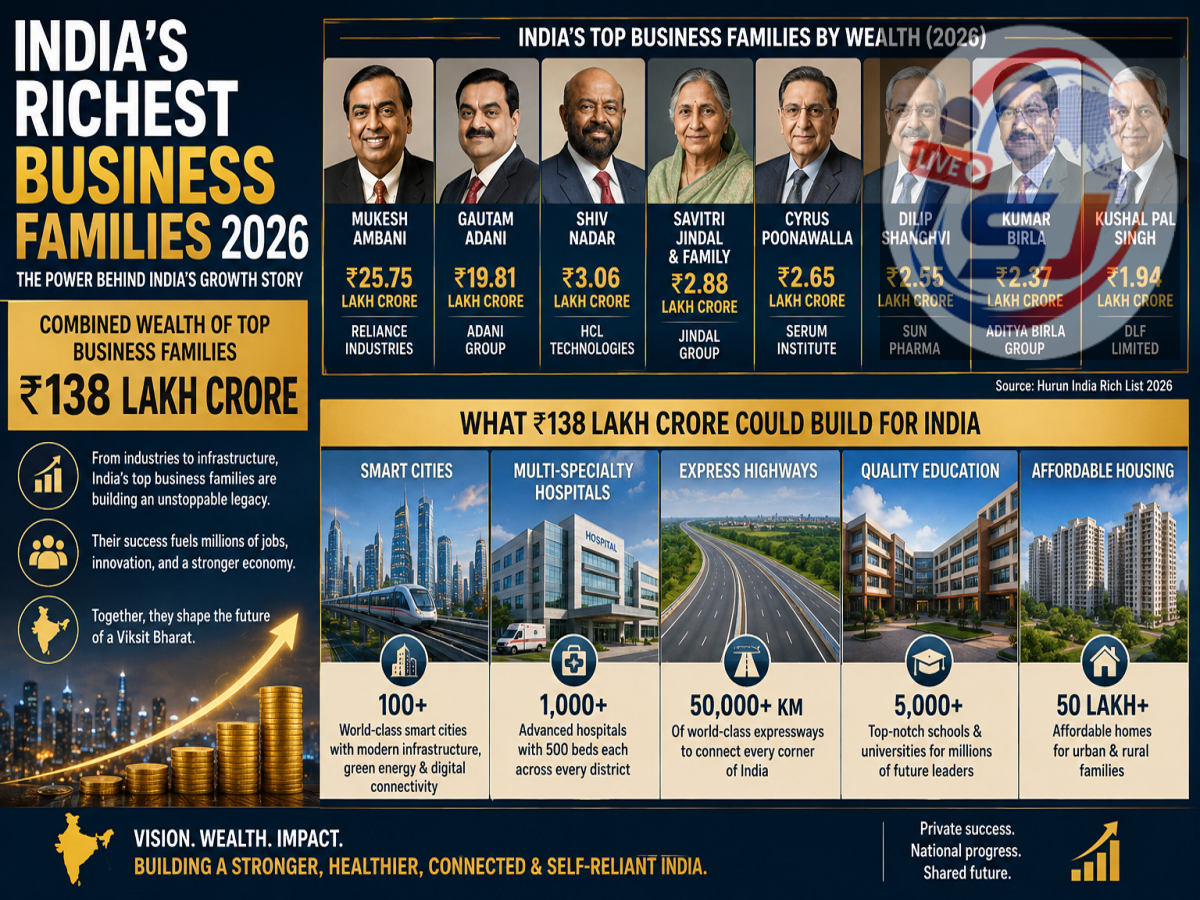
India’s Richest Business Families: India’s wealthiest business families collectively control enormous business value. Here’s a perspective on what sums of this scale could theoretically fund, from modern cities and schools to hospitals and expressways.
India is home to some of the world's largest family-controlled businesses, spanning sectors including energy, telecom, infrastructure, pharmaceuticals, retail, metals and manufacturing.
According to figures cited from the 2026 Barclays Private Clients Hurun India Most Valuable Family Businesses ranking, the Ambani family occupies the top position, followed by the Adani family.
The numbers involved are enormous. The report cited in the article puts the combined value of India's top 10 business families at around ₹70.5 lakh crore, while the top 300 families together are valued at approximately ₹138 lakh crore.
How Much Are India’s Biggest Business Families Worth?
According to the reported ranking, the Ambani family leads with an estimated business value of around ₹25.8 lakh crore, while the Adani family follows at approximately ₹19.6 lakh crore.
The top five cited in the report are:
| Rank | Business Family | Reported Value | Major Business Group |
|---|---|---|---|
| 1 | Ambani family | ₹25.8 lakh crore | Reliance Industries |
| 2 | Adani family | ₹19.6 lakh crore | Adani Group |
| 3 | Sunil Bharti Mittal family | ₹12.1 lakh crore | Bharti Enterprises |
| 4 | Kumar Mangalam Birla family | ₹8.14 lakh crore | Aditya Birla Group |
| 5 | Jindal family | ₹8.02 lakh crore | O.P. Jindal Group |
These figures should be understood as business/family wealth estimates, rather than cash sitting in bank accounts. Much of the value is typically tied to ownership stakes in listed and unlisted companies.
₹138 Lakh Crore Is an Enormous Number
To put ₹138 lakh crore into perspective, it equals:
₹138,00,000 crore, or roughly ₹138 trillion.
Such comparisons are primarily illustrative because private business wealth, government expenditure and national GDP are fundamentally different economic measures.
Still, the figure provides an interesting way to understand the scale of India's biggest family businesses.
Could It Build 100 New Smart Cities?
Suppose a large modern city required around ₹30,000 crore of investment.
Building 100 such cities would cost:
₹30,000 crore × 100 = ₹30 lakh crore.
Theoretically, these cities could include underground electricity and water networks, modern drainage, public transportation, digital infrastructure and technology-assisted traffic-management systems.
Even after spending ₹30 lakh crore on 100 cities, a substantial portion of ₹138 lakh crore would remain.
What About 50,000 High-Tech Schools?
Assume a fully equipped modern school costs around ₹20 crore to construct and develop.
Creating 50,000 schools would require:
₹20 crore × 50,000 = ₹10 lakh crore.
Such campuses could theoretically include science laboratories, robotics facilities, smart classrooms, libraries, sports infrastructure and other educational facilities.
Thousands of Large Hospitals Could Be Built
Healthcare infrastructure provides another way to visualise the amount.
At an assumed construction and development cost of ₹500 crore per hospital, building 5,000 large hospitals would require:
₹500 crore × 5,000 = ₹25 lakh crore.
Again, this is only an illustrative calculation. The actual cost of constructing and operating a large tertiary-care hospital varies significantly depending on land, location, medical equipment, capacity and staffing.
A Massive Expressway Network
Another comparison is India's expanding expressway infrastructure.
If tens of lakh crore rupees were allocated to roads, it could theoretically finance thousands of kilometres of high-capacity expressways, depending on land-acquisition costs, terrain, number of lanes, bridges, tunnels and other infrastructure requirements.
A network stretching across major economic centres could potentially improve connectivity between industrial clusters, ports, cities and logistics hubs.
However, a simple per-kilometre calculation can be misleading because expressway construction costs differ dramatically from one project to another.
What If ₹138 Lakh Crore Were Divided Among 140 Crore People?
This is perhaps the easiest way to understand the scale.
Dividing ₹138 lakh crore equally among an assumed population of 140 crore people works out to approximately:
₹98,571 per person.
In other words, it is close to ₹1 lakh for every person under those assumptions.
This remains a hypothetical comparison because business valuations cannot simply be converted into an equivalent amount of distributable cash.
Other Eye-Catching Comparisons
At this scale, the amount can also be compared hypothetically with extremely expensive assets such as luxury properties, aircraft, large infrastructure projects or precious metals.
However, comparisons claiming that the money could buy a specific number of fighter jets, tonnes of gold or Antilia-like homes should be treated cautiously. Prices depend on specifications, exchange rates, associated infrastructure, contractual terms and market conditions.
Other Major First-Generation Business Families
The ranking also highlights several entrepreneurs who built large businesses rather than inheriting multi-generational corporate groups.
The Dilip Shanghvi family, associated with Sun Pharmaceutical Industries, is cited with wealth of around ₹4.55 lakh crore.
The Poonawalla family, associated with Serum Institute of India, reportedly has wealth of around ₹2.98 lakh crore.
The Radhakishan Damani family, associated with Avenue Supermarts, which operates DMart, is listed at approximately ₹2.86 lakh crore.
Business Wealth and GDP Are Not the Same Thing
There is an important distinction when making such comparisons.
A country's GDP measures the value of goods and services produced over a particular period, usually one year. Family or corporate wealth, on the other hand, represents the estimated value of assets or ownership stakes at a particular point in time.
Similarly, the ₹138 lakh crore figure does not mean India's richest families collectively possess that amount as readily spendable cash.
Stock-market movements can also cause such valuations to rise or fall substantially without the underlying families receiving or losing an equivalent amount of cash.
The Bigger Picture
The figures nevertheless demonstrate the extraordinary scale reached by India's largest family-controlled businesses.
From the Ambanis and Adanis to the Mittals, Birlas and Jindals, these groups operate businesses across some of the most important parts of the economy.
Comparing their combined valuations with the hypothetical cost of smart cities, schools, hospitals and highways offers a simple way of understanding numbers that otherwise become difficult to comprehend once they run into tens or hundreds of lakh crore rupees.