
India Visa Rules 2026: Government Cuts Visa Categories From 13 to 9, Application Forms Simplified by 70%
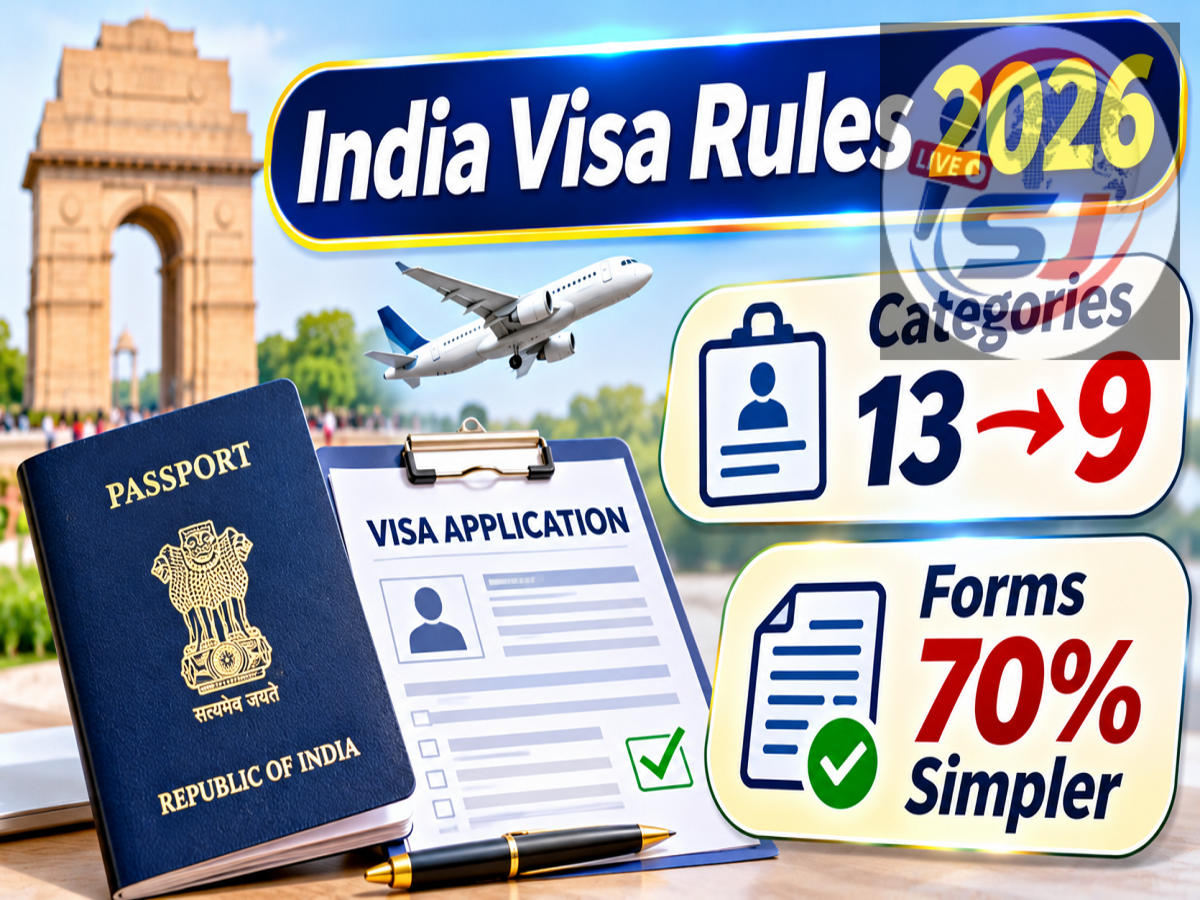
India Visa Rules 2026: The Central Government has announced major changes to India's visa framework to simplify the application process for foreign nationals. The Ministry of Home Affairs (MHA) has reduced the number of main visa categories from 13 to nine and subcategories from 49 to 23.
The government has also streamlined visa application forms, reducing the number of information fields by approximately 65% to 70% across the revised categories.
According to a report published on November 11, 2026, the Ministry is upgrading its IT systems to support the new framework, with implementation expected by the end of 2026.
The changes are intended to make it easier for international tourists, students, business visitors, researchers and medical travellers to identify the appropriate visa and complete their applications.
India Visa System 2026: What Has Changed?
The restructuring is part of a broader effort to modernise India's immigration and visa administration.
| Particulars | Previous System | Revised System |
|---|---|---|
| Main visa categories | 13 | 9 |
| Visa subcategories | 49 | 23 |
| Application information fields | Earlier detailed forms | Approximately 65–70% fewer fields |
| Implementation | Existing framework | Expected by the end of 2026 |
The Ministry expects the simplified forms to reduce the time applicants spend entering information and help officials process applications more efficiently.
However, the revised categories should not be assumed to be operational at every visa application centre until the government completes implementation and publishes the applicable instructions.
What Are the Nine New Visa Categories?
Under the restructured framework, visas will be organised into nine main categories.
-
Business Visa: For eligible business, investment and commercial activities.
-
Diplomatic Visa: For diplomats, certain United Nations representatives and eligible dependants.
-
Work Visa: For qualifying foreign employees and specified professional activities.
-
Journalist Visa: For eligible foreign journalists.
-
Medical Visa: For medical treatment, including recognised AYUSH treatments and accompanying attendants.
-
Official Visa: For eligible non-diplomatic government and international organisation officials.
-
Student Visa: For education, research and specified academic activities.
-
Visitor Visa: For tourism and certain short-term activities.
-
Miscellaneous Visa: For specified categories of foreign nationals not covered by the other classifications.
The restructuring aims to reduce overlap between different visa types and make their purposes easier to understand.
Tourist Visa Renamed Visitor Visa
One of the most noticeable changes is the replacement of the earlier Tourist Visa classification with a broader Visitor Visa category.
The revised category is intended to cover tourism alongside certain short-duration activities, including business meetings, medical consultations, wellness retreats and cultural learning.
The report identifies two Visitor Visa subcategories.
V-1 Visa: Intended for short visits of up to 30 days, with multiple-entry provisions. Permitted activities may include tourism, business meetings, medical consultations, wellness programmes and selected short-term courses.
V-2 Visa: Intended for longer validity periods of one, five or ten years, depending on eligibility. It may cover activities permitted under V-1 as well as mountaineering, for which a separate six-month multiple-entry provision is described.
Actual validity, permitted activities and entry conditions will depend on the official rules applicable to each applicant.
Medical Visa Rules: Four Subcategories Introduced
The revised framework also distinguishes between conventional medical treatment and AYUSH-based treatment.
| Visa Type | Intended Purpose |
|---|---|
| M-1 | Medical treatment other than AYUSH |
| M-2 | Attendants accompanying M-1 patients |
| M-3 | AYUSH-based medical treatment |
| M-4 | Attendants accompanying M-3 patients |
According to the reported framework, M-1 and M-3 visas will generally have a default validity of one year with multiple-entry facilities.
The changes could benefit international patients who require follow-up consultations, repeated hospital visits or treatment in multiple stages.
The government also expects the revised system to support India's medical tourism sector and its Heal in India initiative.
Student Visa Changes: S-1 and S-2 Categories
Foreign students will be covered under two principal student visa subcategories.
S-1 Visa: For eligible school, undergraduate and postgraduate studies.
S-2 Visa: For doctoral programmes, research, visiting academic appointments, internships, exchange programmes and other specified academic or scientific activities.
The revised student framework also covers certain educational programmes involving Indian languages, music, dance, yoga, Buddhist studies and traditional knowledge systems.
Foreign students admitted through the Study in India platform may be eligible for an e-S1 visa.
According to the reported provisions, this visa may be issued for a maximum of five years or the duration of the course, whichever is shorter, with multiple-entry benefits.
Business Visa Divided Into B-1 and B-2
The new framework separates longer-term commercial activities from specified short-term business requirements.
B-1 Visa: Intended for eligible long-term business activities, including establishing industrial or commercial enterprises in India.
B-2 Visa: Intended for certain short-term business activities, contractual assignments, conferences, cultural events, sports-related activities and film production.
The B-2 category also includes provisions for foreign technical specialists supporting industrial and production-related activities.
Such professionals may be required for machinery installation, equipment maintenance, quality testing, IT and ERP implementation, employee training and technical assistance.
The report indicates that certain activities previously covered under the e-B4 classification will be accommodated within the revised B-2 framework.
These changes are intended to simplify arrangements for Indian companies requiring specialised overseas expertise.
How India's Visa Categories Have Changed
The latest restructuring follows an earlier round of simplification.
| Stage | Main Categories | Subcategories |
|---|---|---|
| Before October 2025 restructuring | 22 | 63 |
| After October 2025 restructuring | 13 | 49 |
| Revised 2026 framework | 9 | 23 |
The Ministry had previously announced changes to the visa system on August 27, 2026.
The latest restructuring further consolidates categories that previously covered similar activities.
What About India's Existing e-Visa Facility?
According to the report, India's electronic visa system currently provides electronic travel authorisation under 13 subcategories for eligible nationals of 172 countries.
The new visa classification framework is expected to simplify the wider system, but the availability of individual e-Visa services will continue to depend on official eligibility conditions and implementation arrangements.
Foreign nationals should check the currently operational categories before submitting an application.
When Will the New Visa Rules Take Effect?
The Ministry of Home Affairs is reportedly updating its technology infrastructure to support the revised visa framework.
Implementation is expected by the end of 2026.
However, an expected rollout date is not the same as a confirmed commencement date.
Applicants should follow the visa categories, application forms and instructions available on the official government portal at the time of applying.
Where Can Foreign Nationals Apply for an Indian Visa?
Applicants should use official government channels for visa-related information and applications.
Indian Visa Online: https://indianvisaonline.gov.in/
Ministry of Home Affairs: https://www.mha.gov.in/
Applicants should confirm the appropriate visa type, eligibility, permitted activities, fees and validity before applying.
Final Update
India's revised visa framework reduces the number of main categories from 13 to nine and subcategories from 49 to 23.
Application forms have also reportedly been simplified by reducing information requirements by approximately 65% to 70%.
The changes include a broader Visitor Visa category, separate medical and AYUSH classifications, revised student visa arrangements and a simplified business visa structure.
The new system is expected to become operational by the end of 2026, subject to completion of the government's implementation process.
Foreign nationals planning to visit India should verify the rules currently in force rather than assuming that all revised categories are already available.
Official References: Ministry of Home Affairs, Government of India; Indian Visa Online portal.
Disclaimer: This article is based on the supplied news report. The revised visa classifications, validity periods and implementation schedule should be confirmed against official government notifications before making travel or application decisions.