
India in 1947 vs 2026: How the Country Changed From a Young Economy to a Global Power
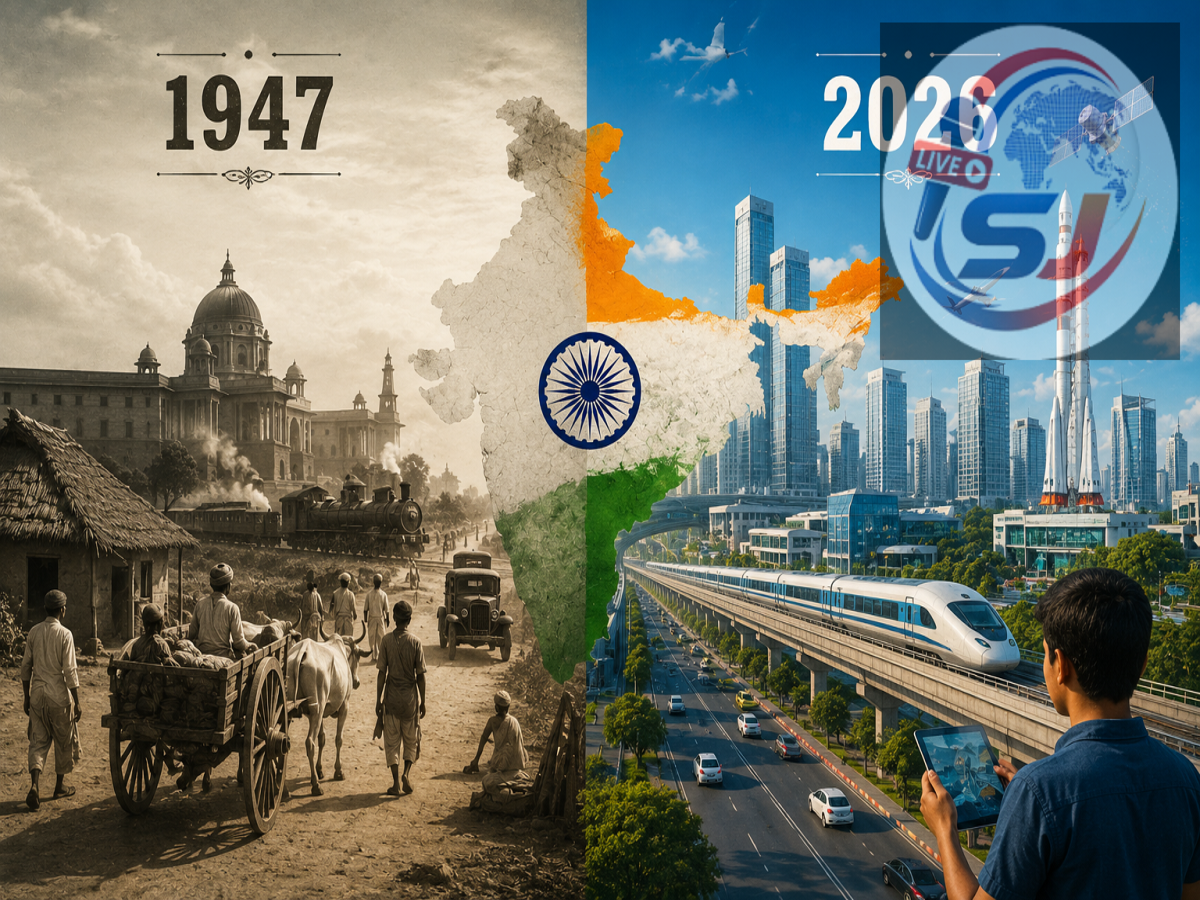
Independence Day 2026: India of 2026 looks dramatically different from the country that became independent on August 15, 1947. At independence, the nation faced widespread poverty, low literacy, limited industrial capacity and enormous development challenges. Nearly eight decades later, India has emerged as one of the world's largest economies, built a vast infrastructure network and developed capabilities in sectors ranging from aviation and digital technology to space and advanced manufacturing.
The transformation becomes even clearer when key economic and social indicators are compared across the two periods. India's population has expanded from roughly 34 crore around independence to more than 140 crore today. Literacy, life expectancy and average incomes have also improved substantially.
Here's a closer look at India's journey from 1947 to 2026.
India's Economy Has Expanded Dramatically
India inherited a weak economy at independence after nearly two centuries of colonial rule. Historical estimates vary depending on the methodology and prices used, making a direct rupee comparison between 1947 and 2026 difficult.
Historical economic research nevertheless shows that India's share of global output had declined significantly during the colonial era.
By 2026, the situation is entirely different. India is now among the world's largest economies, with its nominal GDP running into several trillion dollars.
The country's economic structure has also changed considerably. Agriculture remains important, but services, manufacturing, construction, technology, financial services, telecommunications and other industries now contribute substantially to national output.
This shift from a largely agriculture-dependent economy to a diversified economic system is one of the most significant changes since independence.
Per Capita Income Has Risen Along With the Economy
India's average income levels were extremely low around independence.
Estimates commonly cited for 1947 put annual per capita income at only a few hundred rupees at the prices prevailing at the time. Poverty was widespread, employment opportunities were limited and access to education, healthcare and modern infrastructure was poor across much of the country.
By 2026, nominal per capita income has risen to several lakh rupees annually, although the exact figure depends on whether GDP per capita or national income per capita is being measured.
The increase reflects decades of economic expansion, industrialisation, urbanisation and growth in services.
However, average income figures do not tell the complete story. Income inequality, differences between rural and urban areas and regional variations remain important challenges.
Forex Reserves Tell the Story of India's Economic Journey
India's foreign exchange position provides another striking example of how its economy has evolved.
One of the country's most difficult economic moments came in 1991, when foreign exchange reserves fell to levels sufficient to finance only a short period of imports. India had to take emergency measures, including pledging gold, as it confronted a serious balance-of-payments crisis.
That episode eventually contributed to major economic reforms and greater integration with the global economy.
By 2026, India's foreign exchange reserves are measured in hundreds of billions of dollars, giving policymakers a significantly larger financial buffer against external shocks.
Large reserves can help a country manage periods of currency volatility, international market uncertainty and disruptions in global capital flows.
From Limited Manufacturing to Aircraft Production
Perhaps one of the most visible examples of India's transformation is aviation.
When India became independent, the country had only a limited domestic aviation manufacturing base. Hindustan Aircraft Limited, which later became Hindustan Aeronautics Limited (HAL), had already been established, but India's ability to independently design and manufacture sophisticated aircraft was still at an early stage.
The Indian Air Force operated several foreign-origin aircraft, and the country remained heavily dependent on overseas suppliers for advanced aviation technology.
The situation in 2026 is significantly different.
India has become one of the world's largest aviation markets. The number of operational airports has expanded rapidly over the past decade, while domestic passenger traffic and airline fleets have grown substantially.
Indian carriers have also placed some of the world's largest aircraft orders as they prepare for continued passenger growth.
India Wants to Build More Aircraft at Home
India's aviation ambitions now extend beyond simply purchasing aircraft from international manufacturers.
The government is encouraging domestic production, technology partnerships and the development of a stronger aerospace supply chain.
Indian companies are increasingly working with global original equipment manufacturers, while domestic aerospace companies are expanding their manufacturing capabilities.
Defence aviation is another major focus. Large procurement programmes increasingly include requirements for aircraft or components to be manufactured within India.
The broader objective is to create an ecosystem in which Indian companies participate in design, components, assembly, maintenance and eventually exports.
This is a remarkable contrast with the early years after independence, when India had very limited aerospace infrastructure.
Airports and Air Travel Have Expanded Rapidly
Commercial aviation has also changed the way Indians travel.
Flying was once accessible to only a tiny section of the population. Today, air connectivity reaches a much larger number of cities, including several Tier-2 and Tier-3 destinations.
India's airport network has more than doubled over roughly the past decade, while annual passenger traffic has climbed into hundreds of millions.
Regional connectivity initiatives have also attempted to bring smaller cities onto India's aviation map.
If passenger demand continues to grow as projected, airlines, airports, aircraft maintenance companies and aerospace manufacturers will require substantial investment over the coming years.
Literacy and Life Expectancy Show India's Social Transformation
India's progress is not limited to GDP and industrial development.
At independence, literacy was extremely low, with only a small proportion of the population able to read and write. Educational opportunities were particularly limited in rural areas and among women.
Literacy has risen dramatically since then as schools, universities and other educational institutions have expanded across the country.
Life expectancy has also improved substantially compared with the early years of independence.
Better healthcare access, vaccination, improved sanitation, nutrition, medicines and advances in medical treatment have contributed to Indians living considerably longer on average than previous generations.
Challenges remain, particularly around healthcare quality, learning outcomes and unequal access, but the long-term change is significant.
India's Foreign Policy Has Also Evolved
India's position in international affairs has undergone a major transformation.
In the years after independence, the world was increasingly divided between the United States-led Western bloc and the Soviet bloc. India chose not to formally align itself with either side and later became a prominent voice in the Non-Aligned Movement.
The underlying objective was to preserve India's strategic independence.
In 2026, that principle remains relevant, but India's approach has become more flexible.
India maintains important strategic and economic relationships with countries that may themselves be geopolitical competitors. It works closely with the United States in several areas while maintaining longstanding relations with Russia. India has also deepened ties with European countries, Israel, Gulf nations, Japan and other major economies.
This approach is often described as multi-alignment or strategic autonomy.
1947 vs 2026: India at a Glance
| Indicator | Around 1947 | 2026 |
|---|---|---|
| Population | Around 34 crore | More than 140 crore |
| Literacy | Around 12% | Around 80% |
| Life Expectancy | Around 32 years | Around 70+ years |
| Economy | Predominantly agriculture-based | Diversified services, manufacturing and agriculture economy |
| Foreign Exchange Position | Very limited | Hundreds of billions of dollars in reserves |
| Aviation | Small industry, high foreign dependence | One of the world's largest aviation markets |
| Aircraft Manufacturing | Limited capability | Expanding domestic aerospace ecosystem |
| Foreign Policy | Non-alignment | Strategic autonomy and multi-alignment |
From a Newly Independent Nation to a Major Global Economy
India's transformation between 1947 and 2026 cannot be captured by a single GDP figure or statistic.
The country has moved from widespread poverty and limited industrial capacity to becoming a major economy with capabilities in information technology, pharmaceuticals, automobiles, aviation, defence manufacturing, digital payments and space technology.
At the same time, India's development story remains unfinished. Employment creation, income inequality, education quality, healthcare access, infrastructure and raising living standards for a population of more than 1.4 billion remain major priorities.
Still, the contrast between 1947 and 2026 illustrates the scale of change achieved over nearly eight decades. From an economy struggling to build its basic industrial foundations to a country seeking a larger role in global manufacturing and aviation, India's journey reflects both how far it has travelled and how much work remains ahead.