India Gets Its First LNG Train: Dual-Fuel Technology Can Cut Diesel Use by Up to 40%
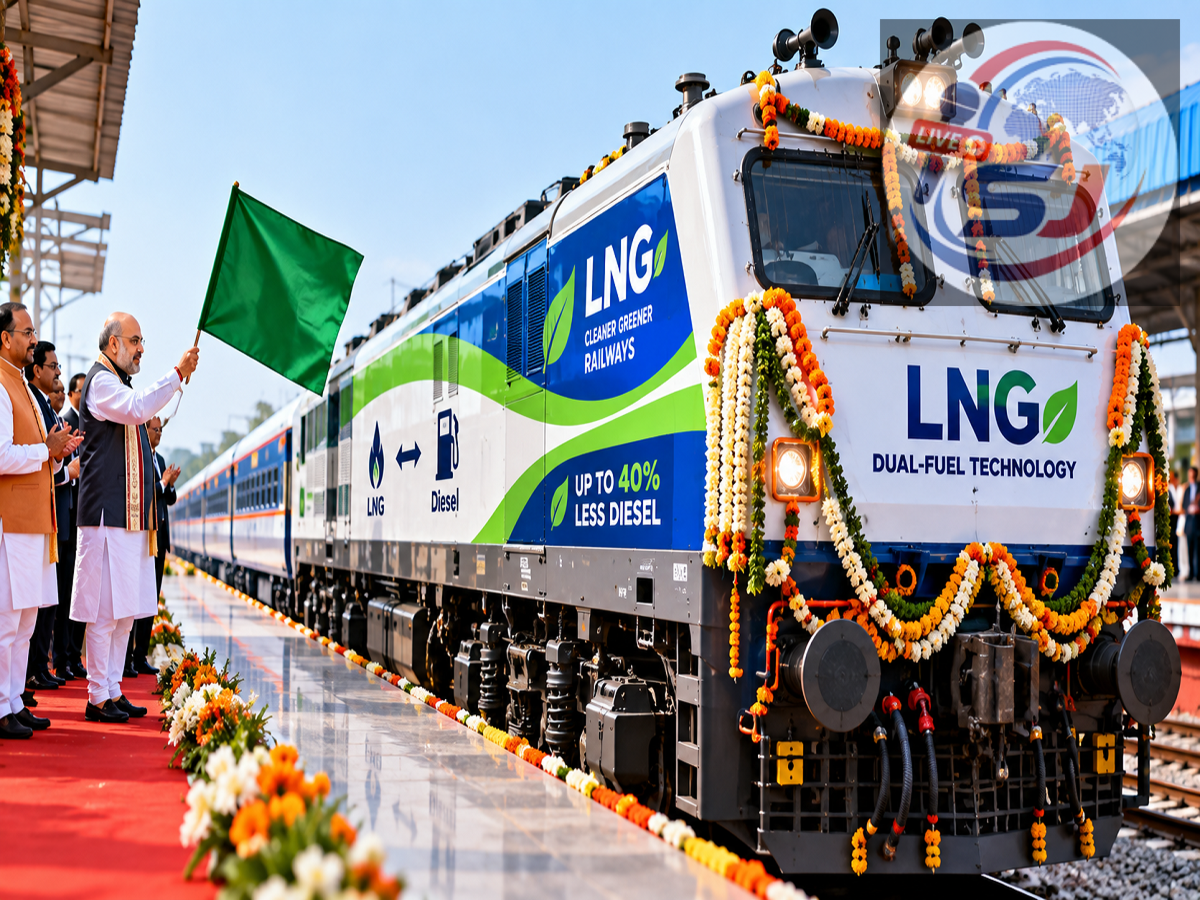
India's First LNG Train: Indian Railways has taken another step towards cleaner and more fuel-efficient rail transport with the launch of the country's first LNG-powered train. Union Home and Cooperation Minister Amit Shah flagged off the train from Sabarmati railway station in Gujarat on September 27, 2026.
The new train is particularly significant because it does not operate entirely on Liquefied Natural Gas (LNG). Instead, Indian Railways has introduced a diesel-LNG dual-fuel system, allowing the power cars to use both fuels.
The technology is aimed at reducing conventional diesel consumption, lowering fuel costs and cutting emissions without compromising normal train operations.
Before its launch, the converted power cars underwent more than 2,000 kilometres of field trials to evaluate the performance and reliability of the new system.
India's First LNG Train Uses Dual-Fuel Technology
The biggest feature of the new train is its dual-fuel arrangement.
Instead of completely replacing diesel, the system allows LNG to substitute a portion of the diesel normally consumed by the engine.
This provides greater operational flexibility. If LNG availability becomes an issue, diesel can continue to support the train's operation.
According to information released about the project, LNG can replace approximately 40% of diesel consumption under the system.
This could reduce Indian Railways' dependence on conventional diesel while allowing existing diesel-based technology to be adapted rather than completely replaced.
Two 1,400-HP Power Cars Converted
The project involves two Driving Power Cars, or DPCs, each rated at 1,400 horsepower.
These power cars have been modified to operate using the LNG-diesel dual-fuel system.
Rather than developing an entirely new propulsion platform from scratch, the project demonstrates how an existing diesel-electric multiple unit configuration can be adapted to use an alternative fuel.
The eight-coach non-AC DEMU has been equipped to operate with the converted power cars.
Over 2,000 Km of Trials Completed Before Launch
The LNG-powered train was not introduced directly into service without testing.
The two converted Driving Power Cars underwent more than 2,000 kilometres of field trials before the launch.
The testing was intended to examine reliability, fuel efficiency and overall performance under operational conditions.
According to Railways-related information reported ahead of the launch, the dual-fuel conversion is designed to maintain the power and operating reliability associated with the conventional diesel system.
How Much LNG Can the Train Carry?
Each converted Driving Power Car has been fitted with an LNG tank with a capacity of approximately 2,200 litres.
The usable LNG quantity is reported to be around 950 to 1,000 kg per DPC.
The fuel-storage arrangement is designed to provide sufficient operational range while reducing the frequency of refuelling.
This is one of the advantages associated with using LNG in such an application because natural gas can be stored in liquid form at very low temperatures, allowing a substantial quantity of fuel to be carried in a relatively compact space.
Diesel Consumption Could Fall by Around 40%
Reducing diesel consumption is one of the primary objectives behind the project.
According to the reported technical details, LNG could replace approximately 40% of the diesel that would otherwise be consumed.
That does not mean the train is completely diesel-free.
It remains a dual-fuel train, and both fuels play a role in its operation. Describing it simply as a train that runs exclusively on LNG would therefore be inaccurate.
The advantage of this arrangement is that Indian Railways can begin reducing diesel consumption while retaining the reliability and flexibility of the existing fuel system.
LNG Train Could Also Reduce Operating Costs
Fuel savings are another potential benefit.
Based on trial data cited by Indian Railways, the estimated annual saving could be around ₹11.9 lakh per Driving Power Car.
For an eight-coach rake using two such power cars, the estimated annual fuel-cost saving could reach approximately ₹23.9 lakh.
These are estimated savings based on trial and operating assumptions, so actual savings can depend on factors such as fuel prices, utilisation and operating conditions.
If the technology is deployed more widely in the future, the cumulative impact on fuel consumption and operating expenses could become more significant.
Lower Emissions Are Another Major Goal
The LNG initiative is also being positioned as part of Indian Railways' move towards cleaner transportation.
Greater use of LNG in place of diesel is expected to reduce emissions of pollutants including carbon dioxide, nitrogen oxides and particulate matter.
The project therefore combines two objectives: reducing fuel expenditure and lowering the environmental impact associated with conventional diesel operations.
It also gives Indian Railways another alternative-fuel technology to evaluate alongside electrification and hydrogen-based railway projects.
India Recently Introduced Its Hydrogen Train Too
The LNG development follows another important alternative-fuel initiative by Indian Railways.
India's hydrogen fuel-cell train was inaugurated earlier in 2026 for operation on the Jind-Sonipat section of Northern Railway.
The hydrogen train and LNG-diesel train use fundamentally different technologies.
The LNG train retains a combustion-based dual-fuel arrangement involving LNG and diesel, while a hydrogen fuel-cell train generates electricity through a fuel-cell system.
Both initiatives, however, are part of efforts to explore lower-emission alternatives for railway transportation.
Why the LNG Train Is Important for Indian Railways
The significance of the project goes beyond the launch of a single train.
Indian Railways operates an enormous transportation network, which means even relatively small improvements in fuel efficiency can become meaningful if successfully scaled across suitable operations.
The LNG project also demonstrates the possibility of modifying existing diesel-based rolling stock to reduce conventional fuel consumption.
However, any large-scale expansion would depend on factors including trial performance, LNG availability, refuelling infrastructure, maintenance requirements, safety considerations and the economics of conversion.
The launch should therefore be viewed as an important technology milestone rather than an indication that all diesel trains will soon be converted to LNG.
A New Alternative-Fuel Chapter for Indian Railways
With the launch from Sabarmati on September 27, India now has its first railway train using an LNG-diesel dual-fuel configuration.
The train's two 1,400-HP Driving Power Cars have been modified to use LNG alongside diesel, potentially reducing diesel consumption by around 40%. More than 2,000 kilometres of testing were completed before the launch.
The project could also deliver fuel-cost savings while reducing emissions compared with conventional diesel-only operation.
Following India's hydrogen-train initiative, the introduction of LNG dual-fuel technology adds another option to Indian Railways' efforts to explore cleaner and more efficient ways of powering trains.
Whether the technology eventually expands to a larger fleet will depend on its long-term operational performance, economics and infrastructure requirements.