
HRA Rules for Government Employees: When House Rent Allowance Can Stop and Who Cannot Claim It
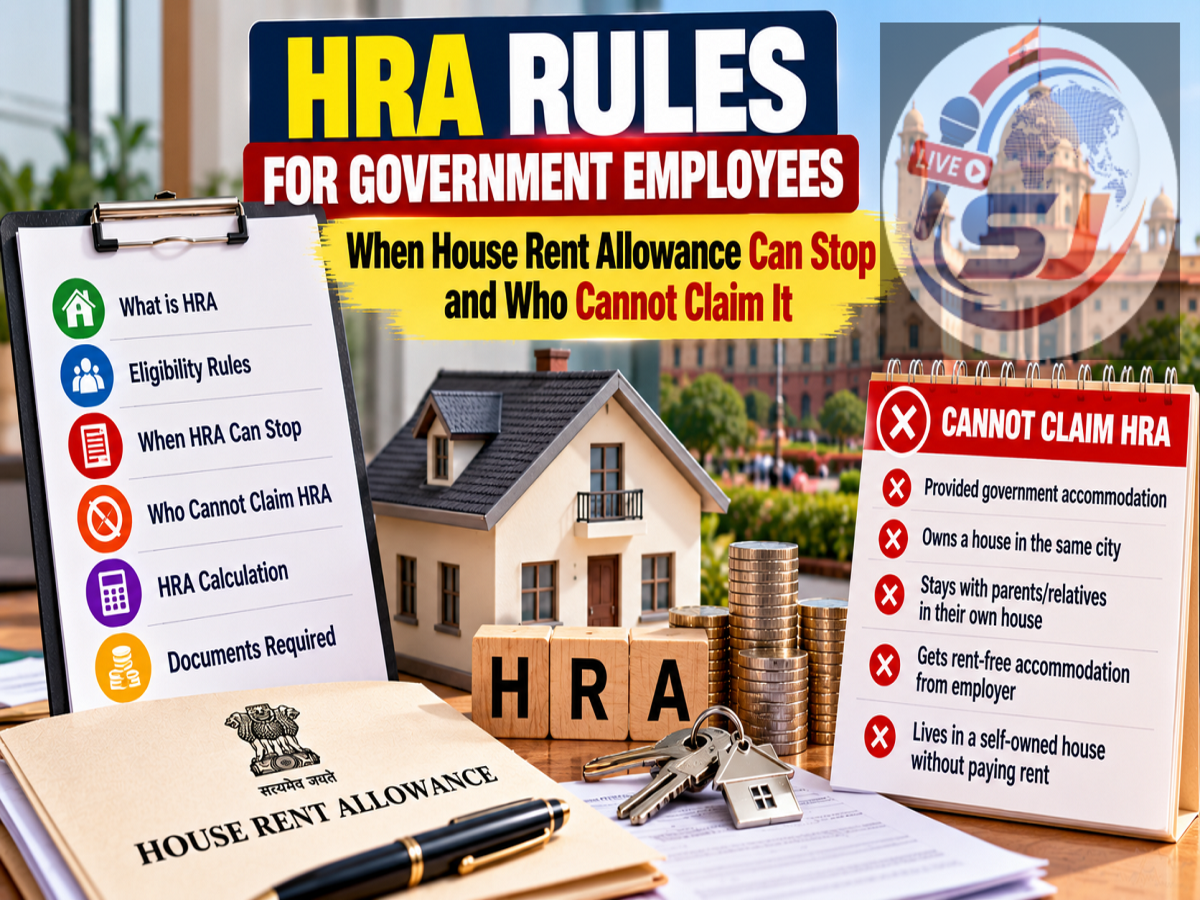
House Rent Allowance (HRA) is an important part of the salary package of many central government employees, but receiving it is subject to specific conditions. Simply staying in a rented house does not automatically settle every question relating to HRA eligibility.
Employees may be required to provide information about the accommodation in which they are living and certify whether the property belongs to them, their spouse, children or parents, or whether it has been taken on rent.
Rules concerning government accommodation are particularly important. In certain situations, an employee staying in government-provided housing may not be eligible to claim HRA.
Employees should also distinguish between receiving HRA as part of salary and claiming income-tax exemption on HRA. The two are governed by different conditions.
Why Is an HRA Certificate Required?
Central government employees claiming HRA may need to provide the prescribed certificate or declaration regarding their accommodation.
The purpose is to establish the employee's housing situation and ensure that HRA is not being drawn in circumstances where government accommodation or another disqualifying housing arrangement is already available.
The employee may need to disclose whether the house being occupied is owned by the employee or a close family member, including a spouse, child or parent, or whether it is rented.
The declaration can also require confirmation about government accommodation allotted to the employee's spouse.
Providing correct information is important because an incorrect declaration can result in recovery of an allowance that was not actually admissible.
Government Accommodation Can Affect HRA Eligibility
One of the most important HRA rules relates to government housing.
According to the supplied information, if an employee is staying in government accommodation that has been provided rent-free to the employee's parents or children by the central or state government, the employee cannot claim HRA for that accommodation.
Similar restrictions can apply where the accommodation has been provided by a government organisation, autonomous body or another covered public institution.
The basic principle is that an employee cannot automatically claim HRA merely because the government accommodation has been formally allotted in the name of another family member.
The actual living arrangement and applicable government rules matter.
What If the Spouse Has Government Accommodation?
Government employees also need to pay attention to accommodation allotted to their husband or wife.
If the employee's spouse has been allotted government accommodation at the same station, this information may need to be disclosed.
An employee staying with a spouse in such government accommodation cannot simply treat the property as a private rented residence and claim HRA for it.
The employee may be required to certify that the spouse has not been allotted government accommodation at the same station.
If accommodation has been allotted, the applicable HRA rules need to be followed.
Living With Parents or Children in Government Housing
The restriction is not necessarily limited to accommodation allotted directly to the employee or spouse.
If an employee is living with parents or children in government accommodation provided to them, HRA eligibility can also be affected.
This is why the prescribed declaration seeks information about the employee's actual residential arrangement rather than only asking whether the employee personally received a government quarter.
Employees should disclose the situation accurately instead of assuming that HRA remains payable because the allotment is in someone else's name.
What Information May Be Required in the HRA Certificate?
The employee may have to provide a declaration confirming the relevant housing circumstances.
Depending on the applicable format and department, information can include whether the employee is staying in privately rented or government-provided accommodation, whether a spouse has received government housing at the same station and whether the employee is living with parents, children or a spouse in government accommodation.
The employee may also be required to enter basic service information such as name, designation and date and sign the declaration.
Employees should use the format prescribed by their department rather than relying on an unofficial declaration found online.
What Happens to HRA After a Transfer?
A transfer or change in posting can also affect HRA.
An employee moving to another station may temporarily stay in accommodation such as a State Bhawan, government guest house or departmental guest house.
According to the supplied information, if the employee is staying in such accommodation and receives reimbursement of the accommodation charges under applicable rules, HRA may not be payable for that period.
The exact treatment depends on the nature of the temporary accommodation, reimbursement received and the government rules applicable to the employee.
Therefore, employees transferred to another city should check their HRA position with the relevant administrative or accounts section.
HRA Usually Changes After Government Accommodation Is Allotted
If an employee is allotted eligible government residential accommodation, HRA generally stops according to the applicable rules.
However, the exact date from which HRA becomes inadmissible can depend on factors such as the allotment, occupation of the accommodation and the rules governing the particular situation.
Employees should therefore avoid assuming that HRA will necessarily stop on the date an allotment letter is issued or on some other arbitrary date.
The effective date should be determined under the applicable government instructions.
HRA Payment and HRA Tax Exemption Are Different
Another common source of confusion is the difference between HRA received from an employer and income-tax exemption claimed on HRA.
Receiving ₹10,000 as HRA in a salary does not automatically mean the entire ₹10,000 is exempt from income tax.
The amount eligible for exemption is calculated under prescribed tax rules and depends on factors including salary, HRA received, rent actually paid and the location of the rented accommodation.
Employees therefore need to consider salary entitlement and tax treatment separately.
Is HRA Tax Exemption Available Under the New Tax Regime?
The HRA exemption under Section 10(13A) is generally associated with the old tax regime, subject to the applicable conditions.
Employees choosing the new tax regime should not assume that they can claim the same HRA exemption available under the old regime.
This can make the choice of tax regime important for employees who pay substantial rent and otherwise qualify for an HRA exemption.
The final tax impact depends on the individual's overall income, deductions, exemptions and applicable tax rules for the relevant financial year.
How Is HRA Tax Exemption Determined?
Under the applicable old-regime rules, the tax-exempt portion of HRA is not simply the entire allowance received.
The calculation considers prescribed factors such as HRA actually received, qualifying salary, rent paid and whether the employee lives in a metro or non-metro location for the purpose of the rule.
The lowest eligible amount under the prescribed calculation generally determines the exemption.
Because individual circumstances vary, employees should calculate their exemption using their actual salary and rent information rather than assuming that the entire HRA shown on the salary slip is tax-free.
Keep Rent and Payment Records
Employees claiming HRA tax exemption should maintain appropriate records supporting their claim.
These can include rent receipts, rental agreements where applicable and evidence of rent payments.
Accurate records can become important if the employer or tax authorities seek supporting information.
Employees should also ensure that the amount claimed corresponds with the period during which they actually occupied the rented property and paid rent.
Incorrect HRA Claims Can Create Tax Problems
An incorrect HRA exemption can result in the amount being added back to taxable income.
This could lead to additional tax liability and, depending on the circumstances, applicable interest or other consequences under tax rules.
Similarly, drawing HRA from the government while being ineligible under accommodation rules can create a separate service or recovery issue.
This is another reason employees should distinguish between employer HRA rules and income-tax exemption rules.
Government Employees Should Check Their Housing Status Carefully
HRA can be a valuable salary component for central government employees, but eligibility depends on the employee's actual housing circumstances.
Government accommodation allotted to the employee, spouse or certain family members can affect the allowance. Transfers and temporary stays in reimbursed government guest houses may also change HRA eligibility.
Separately, employees seeking an income-tax exemption on HRA should remember that the entire allowance is not automatically tax-free, and the Section 10(13A) exemption is relevant under the old tax regime subject to prescribed conditions.
Employees should therefore provide accurate accommodation declarations, maintain rent-payment records and check the applicable departmental and tax rules before making an HRA claim.