
Hopes for a drop in onion prices rise; find out what the Modi government is doing.
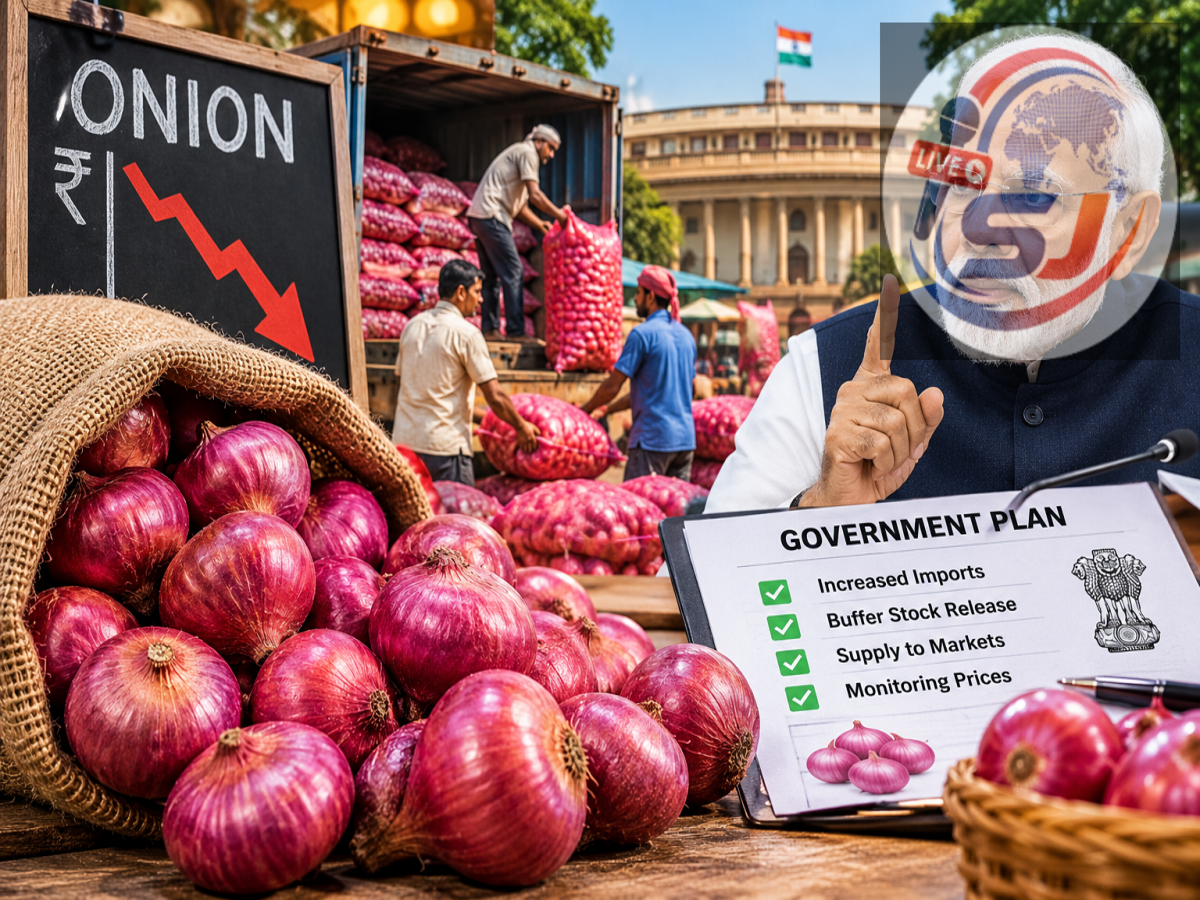
Onion Price Today, October 12, 2026: Households struggling with rising onion prices may get some relief in the coming weeks as fresh crop arrivals and government intervention are expected to improve supplies across India. Onion prices have nearly doubled compared with last year, putting additional pressure on monthly grocery budgets.
According to data cited from the Ministry of Consumer Affairs, the average retail price of onions reached ₹52.99 per kilogram on October 10, 2026, compared with ₹26.65 per kilogram during the corresponding period last year.
This represents an annual increase of approximately 99%, highlighting the sharp rise in the cost of an essential kitchen ingredient.
However, there are signs that the supply situation could improve. Fresh kharif onion arrivals are expected to increase from late October, while the central government has expanded the distribution of onions from its buffer stock to 123 cities.
If supplies improve as anticipated, consumers could begin seeing some relief between late October and November.
Onion Prices Nearly Double in One Year
Onions are an essential part of everyday cooking in millions of Indian households. Even a small increase in their price can affect family budgets, particularly during the festive season.
The latest figures indicate that consumers are paying substantially more for onions than they were a year ago.
On October 10, 2025, the average retail price was approximately ₹26.65 per kilogram.
By October 10, 2026, the average price had climbed to ₹52.99 per kilogram.
| Period | Average Retail Onion Price |
|---|---|
| October 10, 2025 | ₹26.65/kg |
| September 10, 2026 | ₹53.10/kg |
| October 10, 2026 | ₹52.99/kg |
| Annual increase | Approximately 98.8% |
The figures show that onion prices have risen sharply over the past year.
Although the average price declined slightly during the last month, the reduction has been too small to provide meaningful relief to most consumers.
Onion Prices Fall Slightly in One Month
According to the reported consumer affairs data, the average retail price of onions stood at ₹53.10 per kilogram around September 10, 2026.
By October 10, the price had eased to ₹52.99 per kilogram.
This represents a decline of just 11 paise per kilogram over approximately one month.
The small reduction suggests that any improvement in wholesale market conditions has not yet translated into a significant fall in retail prices.
Retail prices can take time to respond to changes in wholesale supply because of transportation costs, storage expenses, distribution margins, and existing inventory purchased at higher rates.
Consequently, consumers may not immediately benefit when fresh produce begins arriving in wholesale markets.
Wholesale Onion Prices Also Remain Elevated
Wholesale onion prices have also increased substantially compared with last year.
According to the supplied report, the average wholesale price was approximately ₹4,591 per quintal.
A quintal is equivalent to 100 kilograms, meaning the reported wholesale price works out to approximately ₹45.91 per kilogram.
The wholesale rate was reportedly 2.4% higher than a month earlier and 123.3% above the corresponding level last year.
These figures indicate that pressure remains in the broader onion supply chain.
The difference between wholesale and retail prices also reflects the additional costs involved in transporting, storing, and selling onions to consumers.
Why Could Onion Prices Fall After October?
One of the main reasons for expecting relief is the anticipated arrival of fresh kharif onions.
Onion production in India follows different seasonal cycles, and the timing of crop arrivals can influence market availability.
During periods when fresh supplies are limited, markets rely more heavily on stored onions.
As fresh produce begins arriving from major producing states, the overall supply position can improve.
Traders expect fresh arrivals to increase gradually from late October and through November.
However, the extent of any price reduction will depend on crop quality, weather conditions, transportation, and the actual quantity reaching markets.
Maharashtra Onion Supply Expected to Improve
Maharashtra is one of India's most important onion-producing states.
The state plays a major role in supplying onions to wholesale markets across the country.
According to the report, limited arrivals from Maharashtra's early kharif crop may begin toward the end of October.
Larger quantities could become available as harvesting and transportation activity increases.
If the new crop reaches markets without significant disruption, it may help reduce pressure on prices.
However, fresh arrivals are expected to increase gradually rather than all at once.
This means consumers may not see an immediate sharp decline in retail prices.
Karnataka, Telangana and Andhra Pradesh May Support Supply
Apart from Maharashtra, several southern states are expected to contribute to onion availability.
The report indicates that supplies from Karnataka, Telangana, and Andhra Pradesh could continue until the end of November.
These arrivals may help meet demand during the transition between different harvesting periods.
A steady flow of onions from multiple producing states could reduce the risk of shortages in major consumption centres.
However, unexpected rainfall, crop damage, or transportation problems could affect the supply outlook.
For this reason, the expected improvement should be viewed as a possibility rather than a guaranteed price reduction.
Old Onion Stocks May Help Meet Demand Until November
Existing onion stocks could also play an important role in stabilising the market.
According to the supplied report, Maharashtra and Madhya Pradesh have sufficient older onion stocks to help meet demand until approximately the third week of November.
Stored onions are particularly important during periods when fresh harvests are not yet available in large quantities.
If these stocks are released steadily, they could help prevent sudden shortages.
However, the quantity of usable stored onions may depend on storage conditions and quality.
Onions can deteriorate during storage, especially when exposed to moisture and unsuitable temperatures.
Therefore, the effective availability of old stocks is an important factor in determining future prices.
Rajasthan's Alwar Region Could Provide Additional Relief
Rajasthan may also contribute to improving onion supplies in northern India.
The report highlights the possibility of increased arrivals from the Alwar region.
Additional supplies from Rajasthan could help reduce northern markets' dependence on onions transported from Maharashtra.
This may be particularly useful because shorter transportation distances can improve delivery efficiency for some markets.
However, the actual impact on retail prices will depend on the volume and timing of arrivals.
If supplies from Rajasthan increase alongside those from Maharashtra and southern states, the combined effect could improve market availability.
Government Expands Buffer Stock Onion Sales to 123 Cities
The central government has also taken steps to address rising onion prices.
According to a government statement dated October 7, 2026, the distribution of onions from buffer stocks has been expanded to 123 cities.
Buffer stocks are reserves maintained to help manage supply shortages and excessive price fluctuations.
When market prices rise sharply, the government can release stored onions through designated distribution channels.
The objective is to increase availability and reduce pressure on consumers.
The government has reportedly strengthened transportation and distribution arrangements to support these sales.
This intervention is particularly relevant during the festive season, when household demand for food products may increase.
However, buffer stock releases do not guarantee that prices will fall immediately in every city.
Their effectiveness depends on the quantity released, distribution coverage, and prevailing market conditions.
Kharif Onion Cultivation Area May Increase by 5%
Another positive development concerns the area under kharif onion cultivation.
According to the government's October 7 statement cited in the report, the area planted with kharif onions is estimated to be approximately 5% higher than last year.
An increase in cultivated area can support higher production if weather and crop conditions remain favourable.
However, more land under cultivation does not automatically guarantee a proportionate increase in output.
Crop yields can be affected by rainfall, temperature, pests, diseases, and other agricultural conditions.
The actual production figures will become clearer as harvesting progresses.
When Will Onion Prices Become Cheaper?
The next several weeks could be important for onion prices across India.
Traders expect market availability to improve as fresh kharif arrivals begin increasing from late October.
Supplies from Maharashtra, Karnataka, Telangana, Andhra Pradesh, and Rajasthan may help support the market through November.
At the same time, government buffer stock sales could provide additional supply.
If these developments proceed as expected, retail prices may begin easing.
However, the report does not provide a reliable estimate of how much prices could decline.
It would therefore be premature to predict a specific price such as ₹30 or ₹40 per kilogram.
The actual retail rate will depend on local demand, supply conditions, transportation costs, and market competition.
Onion Price Outlook October 2026: What Consumers Should Know
Onion prices remain a major concern for households after nearly doubling over the past year.
The reported national average retail price of ₹52.99 per kilogram on October 10 shows that consumers are still facing substantial costs.
However, the supply outlook may improve in the coming weeks.
Fresh kharif crop arrivals, existing onion stocks, increased supply from Rajasthan, and the government's expansion of buffer stock sales to 123 cities could help stabilise prices.
The key takeaway is that onion prices may begin easing from late October into November, but a significant reduction is not yet guaranteed.
Consumers should monitor local market rates as fresh arrivals increase, while the actual extent of relief will depend on how quickly additional supplies reach retail markets.
Disclaimer: The prices, crop estimates, and government measures discussed in this article are based on the supplied October 12, 2026 report. Future onion prices will depend on actual market conditions, and the expected decline should not be interpreted as a confirmed forecast.