
GLOF Explained: What Is a GLOF? How Glacial Lake Bursts Can Trigger Deadly Himalayan Flash Floods
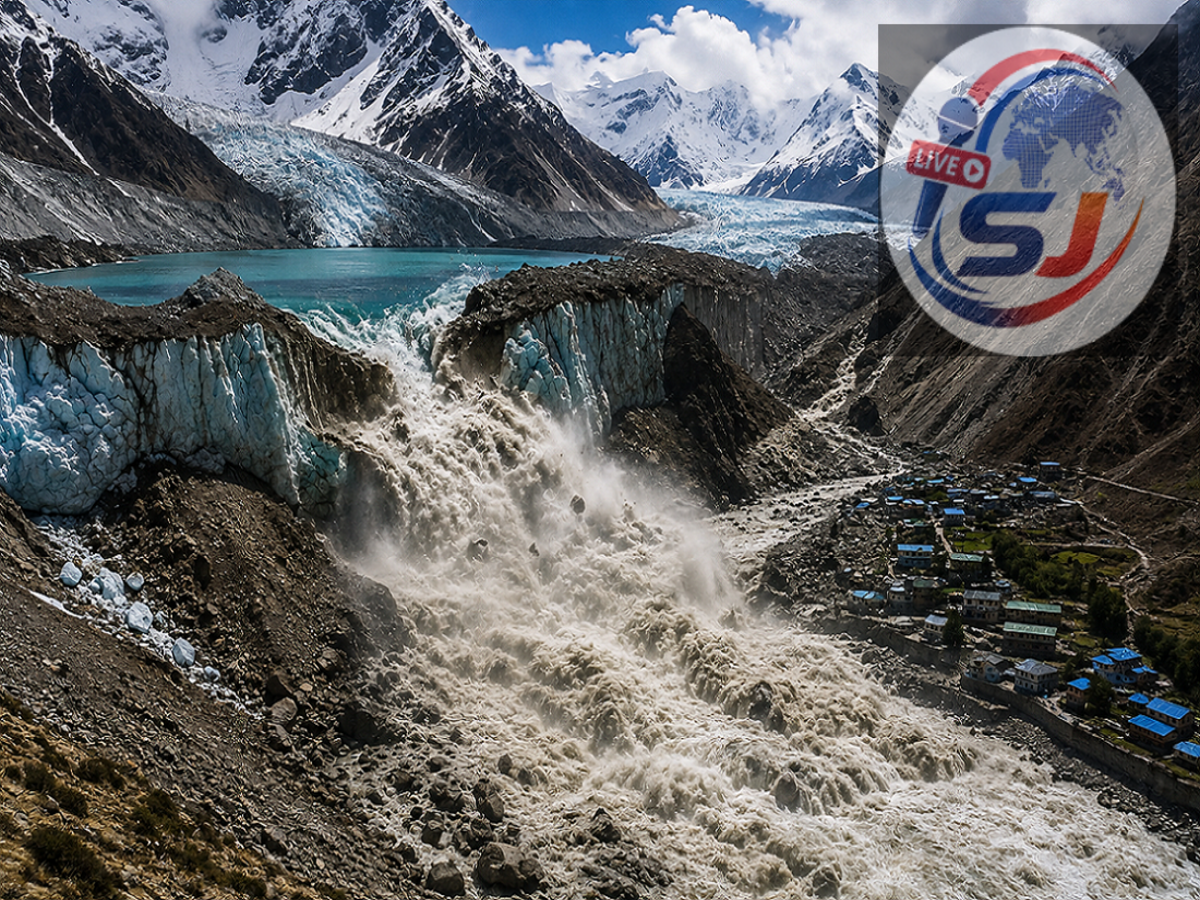
GLOF Explained: The devastating flash flood that struck the Nepal-Tibet border region has once again highlighted the growing danger posed by unstable glaciers, high-altitude lakes and rapidly changing conditions across the Himalayas.
The August 26, 2026 disaster sent a powerful wave of water, ice, rocks and mud through parts of Nepal, destroying settlements, roads, bridges and other infrastructure. While early reports discussed several possible triggers, including an earthquake and a Glacial Lake Outburst Flood, later satellite-based assessments cited by Reuters and the Associated Press indicated that a major glacier collapse likely triggered the catastrophe.
The tragedy has nevertheless renewed attention on GLOFs, or Glacial Lake Outburst Floods, because they represent one of the most serious natural hazards facing communities in Himalayan river valleys.
What Exactly Is a GLOF?
A Glacial Lake Outburst Flood occurs when water stored in a lake associated with a glacier is suddenly released.
As glaciers melt and retreat, depressions can form around or in front of them. Meltwater accumulates in these areas, creating glacial lakes. Some of these lakes are held back by natural barriers made of loose rock, sediment and debris known as moraines.
Unlike a conventional engineered dam, a moraine barrier can be relatively unstable. If the barrier fails or water suddenly overtops it, a huge quantity of water can rush downstream within a short period.
The resulting flood can travel at high speed through steep mountain valleys, carrying much more than water. It may pick up boulders, ice, trees, soil and other debris, turning the flow into an extremely destructive mixture capable of damaging buildings, bridges, roads and power projects.
What Can Trigger a Glacial Lake Outburst?
There is no single cause behind every GLOF. Several natural processes can destabilise a glacial lake.
An avalanche of ice or rock falling into the lake can generate a powerful displacement wave. That wave can overflow the lake's natural barrier and weaken or breach it.
Intense rainfall or rapid snow and ice melt can raise the lake level and increase pressure on the moraine. Earthquakes and landslides can also destabilise already fragile slopes or natural dams.
Water may also gradually seep through a moraine barrier, eroding it internally until the structure eventually fails.
ISRO notes that glacial lake dam failures can be triggered by factors such as ice or rock avalanches, extreme weather and other environmental conditions.
Was the Latest Nepal Disaster Really a GLOF?
This distinction is important because the latest Nepal-Tibet disaster should not automatically be described as a confirmed GLOF.
Early reports suggested that investigators were examining possibilities including a GLOF, avalanche, landslide and earthquake-related trigger.
However, more recent scientific assessments point toward a glacier collapse or ice-rock avalanche.
Reuters reported that satellite images showed a significant section of a glacier at an altitude of around 5,200 metres breaking away and falling more than 1,200 metres into the valley below. The collapse unleashed ice, rock and sediment into the river system, producing a devastating flood surge.
The Associated Press also reported that a U.S. Geological Survey analysis identified glacial collapse, rather than the earthquake itself, as the cause of the flood.
So while the disaster illustrates the broader dangers associated with a warming and unstable Himalayan cryosphere, calling it definitively a GLOF would be premature unless investigators establish that a glacial lake itself burst.
Why Are Glacial Lakes Growing in the Himalayas?
Climate change is increasing concern about glacial hazards across the Himalayan region.
As temperatures rise, glaciers can lose ice and retreat. The space left behind can fill with meltwater, creating new lakes or increasing the size of existing ones.
Satellite monitoring by ISRO shows how significant this expansion has become. Its analysis of the Indian Himalayan river basins identified 2,431 glacial lakes larger than 10 hectares during 2016-17.
Of these, 676 lakes had expanded significantly since 1984. ISRO reported that 130 of the expanding lakes were located within India, including 65 in the Indus basin, seven in the Ganga basin and 58 in the Brahmaputra basin.
These figures do not mean every expanding lake will produce a GLOF. However, the changes underline the need for continuous monitoring and detailed risk assessment.
Why Can GLOFs Be So Destructive?
Mountain geography amplifies the danger.
When a lake suddenly releases water at high altitude, gravity accelerates the flow down steep valleys. The flood can gather additional debris as it moves downstream, increasing both its volume and destructive force.
Narrow valleys can also concentrate the flood into a fast-moving channel.
Communities situated beside rivers may have only minutes or hours to react, particularly if early-warning systems are inadequate.
Infrastructure adds another layer of vulnerability. Roads, bridges, tunnels, hydropower stations and settlements are frequently built along Himalayan river valleys because flat land is limited.
Unfortunately, these are often the same corridors through which flash floods and debris flows travel.
Himalayan Disasters Have Shown the Scale of the Risk
Several major disasters have demonstrated how quickly extreme mountain hazards can destroy infrastructure.
The February 2021 Chamoli disaster in Uttarakhand involved a massive rock-and-ice avalanche that generated a destructive downstream flood, severely damaging hydropower projects.
In October 2023, a GLOF originating from South Lhonak Lake in Sikkim triggered catastrophic flooding in the Teesta basin, causing major loss of life and infrastructure damage.
These events were caused by different physical processes, but together they underline a common challenge: communities and infrastructure in Himalayan valleys can be exposed to rapidly developing disasters originating far upstream.
How Can the Risk Be Reduced?
Preventing every GLOF is impossible, but reducing the danger is achievable.
Satellite surveillance is one of the most important tools. Glacial lakes in remote mountain regions are difficult to inspect regularly on the ground, which makes remote sensing particularly useful. ISRO says satellite imagery can help monitor changes in lake size, glacier retreat and potential GLOF hazards over long periods.
High-risk lakes can also be equipped with sensors that monitor water levels, temperature, slope movement and other warning signs.
Where technically feasible, authorities may gradually lower water levels through controlled drainage systems to reduce pressure.
Early-warning systems downstream are equally important. Sirens, automatic river gauges, communication networks and clearly mapped evacuation routes can give communities precious time to move to safer ground.
Infrastructure planning must also take flood pathways into account. Hydropower projects, roads and settlements in vulnerable valleys need detailed geological and hydrological assessments rather than relying only on historical flood records.
Climate Change Makes Monitoring More Important
The Himalayas are undergoing rapid environmental change, and scientists are increasingly concerned about the consequences for glaciers, permafrost and high-altitude lakes.
Higher temperatures do not mean every glacier will collapse or every glacial lake will burst. The relationship between climate change and individual disasters can be complex.
But sustained glacier retreat, expanding glacial lakes and destabilising mountain slopes can increase the number of locations requiring close observation.
The latest Nepal-Tibet catastrophe is therefore a reminder that Himalayan disaster preparedness must go beyond reacting after a flood occurs.
Better satellite monitoring, stronger early-warning networks, safer infrastructure planning and cross-border sharing of river and glacier data could significantly reduce future losses.
In simple terms, a GLOF is a sudden release of water from a glacial lake. When such a lake fails in steep Himalayan terrain, the result can become a high-speed flood carrying water, rocks, ice and mud for kilometres downstream. As glacial landscapes continue changing, understanding and monitoring these hazards is becoming increasingly important.