
FASTag Rules Change for Persons With Disabilities: Check 3-Year and 5-Year Validity
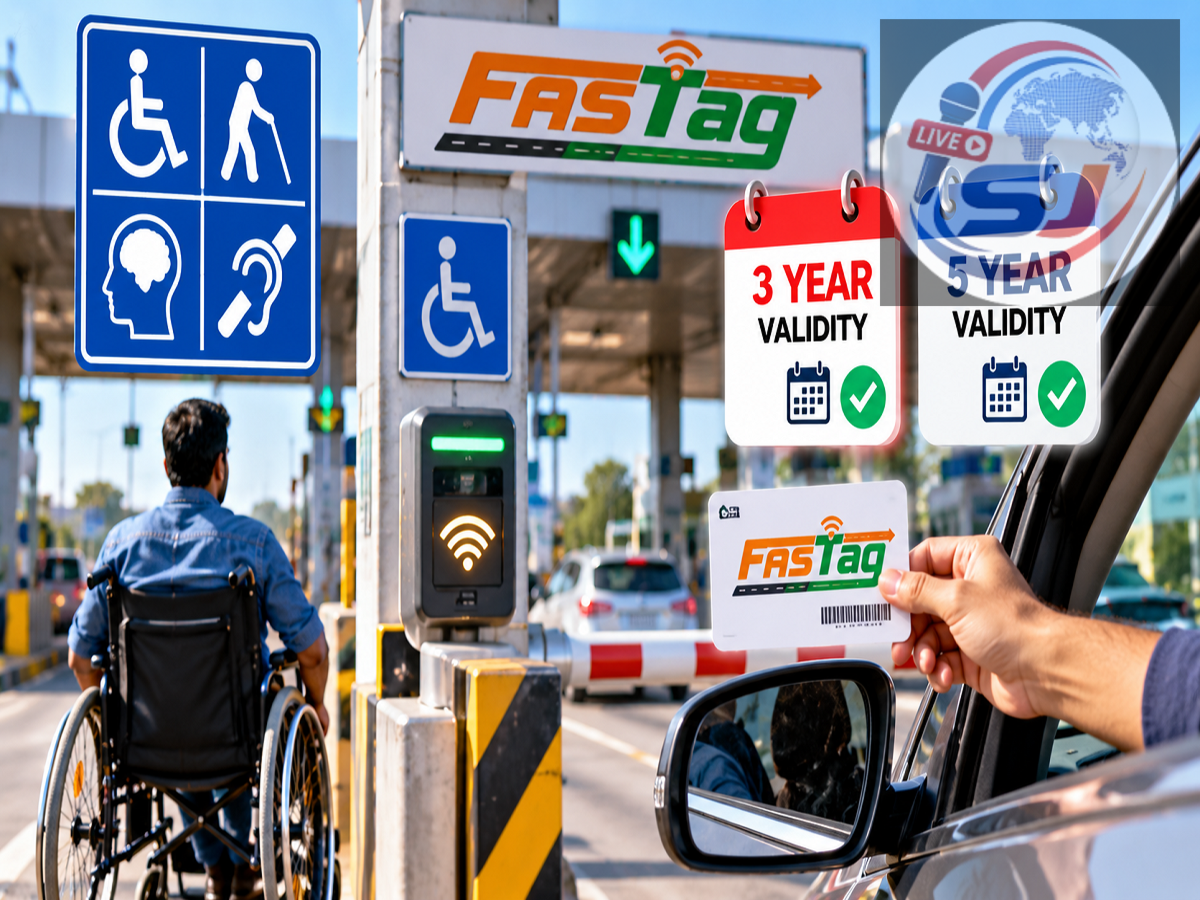
FASTag rules for eligible persons with disabilities have been revised, reducing the need for frequent renewal of exempted FASTags. Under the updated system described in the supplied report, eligible users may receive a FASTag with a validity of either three years or five years, depending on the officially recorded percentage of disability.
The change is particularly important for people who previously had to complete the renewal process every year.
However, there is an important distinction to understand: a FASTag being valid for three or five years does not automatically mean that every toll journey will remain free throughout that entire period.
Any toll exemption continues to depend on the person's eligibility and the applicable provisions of the National Highways Fee Rules, 2008, and related rules.
What Has Changed in FASTag Rules?
According to the supplied information, the Ministry of Road Transport and Highways has changed the validity period for exempted FASTags issued to eligible persons with disabilities.
Previously, such users could be required to renew their FASTag every year.
Under the revised arrangement, the validity period can now be longer and is linked to the disability percentage recorded in official documents.
Eligible applicants can receive either a three-year or five-year validity period.
Once that validity expires, the FASTag may be renewed again if the person continues to meet the applicable eligibility conditions.
Who Can Get a FASTag Valid for Five Years?
According to the rules described in the report, eligible persons with a recorded disability of 70% to 100% can receive an exempted FASTag with validity of up to five years.
This means they would not have to go through the FASTag renewal process every year during that validity period, subject to the applicable conditions.
The percentage should be supported by recognised official disability records.
Applicants should make sure that the information submitted during the application process matches their official documents.
Who Gets Three-Year FASTag Validity?
Eligible persons with a disability of 40% to less than 70% can receive an exempted FASTag with validity of up to three years, according to the supplied report.
Here too, the main benefit is a longer validity period.
Instead of completing a renewal every year, an eligible user would generally need to renew the exempted FASTag after the applicable three-year period, provided eligibility continues.
The change can reduce paperwork and repeated verification for eligible users.
FASTag Validity Based on Disability Percentage
The revised structure described in the report can be understood simply:
| Recorded Disability | Exempted FASTag Validity |
|---|---|
| 40% to below 70% | Up to 3 years |
| 70% to 100% | Up to 5 years |
The percentage must be supported by an applicable government-recognised disability record.
The longer validity should not be confused with the duration of an unconditional toll exemption.
What Documents Are Required?
Applicants seeking an exempted FASTag under this category will need valid documents establishing their eligibility.
According to the supplied information, applicable documents can include a valid disability certificate, a UDID card (Unique Disability ID) or another recognised government record that clearly mentions the disability percentage.
The details in the documents should be accurate and consistent with the information submitted in the FASTag application.
Depending on the applicable process, additional vehicle or identity-related documents may also be required by the issuing authority.
Applicants should check the current official requirements before submitting an application rather than relying on an incomplete document list.
Does Five-Year FASTag Validity Mean Five Years of Free Toll?
Not necessarily.
This is one of the most important points in the revised rules.
A FASTag being valid for five years does not itself create an unconditional right to free toll travel for five years.
Similarly, a three-year FASTag validity should not automatically be interpreted as three years of guaranteed toll-free travel.
The three- and five-year periods primarily relate to the validity or renewal cycle of the exempted FASTag.
Whether a particular journey qualifies for toll exemption depends on the eligibility requirements and applicable toll rules.
Toll Exemption Rules Remain Important
Toll exemptions are governed separately under the applicable provisions of the National Highways Fee Rules, 2008 and related government rules.
Therefore, simply possessing an exempted FASTag does not mean that every vehicle, every person with a disability or every journey will automatically qualify for toll-free passage.
The relevant eligibility conditions still have to be met.
Users should verify whether their vehicle and circumstances fall within the eligible category before assuming that no toll will be charged.
What Happens After Three or Five Years?
Once the FASTag's validity period expires, an eligible user may need to complete the prescribed renewal process.
If the person continues to satisfy the eligibility requirements, the exempted FASTag can be renewed according to the applicable rules.
Users should check whether their disability certificate, UDID details and other records remain valid and accurate before renewal.
If there has been any change in the official disability record, vehicle registration or other required information, the updated documents may need to be provided.
Why Is the New System Useful?
The biggest advantage of the revised validity period is reduced paperwork.
Annual renewal can be inconvenient because users may need to repeatedly submit documents or complete verification.
Extending the validity to three or five years means eligible users will not have to repeat the renewal process every year.
For those with a disability percentage recorded at 70% or above, a five-year validity period can substantially reduce the frequency of renewals.
Those in the 40% to below 70% category can similarly benefit from a three-year period.
Check Your Disability Records Carefully
Anyone applying for an exempted FASTag should ensure that the disability percentage mentioned in the application matches the official certificate or UDID record.
A discrepancy in personal details or disability percentage could create problems during verification.
Applicants should also ensure that vehicle-related information is correct wherever it is required.
Submitting incomplete or incorrect documents could delay approval.
Don't Confuse Validity With Eligibility
The easiest way to understand the revised system is to separate two concepts: FASTag validity and toll-exemption eligibility.
The three- or five-year period tells an eligible user how long the exempted FASTag can remain valid before renewal is required.
It does not independently determine whether every toll transaction during that period will be exempt.
Toll exemption continues to be governed by the applicable eligibility conditions and highway fee rules.
Therefore, eligible users should keep the required supporting documents updated even after receiving a longer-validity FASTag.
New FASTag Rule Reduces Annual Renewal Hassle
The revised FASTag system could make toll-related documentation easier for eligible persons with disabilities.
According to the supplied information, eligible people with 40% to below 70% disability can receive a three-year validity, while those with 70% to 100% disability can receive validity of up to five years.
Valid documents such as a disability certificate, UDID card or another accepted government record showing the disability percentage may be required.
The most important point is that the longer validity removes the need for annual renewal during the applicable period. It should not be interpreted as an automatic three- or five-year toll waiver.
Actual toll exemption will continue to depend on eligibility and the applicable provisions of the National Highways Fee Rules and related government requirements.
Note: FASTag eligibility, toll exemptions and documentation requirements are subject to applicable government rules and may be updated. Applicants should verify the latest requirements through authorised FASTag or highway channels before applying or renewing.