
Delhi Government Makes Aadhaar Authentication Optional: Voter ID, Passport and Driving Licence Also Accepted
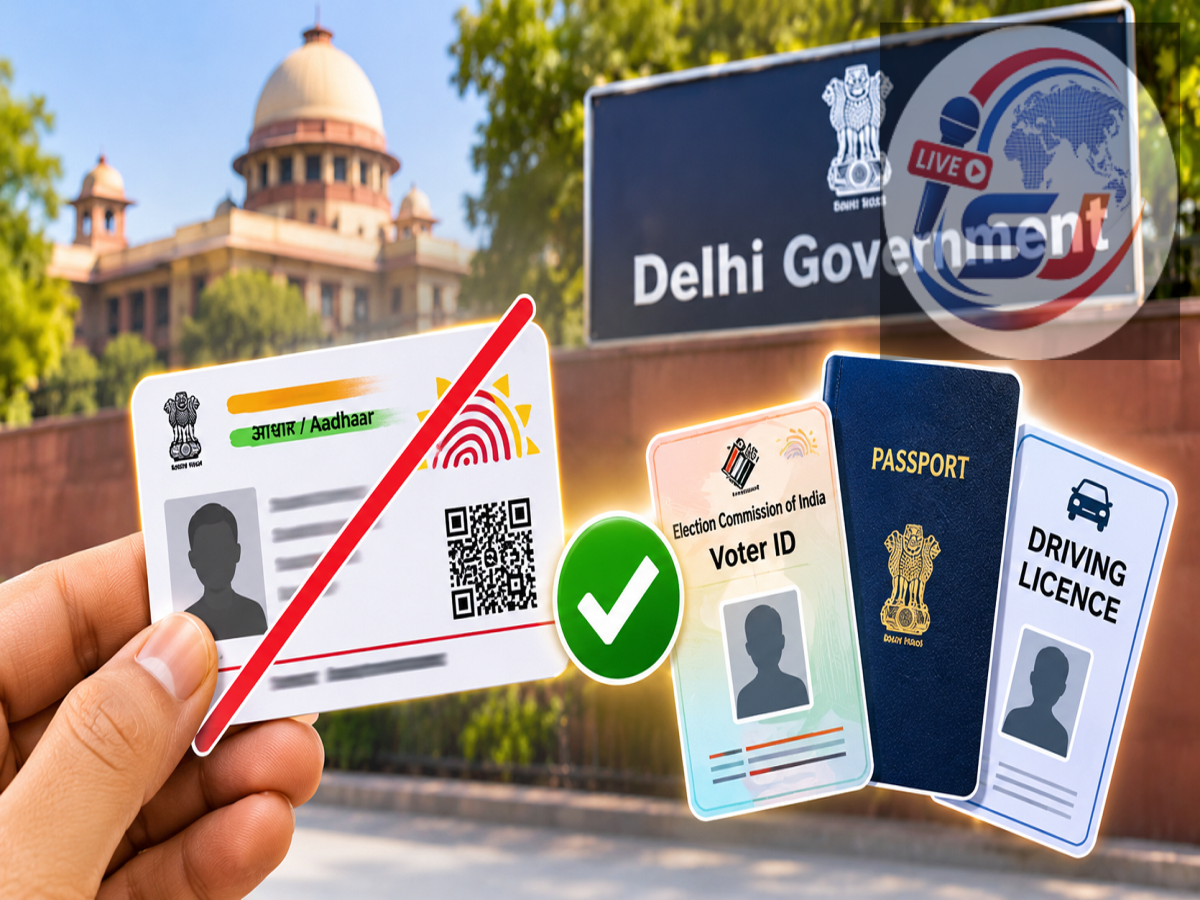
Delhi Aadhaar Rules 2026: Residents of Delhi will no longer be required to undergo Aadhaar authentication to access government services covered by the Delhi government's latest notification. In an important move aimed at making public services more accessible, the administration has clarified that eligible citizens should not be denied services simply because they do not have an Aadhaar number, cannot complete Aadhaar verification or choose not to use it.
According to a report published by Live Hindustan on November 17, 2026, the Delhi government's Information Technology Department has issued a notification allowing alternative identity verification methods. Documents such as voter identity cards, driving licences, passports and other government-issued photo identification documents can be used for verification.
The decision is expected to benefit residents who face difficulties with Aadhaar authentication, including biometric verification failures and other technical problems.
Aadhaar Authentication No Longer Compulsory for Covered Delhi Government Services
The Delhi government has clarified that Aadhaar authentication will be voluntary under the framework outlined in its latest notification.
Previously, some residents may have encountered difficulties accessing services when Aadhaar-based verification could not be completed successfully.
Under the newly announced arrangement, departments are expected to provide alternative methods of establishing identity rather than relying exclusively on Aadhaar authentication.
This means eligible residents should have access to verification options even when they cannot or do not wish to authenticate themselves through Aadhaar.
However, the notification should not be interpreted as automatically eliminating every Aadhaar-related requirement under separate central laws or scheme-specific rules. The precise requirements may depend on the service concerned.
Which Documents Can Be Used Instead of Aadhaar?
The notification identifies several alternative documents that may be accepted for identity verification.
These include commonly used government-issued photo identity documents.
| Identity Document |
Purpose |
|---|---|
| Voter ID Card |
Alternative proof of identity |
| Driving Licence |
Government-issued photo identification |
| Passport |
Alternative identity verification |
| Other Government Photo ID |
Identification issued by central or state authorities |
| Aadhaar |
Voluntary authentication option under the notified framework |
The availability of these alternatives means that residents covered by the notification will not necessarily need to complete Aadhaar authentication for every relevant government service.
Applicants should still check whether a particular service requires additional documents for address, age, income, residence or eligibility verification.
What Is the Unified Citizen Data Platform?
The government's notification specifically refers to the Unified Citizen Data Platform, commonly known as UCDP.
The platform is associated with the government's efforts to improve digital public service delivery and manage citizen-related information more efficiently.
According to the reported notification, Aadhaar authentication for the UCDP will remain voluntary.
This distinction is important because the use of a digital platform does not automatically mean that Aadhaar-based identity verification must be compulsory.
By allowing alternative identity documents, the administration aims to make the verification process more accessible to residents who prefer other methods or encounter technical difficulties.
Aadhaar Verification Will Require the Resident's Consent
Another important aspect of the notification concerns consent.
The Delhi government has stated that departments must obtain the Aadhaar holder's consent before carrying out Aadhaar authentication under the notified arrangement.
This means authentication should not be performed without the necessary permission from the individual concerned.
Consent-based verification is intended to give residents greater control over the use of their Aadhaar credentials.
Government departments are also expected to inform residents about available alternative identification methods.
The measure places emphasis on ensuring that citizens understand their options before choosing how to verify their identity.
What Happens If Aadhaar Authentication Fails?
Aadhaar authentication can sometimes fail because of biometric mismatches, connectivity problems, technical errors or difficulties associated with the verification process.
Such problems can create inconvenience for residents attempting to access government services.
Under the newly reported Delhi government arrangement, failure to complete Aadhaar authentication should not, by itself, result in denial of a covered service.
Departments are expected to offer practical alternative identity verification options.
For example, a resident unable to complete Aadhaar-based verification may be able to establish identity using a valid voter ID card, driving licence or passport.
However, the applicant must still satisfy the eligibility conditions and documentation requirements of the relevant government service.
Why Has the Delhi Government Introduced This Change?
The decision reflects an effort to balance digital convenience with accessibility.
Aadhaar authentication can simplify identity verification and reduce the need for multiple documents in certain government processes.
At the same time, depending entirely on one verification method can create difficulties for individuals who cannot successfully complete that process.
Providing alternative identification options may help departments serve a wider range of residents.
The change can be particularly relevant for people who experience repeated authentication failures or prefer not to use Aadhaar for optional verification.
It also reinforces the principle that access to public services should not depend solely on the successful completion of a particular digital authentication process where alternatives are permitted.
Notification Issued Under Aadhaar Authentication Rules, 2020
According to the report, the Delhi government's Information Technology Department issued the notification under Rule 5 of the Aadhaar Authentication for Good Governance (Social Welfare, Innovation, Knowledge) Rules, 2020.
These rules establish a framework for the use of Aadhaar authentication for specified governance-related purposes.
The notification reportedly identifies voluntary authentication as part of the arrangement for the Unified Citizen Data Platform.
It also provides for alternative identity verification and obtaining consent before authentication.
The legal framework is intended to support the use of Aadhaar for permitted purposes while maintaining safeguards for residents.
Will Aadhaar Still Be Useful for Government Services?
Yes. The notification does not mean Aadhaar has lost its relevance as an identity verification tool.
Aadhaar continues to be widely used across India for various administrative, financial and welfare-related processes.
The Delhi government has acknowledged that Aadhaar-based authentication can simplify access to services and benefits by reducing the need to submit multiple identity documents.
It may also help authorities verify beneficiaries and reduce certain forms of misuse in welfare delivery.
The key change is that Aadhaar authentication will not be the only available verification method under the newly notified arrangement.
Residents who prefer using Aadhaar may continue to do so where the service supports it.
What Should Delhi Residents Do When Applying for Government Services?
Residents applying for government services should first check the identification and eligibility requirements published by the department concerned.
Where alternative verification is permitted, applicants can choose an accepted document rather than relying exclusively on Aadhaar authentication.
They should ensure that the identity document is valid and that the information provided in the application is accurate.
If Aadhaar authentication fails, applicants can ask the department about the alternative verification procedure available under the applicable rules.
For services governed by separate central or state regulations, additional requirements may continue to apply.
Residents should rely on official departmental instructions rather than assuming that one identity document is sufficient for every government application.
How Will the New Aadhaar Rules Benefit Citizens?
The revised approach may provide several practical advantages.
First, it can reduce dependence on a single authentication system, helping residents avoid unnecessary difficulties caused by technical failures.
Second, the availability of alternative documents gives applicants more flexibility when proving their identity.
Third, the consent requirement provides greater clarity regarding the use of Aadhaar authentication.
Finally, allowing multiple verification methods may make digital government services more accessible to people who encounter problems with Aadhaar-based processes.
The actual benefits will depend on how effectively the relevant departments implement the notification.
Conclusion
The Delhi government's decision to make Aadhaar authentication voluntary under its notified framework represents an important development in public service delivery.
Residents covered by the arrangement can use alternative identification documents, including voter ID cards, driving licences, passports and other recognised government-issued photo IDs.
The administration has also emphasised that eligible citizens should not be denied covered services merely because they cannot complete Aadhaar authentication or decline to use it.
However, applicants must continue to meet the eligibility and documentation conditions applicable to each service.
Note: This article is based on the supplied news report. The complete official notification has not been independently examined here. Readers should consult the relevant Delhi government department for service-specific requirements.