
Are SBI and PNB Employees Central Government Staff? Know Their Employment Status and Service Rules
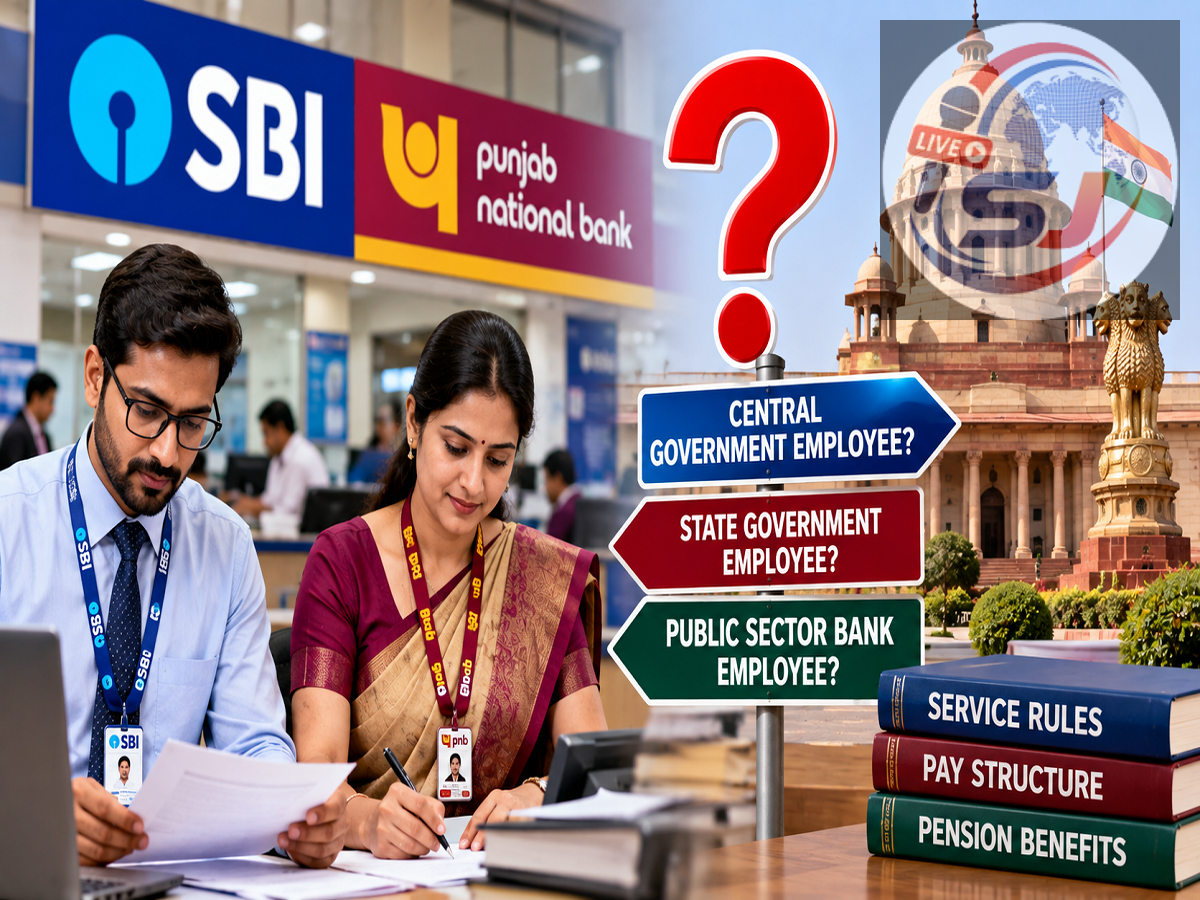
People working in public sector banks such as State Bank of India (SBI) and Punjab National Bank (PNB) are often described informally as “government bank employees.” This frequently creates confusion over whether they are also considered Central Government employees and whether the same salary, pension and service rules apply to them.
The simple distinction is that an employee of a public sector bank is not automatically a Central Government employee merely because the government owns or controls the bank.
Employees working directly under Central Government ministries and departments belong to a different employment framework from staff recruited by public sector banks. PSB employees are governed primarily by the service regulations, settlements and employment conditions applicable to their respective banks and the banking sector.
Understanding this difference becomes particularly important when discussing issues such as the Pay Commission, salary revisions, pensions, allowances, holidays and service benefits.
Who Is Considered a Central Government Employee?
Central Government employees generally work in ministries, departments and offices that form part of the Union government's administrative structure.
This can include employees serving in areas such as the Income Tax Department, Indian Railways, postal services and civilian defence establishments, along with personnel appointed to various other Central Government services and departments.
Their salaries and service conditions are governed by the rules applicable to their respective Central Government posts.
Public sector bank employees, however, belong to a separate institutional framework.
Where Do SBI and PNB Employees Fit?
SBI, PNB and several other major banks operate in the public sector, which is why they are commonly called government banks.
But their employees should generally be described as public sector bank employees, rather than employees directly serving a Central Government ministry or department.
This distinction matters because their recruitment, salary structures, promotions, retirement benefits and other employment conditions are governed by the rules applicable to the bank and the banking industry.
The following table provides a broad comparison:
| Employment Category | Generally Includes | Examples |
|---|---|---|
| Central Government Employees | Union ministries, departments and attached/subordinate offices | Income Tax, Railways, Postal Department, civilian defence establishments |
| State Government Employees | Departments controlled by state governments | State police, education and health departments |
| Local Body Employees | Municipal and local government institutions | Municipal corporations, municipalities and panchayats |
| Public Sector/PSB Employees | Government-controlled enterprises and public sector banks | SBI, PNB, ONGC, BHEL and other PSUs/PSBs |
| Autonomous/Statutory or Constitutional Bodies | Institutions operating under their own statutory or administrative framework | RBI, universities and various statutory/autonomous institutions |
The precise employment status of personnel in autonomous and constitutional bodies can differ considerably, so they should not all be treated as belonging to one identical service category.
Does the Central Pay Commission Automatically Cover Bank Employees?
This distinction becomes particularly important whenever a new Central Pay Commission is discussed.
Central Pay Commissions primarily deal with the pay structure of employees and pensioners covered by the relevant Central Government framework.
Public sector bank employees have a separate mechanism for determining their pay and service conditions. Their wage revisions have traditionally involved industry-level settlements and agreements between banking-sector organisations and employee unions, along with the applicable rules for officers.
Therefore, an increase recommended for Central Government employees under a Pay Commission should not automatically be assumed to apply to SBI or PNB employees.
Similarly, terms such as fitment factor, Central Government pay matrix and Pay Commission Level 1 to Level 18 should not automatically be applied to public sector bank employees.
What Are Group A, B and C Government Posts?
Central and state government employment is also commonly classified into Group A, Group B and Group C posts.
Group A generally includes senior administrative, managerial and professional positions. Depending on the service, examples can include senior civil service officers, government doctors, scientists and other higher-level posts.
Group B broadly covers a range of supervisory and middle-level positions. Some Group B posts are gazetted while others are non-gazetted.
Group C includes a large number of clerical, technical, operational and support posts within government departments.
The former Group D category has largely been restructured, with many such Central Government posts having been incorporated into the Group C framework following earlier pay reforms.
However, this classification should not be casually extended to employees of public sector banks.
For example, an SBI or PNB clerk may perform clerical duties, but that does not automatically make the employee a Central Government Group C employee. Banks have their own designations, cadres and promotion structures.
What Does Gazetted and Non-Gazetted Mean?
Another classification frequently associated with government employment is gazetted versus non-gazetted status.
Gazetted officers hold posts for which the applicable appointment or status is notified through the official government framework. Group A posts and certain Group B posts generally fall within the gazetted category.
Many other Group B employees and Group C personnel are non-gazetted.
Once again, this classification belongs to the relevant government service framework and should not automatically be used to categorise employees of SBI, PNB or another public sector bank.
Government Ownership Does Not Mean Identical Employment Rules
The confusion largely arises from the word “government.”
A bank can be government-controlled without every person employed by that institution becoming a direct employee of the Central Government.
A similar distinction can arise with public sector undertakings. Employees working for government-controlled companies may be part of the broader public sector, but their salaries and service conditions can differ significantly from those of employees appointed directly to Central Government departments.
The employer's legal and administrative structure is therefore more important than simply asking whether the government owns the organisation.
What About Permanent and Contract Employees?
Employment status can become even more complicated when contractual and outsourced workers are considered.
A person may physically work inside a government office or public sector institution without holding a regular government post.
Contractual workers, outsourced staff and daily-wage workers may be employed under arrangements that differ from those applicable to permanent employees. Their pay, pension, leave and other benefits depend on their contract and the relevant employment rules.
Working at a government-controlled workplace therefore does not by itself establish that a person is a regular Central Government employee.
SBI and PNB Employees: The Key Difference
The easiest way to understand the distinction is to look at the employer.
A person appointed to an eligible post directly under a Central Government ministry or department may be covered by the relevant Central Government service rules.
A person recruited by SBI, PNB or another public sector bank, on the other hand, is generally an employee of that bank and is covered by the applicable banking-sector service framework.
So, while SBI and PNB are public sector banks and their employees are commonly called government bank employees, that does not make their staff Central Government employees for purposes such as Central Pay Commission pay scales and service classifications.
This distinction is especially important when reading reports about the 8th Pay Commission, DA revisions, pay matrix changes or Central Government pension rules. Public sector bank employees should check the rules and settlements applicable specifically to the banking sector rather than assuming that every benefit announced for Central Government employees will automatically apply to them.