
3kW Rooftop Solar for a Low Electricity Bill: Smart Investment or Unnecessary Expense?
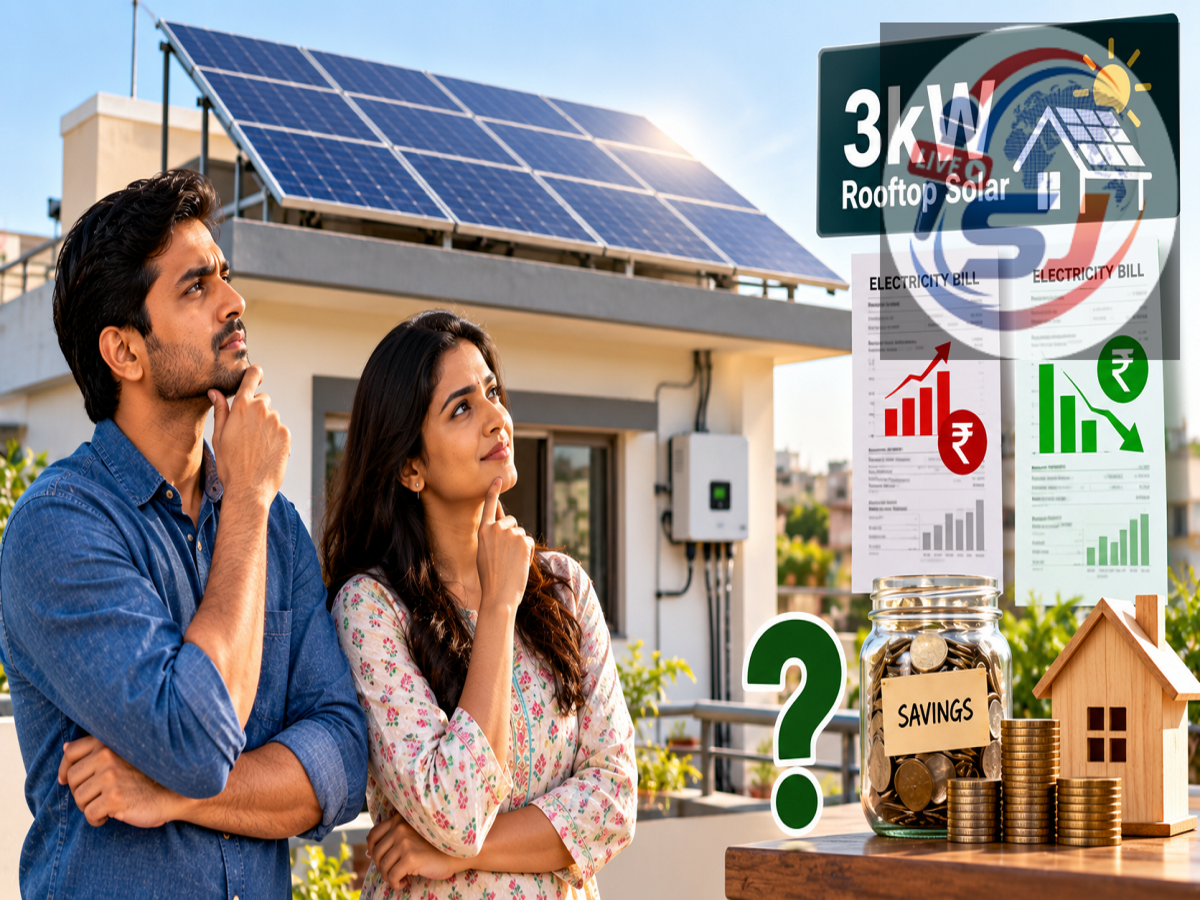
3kW Solar Panel for Home: Rooftop solar can help households reduce their dependence on grid electricity and potentially lower electricity bills for years. But installing a bigger solar system does not automatically mean bigger financial savings.
If your household consumes relatively little electricity every month, installing a 3kW rooftop solar system without first calculating your actual requirements could leave you with a system larger than you need.
The right solar capacity should generally be decided after considering monthly electricity consumption, available rooftop space, sunlight, local electricity tariffs, net-metering rules, installation cost and expected future consumption.
So, is a 3kW solar system worthwhile for a household using only 100-150 units of electricity a month? Here's what homeowners should consider.
Start With Your Monthly Electricity Consumption
Before asking an installer for a 1kW, 2kW or 3kW system, check your electricity bills for at least the past several months.
Look at the number of units, or kilowatt-hours (kWh), consumed rather than focusing only on the rupee amount of the bill.
This matters because electricity tariffs can include fixed charges, slabs and other components. Two households with similar bills may not necessarily consume exactly the same amount of electricity.
If your household consistently consumes less than 100-150 units per month, a 3kW system could be oversized for your current requirements.
A smaller system may be more economical, depending on your consumption pattern and local rules.
How Much Electricity Can a 3kW Solar System Generate?
The supplied estimates suggest that a 3kW rooftop solar system could generate roughly 300-450 units of electricity per month.
Actual output, however, should not be treated as fixed.
Generation depends on several factors, including the amount of sunlight available, season, geographical location, panel orientation and tilt, shading from nearby buildings or trees, panel efficiency, inverter performance, dust and maintenance.
Therefore, 300-450 units should be treated as an indicative range rather than a guaranteed monthly output.
What If Your Home Uses Only 100-150 Units?
Suppose your household consumes around 120 units every month but you install a solar system capable of producing substantially more electricity.
In an on-grid setup, excess generation may potentially be exported to the electricity grid depending on the applicable metering arrangement and rules of the local electricity distribution company.
But surplus generation should not automatically be valued at the same rate you pay when purchasing electricity from the grid.
The financial treatment of exported electricity can vary depending on state regulations, DISCOM policies and whether net metering, net billing or another settlement mechanism applies.
For this reason, installing substantially more capacity than your household requires solely because the roof has enough space may not always provide the best financial return.
Could a 1kW System Be Enough?
For households consuming less than around 100-150 units per month, a smaller rooftop system such as 1kW may be worth evaluating first, as suggested in the supplied report.
However, this should not be treated as a universal rule.
A household's ideal solar capacity depends on annual consumption, local solar generation potential and the percentage of electricity consumption that the homeowner wants solar to cover.
Checking an entire year's electricity bills is usually more informative than looking at a single month because both electricity use and solar production can change seasonally.
How Much Can a 3kW Solar System Cost?
According to the supplied estimates, installing a 3kW rooftop solar system can involve an initial expenditure of approximately ₹1.4 lakh to ₹2 lakh.
Actual quotations can differ considerably depending on panel technology, inverter, mounting structure, installation complexity, wiring, safety equipment, vendor, warranty and other components.
The effective cost to the homeowner can also differ if the installation qualifies for a government subsidy.
Therefore, consumers should compare the gross installation cost and final out-of-pocket cost after any eligible subsidy before calculating the payback period.
Bigger System Can Mean a Longer Payback Period
Suppose your household has a very small electricity bill but you spend substantially more to install a 3kW system.
If much of the electricity generated cannot deliver equivalent financial savings, recovering the additional upfront investment could take longer.
This is why the goal should not necessarily be to install the maximum capacity possible.
A properly sized system can sometimes deliver a better return on investment than a larger system that generates substantial surplus electricity.
When Does a 3kW Solar System Make More Sense?
A 3kW rooftop system becomes more attractive when household electricity consumption is relatively high.
The supplied report suggests considering a 3kW system for homes consuming around 300 units or more per month.
It could also make sense for a household whose electricity consumption is expected to increase significantly.
For example, future electricity use could rise if the family plans to add more air conditioners, electric water heaters, additional appliances or other high-consumption equipment.
In such circumstances, sizing a solar system only according to today's consumption could result in insufficient capacity later.
Think About Future Electricity Needs
Solar panels are a long-term investment, so homeowners should not look only at their current electricity bill.
Ask how the household could change over the coming years.
A family currently using 150 units a month might use considerably more electricity in the future after installing additional air conditioners or other appliances.
If future consumption is reasonably predictable, some additional solar capacity may make sense.
But installing a much larger system based only on the possibility that consumption might increase someday could unnecessarily raise the initial investment.
1kW vs 3kW Solar: Basic Comparison
| Factor | Smaller System, such as 1kW | 3kW System |
|---|---|---|
| Best suited for | Lower electricity consumption | Moderate-to-higher consumption |
| Initial investment | Lower | Higher |
| Electricity generation | Lower | Significantly higher |
| Rooftop space needed | Less | More |
| Risk of excess generation | Lower for low-use homes | Higher if household consumption is very low |
| Future capacity | More limited | Better if electricity demand is expected to rise |
| Financial return | Can be attractive if correctly sized | Depends heavily on usage and treatment of surplus power |
The actual numbers will vary according to location and installation conditions.
Don't Calculate Savings From Electricity Bill Alone
One common mistake is to assume that if a household currently pays ₹2,000 per month for electricity, installing solar will automatically save the entire ₹2,000.
Electricity bills may contain fixed charges and other components that do not necessarily disappear after installing rooftop solar.
Solar production also varies through the year.
The correct calculation should compare expected annual solar generation with annual electricity consumption and then apply the relevant electricity tariff and metering rules.
Check Net-Metering Rules Before Installing
This is particularly important if you are considering a solar system larger than your current requirements.
Ask your local electricity distribution company how surplus solar generation will be treated.
Questions to clarify include whether net metering is available, how exported units are credited, whether there are capacity restrictions and how unused credits are settled.
These rules can significantly affect whether an oversized 3kW system makes financial sense.
Bottom Line
If your household consumes less than around 100-150 electricity units per month and you do not expect consumption to rise substantially, installing a 3kW rooftop solar system may be larger and more expensive than necessary.
A smaller system, potentially around 1kW depending on actual annual consumption and local conditions, could be worth evaluating instead.
On the other hand, if your household regularly consumes around 300 units or more per month, or you expect electricity demand to increase significantly, a 3kW system may make more sense.
The best approach is to review at least several months—and preferably a full year—of electricity consumption, obtain generation estimates for your rooftop, check available subsidies and understand your DISCOM's net-metering rules before choosing the capacity.
With rooftop solar, the most financially sensible system is not necessarily the biggest one—it is the one that most closely matches your electricity needs and expected future usage.