
How Do Blind People Know Whether It Is Day or Night? The Science Behind the Body’s Time Signals
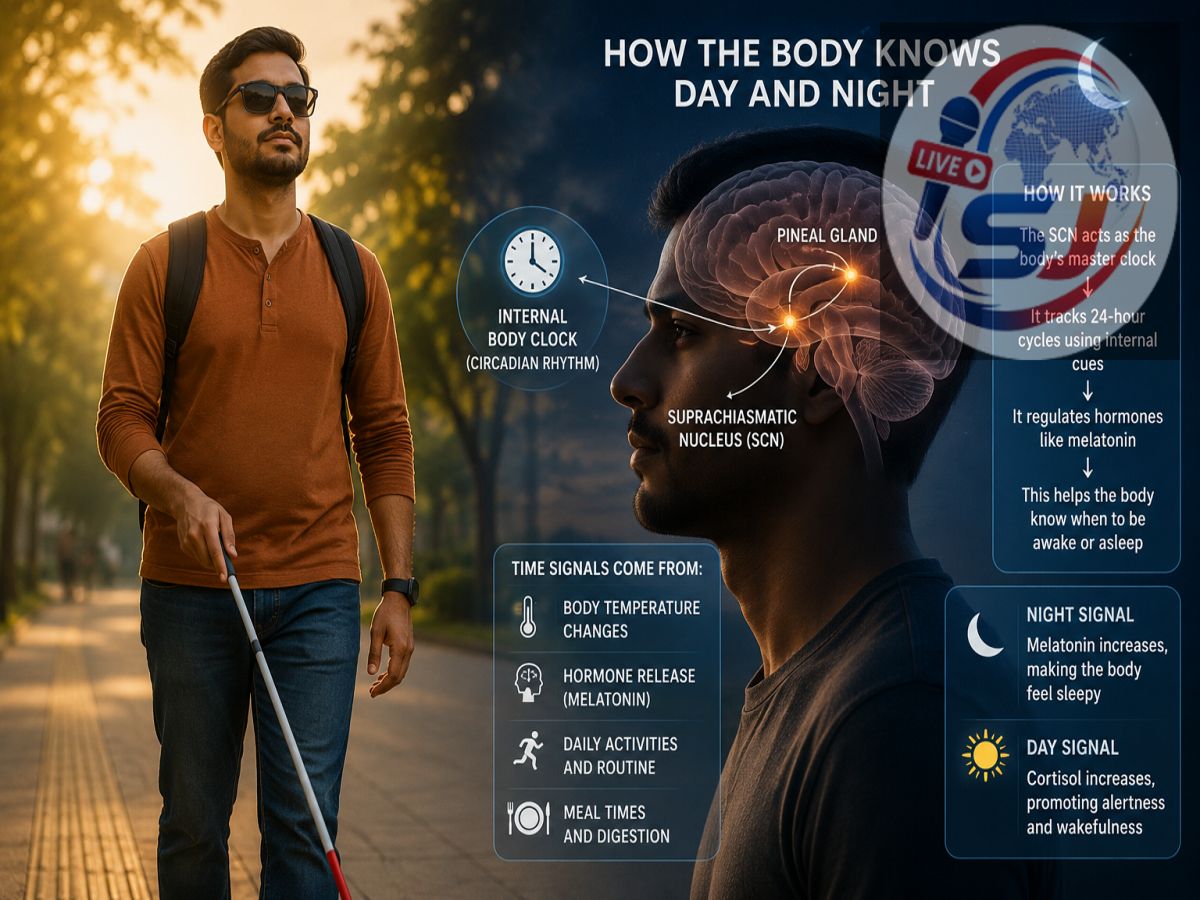
How Blind People Sense Day and Night: For sighted people, recognising morning or night often happens almost automatically. Sunlight coming through a window signals daytime, while darkness indicates that evening or night has arrived. But how does someone who is blind distinguish between different times of the day without relying on these visual clues?
The answer is more complex than simply seeing or not seeing light. The human body has an internal timing system that regulates sleep, alertness and many other biological processes. In addition, many blind and visually impaired people retain some ability to detect light even when they cannot form useful visual images.
Environmental sounds, temperature changes, daily routines and accessible technology can provide further information about the time of day.
Here is the science behind how these different signals work.
Blindness Does Not Always Mean Complete Absence of Light Perception
Blindness covers a wide range of visual conditions. A person may be legally blind while still being able to perceive light, movement, shapes or differences in brightness.
Some people who cannot recognise objects or navigate using vision can nevertheless distinguish between a brightly illuminated environment and darkness.
This remaining light sensitivity can provide valuable information about whether it is daytime or nighttime. Sunlight entering a room, for example, may be detectable even if the person cannot visually identify the window, surrounding objects or the scene outside.
People with no conscious light perception, however, may rely more heavily on their internal body clock and non-visual cues.
The Body Has Its Own 24-Hour Clock
One of the most important mechanisms involved in recognising the daily cycle is the circadian rhythm.
The circadian system acts like an internal biological clock. It helps regulate when we feel awake, when we become sleepy and when several physiological processes occur.
For most people, this internal clock operates on a cycle close to 24 hours and is regularly synchronised with the outside world.
Light is one of the strongest signals used by the brain to keep this biological clock aligned with Earth's day-night cycle.
Interestingly, the eyes contain specialised cells that play an important role in this process even though their primary purpose is not conventional vision.
Special Retinal Cells Can Detect Light Without Creating Images
When we think about vision, rods and cones usually come to mind. These photoreceptor cells help us perceive brightness, colour, detail and movement.
However, the retina also contains specialised cells known as intrinsically photosensitive retinal ganglion cells, or ipRGCs.
These cells contain a light-sensitive pigment called melanopsin.
Rather than primarily helping the brain construct pictures of the world, ipRGCs are involved in detecting environmental light and sending information related to the day-night cycle to the brain.
The signals travel to an area of the brain known as the suprachiasmatic nucleus (SCN), which functions as a central regulator of the body's circadian rhythms.
Depending on the cause and extent of blindness, these non-image-forming pathways may remain functional even when conventional vision is severely impaired.
Melatonin Helps the Body Prepare for Sleep
The brain's response to light and darkness is closely linked with melatonin, a hormone that plays a major role in regulating sleep timing.
Under typical conditions, melatonin levels begin increasing in the evening as the environment becomes darker. This biological change helps prepare the body for sleep.
Light exposure, particularly at appropriate times of day, helps keep this process synchronised with the external 24-hour cycle.
This explains why the body's perception of day and night is not based entirely on consciously seeing sunlight or darkness.
What Happens When a Person Cannot Detect Light at All?
The situation can be different for some people who are totally blind and have no functional light perception.
Without light signals reaching the circadian system, the body's internal clock may struggle to remain synchronised with the conventional 24-hour day.
Some totally blind people can develop a condition known as Non-24-Hour Sleep-Wake Disorder, often shortened to Non-24.
In this condition, the internal sleep-wake cycle can gradually shift later from one day to the next because the biological clock is not being adequately reset by environmental light.
As a result, periods when a person feels sleepy or alert may progressively move out of alignment with the normal day-night schedule.
Not every blind person experiences Non-24, and its occurrence depends partly on whether pathways responsible for detecting light remain functional.
Sounds Can Provide Powerful Clues About Time
Biology is only part of the story. Daily life is filled with predictable sounds that provide information about the time.
Morning may bring birdsong, increasing traffic, people leaving for work or school, household activity and sounds associated with neighbourhood routines.
As the evening progresses, many of these sounds change. Traffic patterns may decrease, shops may close, household routines shift and neighbourhoods can become quieter.
People naturally learn these patterns and can use them as practical indicators of what part of the day it is.
Temperature and Daily Routines Also Provide Information
Environmental temperature can offer additional clues.
Early mornings may feel cooler, afternoons are often warmer and temperatures may fall again after sunset. These patterns vary with location, weather and season, so they are not precise clocks, but they can contribute to a broader awareness of the time of day.
Daily routines are another powerful cue. Meal schedules, work or school timings and the activities of family members create predictable patterns.
Repeated every day, these routines become reliable reference points for understanding time.
Technology Makes Checking the Exact Time Much Easier
Modern accessibility technology has made obtaining precise time and weather information considerably easier for blind and visually impaired users.
Talking watches and clocks can announce the time audibly, while smartphones provide screen readers and voice assistants capable of reading the time, alarms, calendars and weather information.
Smart speakers and voice-controlled assistants can also provide time, weather forecasts, reminders and schedules through spoken commands.
Braille watches and other tactile devices provide additional options for users who prefer touch-based information.
Day and Night Are Detected Through More Than Vision
Knowing whether it is morning, afternoon or night does not depend solely on being able to look at the sky.
Depending on an individual's type of vision loss, some light perception may remain available. The circadian system can also respond to light through specialised retinal pathways that are distinct from conventional image-forming vision.
Hormonal changes, environmental sounds, temperature, routines and accessible technology provide additional information.
Together, these mechanisms show that the human body's relationship with time extends far beyond simply watching the Sun rise and set.